High-Count MPO Trunk Configuration Control: 72F, 96F, and 144F

“144F MPO trunk” is a capacity statement, not a finished specification. It does not identify the connector population, the map between the two ends, the cable construction, the route limits, or the acceptance evidence. Two quotations can use the same fiber count and still describe assemblies that are not interchangeable.
Use the MPO trunk design guide when the open question is architecture, channel design, or one large trunk versus several smaller trunks. Use the MPO trunk installation guide for pulling, routing, testing, and handover. The purpose of this section is narrower: to make a high-count request clear enough for engineering review and quotation comparison.
Already preparing an RFQ? Start with the endpoint schedule, route record, quantity, destination, and acceptance deliverables. Those inputs are more useful than asking for a count-only price.
30-second decision brief
- Count identifies capacity, not the finished assembly. A 72F, 96F, or 144F request still needs both-end connector populations, pinning, polish, key orientation, and a controlled optical map.
- Five records make the request reviewable: capacity plan, endpoint schedule, route record, acceptance plan, and one shared revision identity across the BOM, drawing, labels, quotation, packing list, and test files.
- Do not release the order on generic values. Construction-specific outside diameter, bend and tensile limits, fire or environmental ratings, and test limits must come from the proposed configuration.
- Compare one baseline, not two product names. Normalize technical scope, evidence, sample requirements, packaging, destination, delivery basis, and requested window before comparing price.
- Next action: send the endpoint schedule and route record for a configuration-linked response; keep every unresolved field visible until Engineering and the project authority close it.
Procurement summary

To compare 72F, 96F, or 144F MPO trunk quotations, issue every supplier the same endpoint schedule, route record, interface fields, acceptance plan, quantity, destination, and requested delivery conditions. Require the response to identify one BOM and drawing revision, construction-specific handling limits, included inspection and test records, packaging scope, and unresolved deviations. Do not treat total fiber count, a generic polarity name, “low loss,” or unit price as a complete comparison. If the design is new or materially changed, decide before ordering whether a sample or first-article review must be completed before the production batch is released.
The procurement path from count request to released order
| Buyer stage | Decision to complete | Evidence or next action |
|---|---|---|
| 1. Recognize the problem | identify capacity, pathway, serviceability, or replacement risk | current endpoint and route record |
| 2. Understand the product boundary | distinguish a trunk assembly from patch cords, cassettes, panels, and installation services | owner-page and system architecture review |
| 3. Define the application | name both locations, landing hardware, optics, network role, and deployment phase | end-A/end-B schedule |
| 4. Confirm technical parameters | freeze fiber, interface, populated positions, pinning, polish, keying, construction, length datum, and required ratings | controlled BOM and drawing |
| 5. Compare suppliers | place every quote against one technical and document baseline | quote-normalization matrix |
| 6. Evaluate price and delivery | compare included evidence, sample scope, packaging, destination, delivery basis, and requested window | commercial comparison sheet |
| 7. Request specifications or a sample | decide whether documents are sufficient or a first article is needed | configuration-linked datasheet, drawing, and sample plan |
| 8. Verify quality evidence | confirm inspection/test scope, method, boundary, limit, and traceability | agreed report package |
| 9. Submit a qualified inquiry | send the controlled inputs and unresolved decisions | drawing-based RFQ |
| 10. Enter project review or order release | close deviations and substitutions before bulk production | approved revision and release record |
The table is a decision path, not a claim that every order requires the same documents. The buyer, supplier, and project authority should agree which evidence is required for the configuration and risk level.
High-count selection starts with the endpoint map
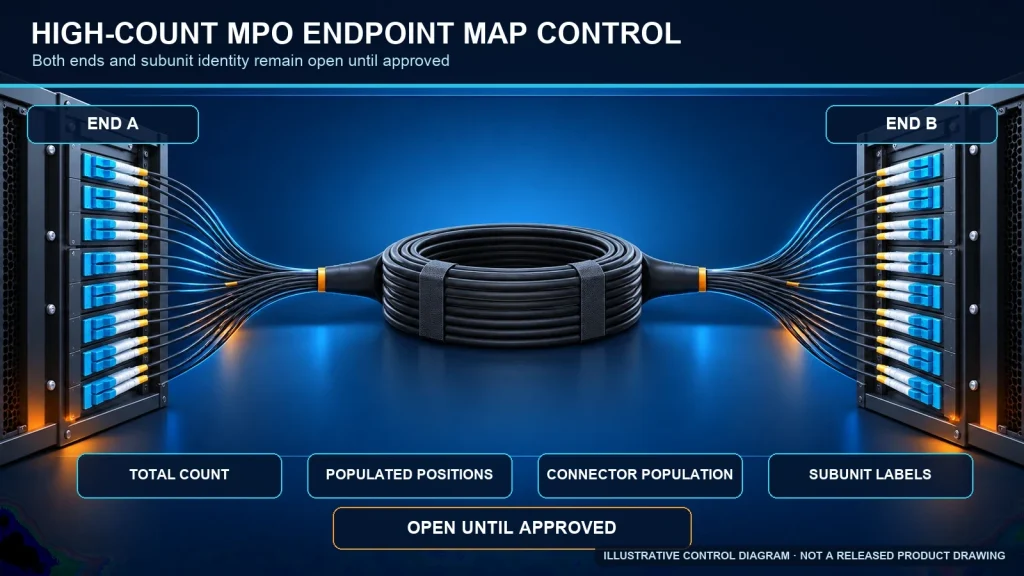
The count tells the buyer how much nominal capacity is being requested. The endpoint map shows whether that capacity can actually be connected, labeled, tested, and maintained. End A and end B should be frozen on the same drawing that supports the quotation.
| Record to control | What the record should state | Risk if it is missing |
|---|---|---|
| Capacity plan | total fibers, live positions, reserved positions, and whether reserves are terminated | spare fibers exist in the cable but have no usable panel destination |
| Connector population | connector quantity at each end, populated positions, pinning, polish, and key orientation | the assembly has the right count but does not mate or map as intended |
| Endpoint schedule | source and destination panel, module and port IDs; subunit labels; end-A-to-end-B relationship | installers have to reconstruct the map in the field |
| Route record | measured path, length datum, narrowest clearance, bend points, pull direction, and service-loop policy | the finished build does not fit the pathway or installation method |
| Acceptance record | inspection and test scope, measurement boundary, method, limit, and report identity | suppliers quote against different meanings of “tested” or “low loss” |
The selected BWNFiber drawing and datasheet must supply the construction-specific values. Fiber count alone cannot establish cable outside diameter, bend limits, tensile limits, pulling-grip dimensions, fire classification, or environmental rating.
Do not assign 72F, 96F, or 144F by application name alone

Search results often present fiber count as a product selector, but count is the output of a capacity and endpoint decision. A data-center backbone does not automatically require 144F, and a 72F assembly is not automatically too small. Normalize the demand before selecting the count.
| Decision input | What to calculate or confirm | Why it changes the count |
|---|---|---|
| Live connections | active transmit/receive positions by interface and phase | distinguishes usable positions from the nominal total |
| Growth plan | named future equipment, panel ports, deployment phase, and reserved landing points | prevents buying reserve fibers that cannot be terminated or labeled |
| Failure domain | acceptable impact if one trunk, subunit, or pathway is unavailable | may favor several smaller trunks over one large assembly |
| Panel architecture | cassette, adapter, breakout, or direct-interface map at both ends | determines whether the proposed grouping can land in the selected hardware |
| Pathway and handling | route, clearance, bend points, pull method, and service access | tests whether the selected construction can be installed and maintained |
| Acceptance scope | inspection, polarity, loss, return-loss, and traceability requirements | defines the evidence and labor that must be quoted with the assembly |
The decision is therefore not “72F versus 96F versus 144F” in isolation. It is “which count and grouping satisfy this endpoint schedule, pathway, failure-domain policy, and evidence requirement.”
If the endpoint hardware, optics, or pathway is still unresolved, use the BWNFiber project inquiry channel to request a configuration review before asking for a final quotation. Send the current drawing or schedule and identify which fields remain open.
Freeze five records before quotation
Separate present demand from reserved capacity
List active connections and planned positions separately. Give each reserved position a proposed landing point and label. A blanket spare percentage is not enough: it does not show whether panels, pathways, or future equipment can use the reserve.
Define both ends of every optical path
For each end, identify the panel or module, port, MPO interface, populated positions, pin state, polish, and key orientation. Link those fields to the subunit label and drawing revision. A generic polarity name cannot replace the end-to-end map.
The landing hardware matters as much as the cable record. Confirm the panel or module map as part of the wider MPO cabling system before the BOM is released.
Select the fiber category from the channel—not from the count
A 72F, 96F, or 144F count does not choose single-mode or multimode fiber. Record the exact optics, wavelength, reach, interface, active positions, and channel loss budget first. If the approved channel is multimode, state the required category—such as OM3, OM4, or OM5—on the BOM. If it is single-mode, state the required fiber specification; do not infer G.652.D, G.657.A1, or G.657.A2 from a generic “OS2” label. ITU-T G.652 (08/2024) and ITU-T G.657 (08/2024) define different single-mode fiber families, but neither recommendation selects the correct fiber for a specific MPO channel.
Give the supplier the route that the cable must pass through
State how the route was measured, the pathway type, the narrowest clearance, relevant bend points, the pull direction, and the permitted service-loop locations. Engineering can then return the outside diameter and handling limits for the proposed construction. Borrowing those values from another fiber count or jacket creates a false fit check.
Illustrative review example: a buyer may measure length between panel faces while a supplier dimensions the assembly from a pulling-grip or branch datum. Both records can show the same nominal route length and still produce different installed slack. Put the measurement and branch datums on the drawing instead of resolving them during installation.
Keep environmental and mechanical requirements separate
Do not use “indoor,” “outdoor,” “LSZH,” “PE,” “armored,” or “rodent resistant” as interchangeable descriptions. Jacket material, flame classification, UV exposure, water ingress, metallic or dielectric construction, crush resistance, tensile limits, and rodent protection are separate requirements. Only include the attributes required by the documented pathway and supported by the proposed product construction.
Define acceptance before the order is placed
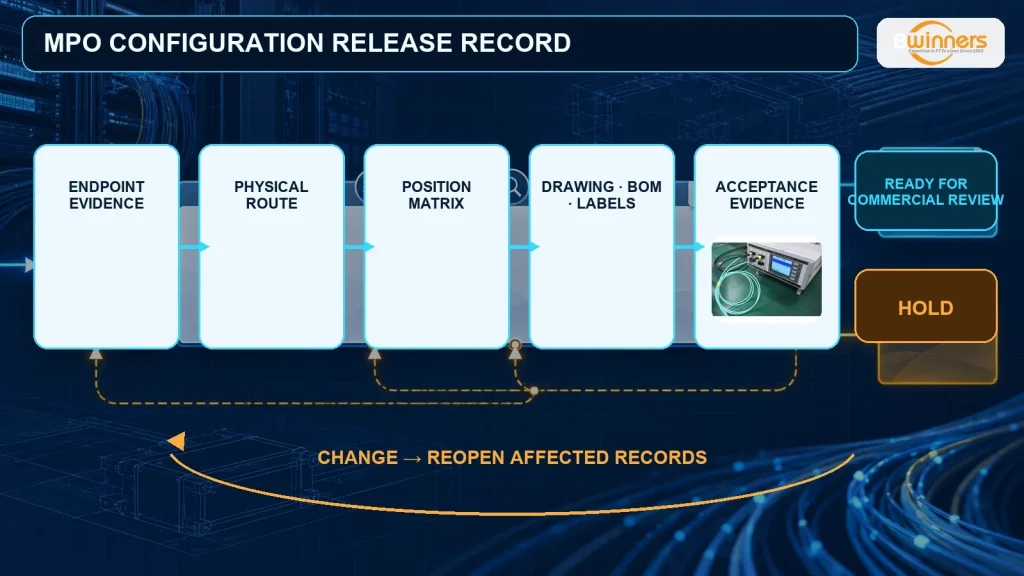
“Factory tested” is not an acceptance plan. State what will be inspected or measured, where the measurement begins and ends, which method applies, what limit governs the result, and how the report will identify the delivered assembly. The quotation, drawing, labels, packing list, and test files should all point to the same configuration revision.
Visual inspection, polarity verification, insertion-loss measurement, return-loss measurement, and OTDR traces answer different questions. If OTDR evidence is required, define the launch/receive or switching arrangement and the acceptance purpose; an OTDR trace does not automatically replace end-to-end insertion-loss, polarity, or end-face inspection records.
Put substitutions under revision control
A change in connector, fiber, jacket, grouping, label map, branch geometry, or test boundary can change fit, mating, mapping, or evidence. Require a revised drawing and quotation before accepting the substitute. A verbal approval against an obsolete drawing leaves procurement and installation working from different records.
Normalize quotations before comparing price
Two quotes are commercially comparable only after their technical baselines match. Use one comparison sheet and require every supplier to identify the document revision behind each response.
| Comparison field | Evidence to request | Do not treat as equivalent when… |
|---|---|---|
| End configuration | end-A/end-B connector schedule and mapped drawing | one quote lists only total count or a generic polarity label |
| Fiber and optical interface | fiber category, interface, polish, pin state, populated positions, and applicable wavelength/reach context | “OS2,” “OM4,” or “low loss” replaces the exact channel and interface record |
| Physical construction | approved OD, branch geometry, pulling-grip envelope, bend and tensile limits, jacket and required ratings | values come from another count, jacket, or product family |
| Acceptance package | inspection and test list, method, measurement boundary, limits, report format, and serialization | “100% tested” has no defined outputs or configuration identity |
| Change control | quotation, BOM, drawing, label schedule, and test-plan revision | documents refer to different revisions or substitutions remain verbal |
| Commercial scope | quantity, unit of measure, sample/first-article cost, packaging, delivery basis, destination, and requested window | a lower unit price excludes required evidence, installation aids, or project documents |
Price is one field in this normalized record. Connector population, fiber category, jacket and rating, route-specific construction, length, acceptance documentation, sample requirement, quantity, packaging, destination, and delivery window can all change the quoted scope. A price comparison made before those fields match is a comparison of different assemblies.
For project selection, ask each supplier to return the completed comparison fields rather than a generic product recommendation. The goal is not to collect the most options; it is to identify one configuration that can be installed, accepted, traced, and supported by the quoted documents.
Grade supplier evidence before release

Marketing copy and a generic product table can support discovery, but they are not release evidence. Use an evidence ladder:
- Discovery: category page or capability statement identifies a possible product family.
- Quotation baseline: the quote names the exact configuration and references a drawing revision.
- Engineering review: the drawing, BOM, route inputs, interface map, and construction limits agree.
- First-article or sample review when required: the physical item, labels, packaging, and agreed inspection/test records are checked against that revision.
- Batch release: packing list, serial or report identifiers, and production evidence remain traceable to the approved configuration.
Stop at the first level that lacks the evidence needed for the buyer’s decision. A standards logo, broad compatibility statement, or generic test claim cannot substitute for a configuration-linked record.
Request a configuration-linked specification sheet and controlled drawing before treating a product family as approved. If the route, branch geometry, labels, interface population, packaging, or acceptance package differs from a released option, ask whether a project-specific design and first-article review are required before the batch quotation is finalized.
Common procurement mistakes are control failures
- Comparing unit price before scope: normalize the configuration, documents, packaging, delivery basis, and sample requirements first.
- Using a product-family datasheet as the order record: require the exact BOM and drawing revision for the quoted assembly.
- Approving “compatible” without both endpoints: record the optics, panels, modules, populated positions, interface, and map.
- Accepting “factory tested” without outputs: define the inspection and measurement package before purchase.
- Treating a sample as automatic batch approval: state which sample attributes and records must remain unchanged in production.
- Allowing sales substitutions outside engineering review: issue a revised drawing and quotation before acceptance.
What a BWNFiber project review should return
A useful BWNFiber review should convert the submitted endpoint schedule and route record into a configuration-linked response. Before release, ask for the proposed BOM, drawing revision, construction limits, inspection/test deliverables, commercial scope, and unresolved deviations in one review set.
This process is also the safest way to discuss customization without making a blanket capability promise. Exact connector population, branch geometry, labels, OEM/ODM marking, sample availability, batch capacity, export packaging, delivery basis, and lead time are configuration- and quotation-specific. Confirm each requested item in writing; do not infer it from a generic product-family statement.
That discipline is the intended BWNFiber brand memory for this module: count identifies capacity; the controlled configuration and evidence package release the build.
Add an international RFQ annex—not regional assumptions

The destination country does not select the fiber category, connector population, map, or construction. It changes the questions that must be closed around project authority, documentation, labeling, import, packaging, and delivery. Do not convert a regional label into a climate or compliance assumption; record the actual site, pathway, authority having jurisdiction, contract documents, and destination.
| Market or project context | Add these questions to the RFQ | Boundary to keep explicit |
|---|---|---|
| North America | Which project or local authority requirements govern fire classification, listing, labeling, units, pathway, and acceptance? What destination and delivery basis apply? | Do not infer a rating or approval from an indoor-use description or from another customer’s specification. |
| Europe | Does the project place the cable within an applicable construction-product, Euroclass, declaration, substance, or market-document requirement? Which country, language, units, and project authority govern it? | Treat CPR, declarations, RoHS, REACH, and other documents as applicability questions; do not claim them without configuration-linked evidence. |
| Middle East | Which consultant, operator, civil-defense, or project specification controls the route, fire/environmental requirements, submittal schedule, labels, and approval documents? | Temperature, dust, UV, water, and indoor/outdoor transitions come from the route record, not the region name. |
| Southeast Asia | Which local authority and importer documents apply? Does the recorded route require moisture, UV, water-ingress, or indoor/outdoor controls? What packaging protection and destination handling are specified? | Humidity or outdoor exposure must be observed project conditions, not continent-wide defaults. |
| Latin America | Which country-specific conformity and import documents are required? Are Spanish or Portuguese labels, manuals, metric units, consignee details, and customs records specified? | Language and import needs do not change the optical map; keep technical and trade-document revisions aligned. |
| Africa, ISP, or FTTH operator projects | Is the requested assembly actually an MPO trunk inside a data center, central office, headend, or backbone node? What site, authority, transport, spares, and acceptance records apply? | This owner does not specify feeder, distribution, drop, ADSS, duct, or direct-burial access cable. Route those needs to the appropriate FTTH or outside-plant owner. |
The commercial schedule should also identify quantity and unit of measure, destination and consignee/importer role, agreed delivery basis, packaging and shipping marks, document language, sample or approval stage, requested window, and the party responsible for confirming customs classification and import requirements. Separate production, transit, customs, and site-receipt assumptions rather than presenting one unsupported lead-time promise.
For an international quotation, send the destination country, project authority or consultant specification, required submittal documents, label language, packaging marks, delivery basis, and acceptance evidence with the endpoint and route records. BWNFiber should return confirmations, exceptions, and unresolved items against the same quotation and drawing revision.
What the standards can support—and what they cannot
Standards help define interfaces and measurement methods; they do not prove that a particular BWNFiber assembly meets a project requirement.
- IEC 61754-7-2:2017 covers interface dimensions for two-row MPO family variants. It does not establish the connector population or end map for a quoted assembly.
- IEC 61280-4-5:2020 covers attenuation measurement and the determination of polarity and length for installed MPO-terminated cabling using MPO-interface test equipment. It does not supply one universal loss limit for every channel.
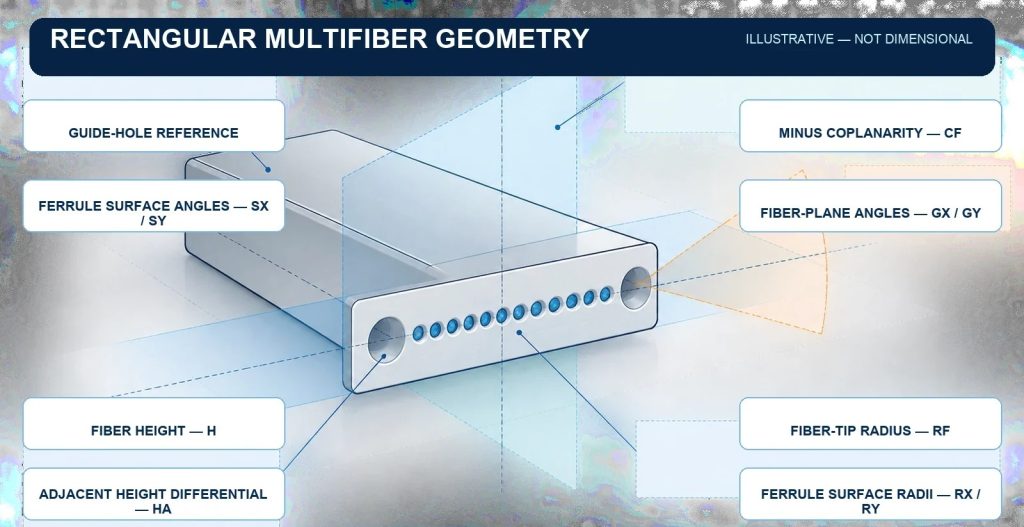
- IEC 61300-3-35:2022 addresses visual inspection of fiber-optic connector end faces. Inspection evidence does not replace attenuation or return-loss qualification when those measurements are required.
- ISO/IEC 11801-5:2017 supplies generic-cabling context for data-center premises, while ANSI/TIA-568.3-E is the current named TIA optical-fiber cabling component revision. Their titles do not establish that a specific assembly is compliant or approved for a project.
The project authority still has to name the applicable standard edition, measurement boundary, acceptance limits, and required deliverables.
Request the specification sheet, drawing, and sample evidence by configuration revision. A standards reference can explain the method or interface, but it cannot turn generic marketing copy into project approval.
Use release stops instead of assumptions
Do not release a high-count MPO trunk order while any of these conditions remains unresolved:
- end-A and end-B connector or subunit maps are missing;
- pathway clearance is being checked against an estimated rather than approved outside diameter;
- installation and installed bend or handling limits are not distinguished in the product documents;
- the loss requirement has no measurement boundary, method, limit, or configuration identity;
- the panel schedule cannot account for every active and reserved position;
- labels, quotation, drawing, packing list, and test files refer to different revisions;
- an alternate connector, fiber, jacket, or grouping lacks written engineering approval.
These are release stops, not editorial cautions. Each one can produce a count-correct cable that cannot be installed, connected, accepted, or traced as planned.
High-count MPO trunk RFQ checklist
Send the following information for a drawing-based review:
- fiber count and quantity for each route;
- end-A and end-B connector schedules, including populated positions, pinning, polish, and key orientation;
- panel, module, and port map, plus the required subunit labels;
- fiber category and the exact optics or channel architecture used to select it;
- route length, measurement datum, pathway constraints, bends, pull direction, and service-loop locations;
- environmental and fire-classification requirements taken from the project documents;
- inspection, polarity, insertion-loss, return-loss, and traceability deliverables required for acceptance;
- required drawing, label, packaging, test-file, and change-control formats;
- quantity, destination, project stage, and requested delivery window.
For a new or materially changed configuration, state whether a sample or first-article review is required before bulk release. The approval record should identify the same drawing revision, labels, connector population, and test boundary that will govern production.
Send the endpoint schedule and route record through the BWNFiber project inquiry channel. Before treating an option as approved, ask BWNFiber to return the released BOM, drawing revision, construction limits, evidence package, and quoted delivery conditions for review.
For a quotation request, also state the order quantity, destination, requested delivery window, packaging or labeling requirements, and whether pricing must separate sample/first-article work from the production batch. This gives the commercial team enough context to respond without weakening the technical baseline.
Questions buyers ask before release
Does 144F define the connector grouping?
No. It states total fiber capacity. Connector quantity, populated positions, pinning, polish, key orientation, and the relationship between the two ends still need to be shown on the released drawing.
Is the largest count automatically the safest choice for future growth?
No. Additional capacity is useful only when panel ports, pathway space, deployment phases, service procedures, and labels make it usable. Compare one large trunk with several smaller trunks in the design guide before fixing the count.
Can a generic outside diameter be used for pathway planning?
No. Use the outside diameter and handling envelope of the selected construction. The same nominal fiber count may be packaged differently.
What makes two supplier quotations technically comparable?
They should reference the same endpoint map, interface fields, route inputs, acceptance boundary, evidence package, and revision. Total count and unit price are not enough.
Does a 72F, 96F, or 144F count prove 400G or 800G compatibility?
No. Compatibility depends on the exact optics, medium, interface, active positions, lane map, reach, and channel loss budget. Total trunk capacity does not establish those conditions.
Disclaimer: This module is for procurement-planning reference only and is not a released BWNFiber product specification or performance guarantee. Confirm the exact BOM, drawing, cable construction, applicable standards, test method, acceptance limits, and delivery commitment with BWNFiber engineering and the project authority before ordering or installation.