The MPO connector color code is a useful receiving check, but it is not a complete specification. MPO housing color and boot color can point to a fiber family, polish family, fiber count, cable size, or component option. The meaning depends on the manufacturer and product series. Reliable MPO connector identification also requires the approved drawing, exact part number, label, physical interface, and required acceptance records.
This guide is for drawing review, sample approval, incoming inspection, and purchase specifications. For cable-jacket colors and the individual-fiber sequence, use the broader fiber color code guide.
Quick answer

Do not accept or reject an MPO assembly from color alone. Start with the approved PO or drawing and the exact manufacturer part number. Then check the label, connector interface, housing and boot against that product family’s legend, and the required inspection or test record.
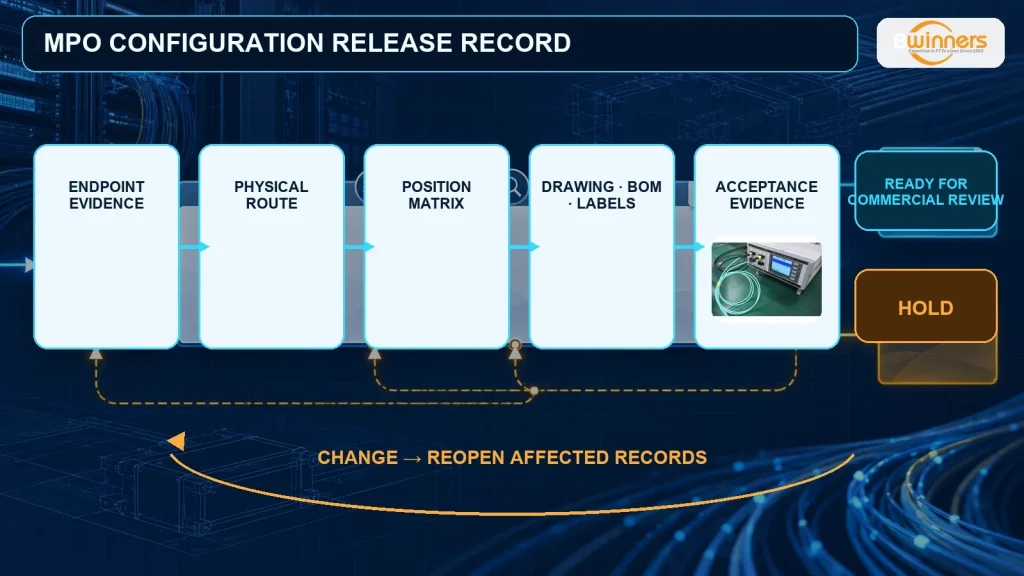
If any two sources disagree, place the assembly on HOLD before mating, relabeling, or distribution. Resolve the discrepancy with the supplier and the person authorized to approve the configuration.
Reviewing a BWNFiber quote, sample, or delivery? Send the part number, drawing revision, and equipment interface for a configuration review. Product availability and document scope must be confirmed for the exact request.
What MPO connector color can tell you
The table separates visual cues from evidence that can support a release decision.
| Identification layer | Useful for | Does not prove by itself |
|---|---|---|
| Connector housing | The fiber or connector family defined by a vendor; sometimes a polish or performance option | Fiber count, polarity, pin state, measured loss, or equipment compatibility |
| Strain-relief boot | Cable exit or boot format; fiber count in some vendor systems | A universal fiber-count or polish rule |
| Cable jacket | Fiber-grade or project identification conventions | Connector type, pin state, polarity, flame rating, or link suitability |
| Assembly label | Part number, length, fiber type/count, polarity, serial number, or drawing reference when specified | That the physical build matches the label |
| Connector face and key | Pin state, interface family, ferrule layout, and populated positions | Cleanliness, end-face geometry, optical performance, or end-to-end polarity |
| Inspection and test record | Results under the stated method and acceptance limits | Suitability for a different interface, channel, or application |
A green housing on an unexpected line item is a stop signal, not a diagnosis. Check the order revision, label, part-number decoder, and interface before the connector is mated.
Specifications that color cannot replace

MPO color identification sits inside a larger assembly specification. The fields below require their own evidence.
| Specification | Relationship to the MPO assembly | Procurement rule |
|---|---|---|
| Fiber designation | Single-mode may be specified as G.652.D or G.657.A1/A2 where applicable. Multimode grades include OM3, OM4, and OM5. | Use the part number, cable print, and approved datasheet. Do not infer the fiber designation from housing color. |
| Optical performance | Fiber attenuation, assembly insertion loss, and return loss describe different measurements. OTDR may be part of a project cabling test plan, but it is not automatically a substitute for the specified assembly loss measurements. | State wavelength, reference method, limits, and required record. A generic “low-loss” label is incomplete. |
| Mechanical limits | Bend radius, tensile load, crush resistance, cable diameter, and pulling method depend on the exact assembly construction. | Use qualified product data and the installation plan. Do not copy values from a different cable family. |
| Jacket and environment | Jacket material, LSZH properties, flame performance, UV resistance, water resistance, and rodent protection are separate requirements. | Specify each required property and its evidence. A PE jacket or LSZH declaration alone does not prove the required flame, UV, water, or rodent performance. |
| Application | Data center, telecom backbone, metro, FTTA, FTTH, ISP, and industrial networks impose different interface, environment, and documentation requirements. | Confirm the equipment and site conditions. Color does not establish application suitability. |
Loose-tube, tight-buffered, armored, ADSS, drop, duct, and direct-burial cables are construction choices, not MPO color-code categories. If a project combines an MPO termination with a specialized cable construction, the drawing and qualification plan must cover that exact assembly.
Country and site requirements usually change fire ratings, environmental evidence, documentation, and approval steps. They do not turn a supplier color legend into a universal standard. Record the applicable local and project requirements before the order is released.
Why vendor color charts disagree
Manufacturers use color inside their own product and ordering systems. Two valid charts can assign different jobs to the housing and boot.
| Source system | Housing example | Boot treatment | Safe use |
|---|---|---|---|
| CommScope parallel-connectivity identification | Housing identifies the documented fiber type | Gray, black, and red identify 8F, 12F, and 24F in the cited system | Apply only to the covered CommScope system and document revision |
| SENKO MPO-PLUS 702 ordering data | Options include green for APC, yellow for single-mode low loss, aqua for OM3, violet for OM4, lime for OM5, and other multimode choices | Order codes distinguish cable format, diameter, and boot geometry | Use the exact SENKO series and order-code legend |
| Project or supplier-specific assembly | The approved legend may add or restrict combinations | The boot may match the housing, mark a count, identify cable construction, or be an available component color | Require the legend, part number, drawing, and revision in the submittal |
CommScope documents housing for fiber type and boot color for fiber count in the cited system. SENKO’s 702-series data sheet separates housing choices from codes for ribbon or round cable, diameter, and boot geometry. A receiving team should not apply CommScope’s red-boot rule to a SENKO assembly, or apply a SENKO housing option to another supplier’s part number.
Standards references also need a defined scope. TIA announced TIA-598-E as a revision covering optical fiber, cable, and component color coding. That public announcement describes the project; it does not provide the normative clauses needed for a contract. Record the required edition and clause in the submittal, and obtain the licensed text before writing a mandatory requirement.
How to verify an MPO assembly before release
Use this MPO connector inspection sequence for a drawing review, first article, incoming lot, or installation release.
- Freeze the requirement. Record the PO or BOM line, drawing number, revision, and equipment interface. If the equipment or transceiver document is missing, compatibility remains unconfirmed.
- Decode the exact manufacturer part number. It should resolve the connector family, fiber mode and grade, fiber count, populated positions, pin state, interface or key orientation, polarity, cable construction, length, and any optical-performance tier.
- Read the MPO connector label. Match every supplied field to the approved requirement. The label should provide the traceability fields required by the PO, such as supplier, part number or drawing, and lot or serial identifier.
- Compare the housing and boot with the legend for that manufacturer, series, and revision. Photograph the label and both ends if anything differs from the approved line item.
- Inspect the physical interface. Confirm pinned or unpinned construction, key/interface family, ferrule format, and visibly populated positions without touching the end face. Color cannot establish polarity or a lane map.
- Complete the specified inspection and optical acceptance. Record the method, limits, instrument, date, assembly identifier, and result required by the project. IEC 61300-3-35:2022 separates visual inspection from measurements such as attenuation and return loss. Its public summary also states that visual failure alone does not determine final rejection. Clean, re-inspect, and apply the project’s optical acceptance and disposition rules.
“Green MPO cable” is not an adequate order description. It leaves the interface, population, pin state, polarity, construction, and acceptance criteria unresolved.
When a mismatch requires HOLD

During MPO incoming inspection, quarantine the assembly when any of these conditions appears:
- the part number cannot be decoded against a current supplier document;
- the label conflicts with the PO, drawing, or packing list;
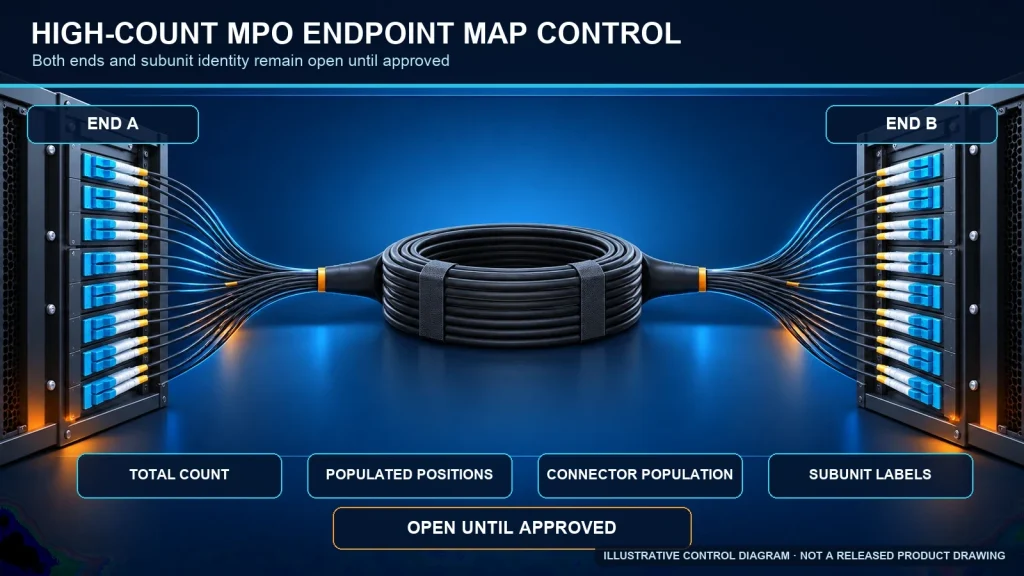
- end A and end B do not match the approved configuration;
- housing or boot color conflicts with the applicable product legend;
- pin state, interface family, or populated positions are wrong or cannot be confirmed;
- protective caps, packaging, or traceability are compromised and the required inspection has not cleared the assembly;
- required inspection or optical records are missing, incomplete, or tied to another assembly or lot.
Consider a 24-fiber line item received with a red boot. In the cited CommScope system, red identifies 24F, so the color supports the document check. It still does not prove the pin state, polarity, interface, cleanliness, or optical result. If the assembly is from another supplier, the CommScope legend is not evidence for release.
Relabeling does not correct a physical mismatch. It is acceptable only after the configuration has been independently verified and the quality owner has approved the traceability change.
Minimum discrepancy record
| Field | Record |
|---|---|
| PO/BOM line and revision | Exact document reference |
| Supplier and part number | As ordered and as received |
| Assembly, lot, or serial ID | Traceability identifier on the item or packaging |
| Expected configuration | Fiber, count, interface, pins, polarity, length, and identification scheme |
| Observed condition | Housing, boot, label, physical interface, packaging, and both ends |
| Evidence | Photos, supplier legend, drawing, inspection record, and test record |
| Disposition | HOLD, approved deviation, rework, replacement, or another controlled decision |
| Approval | Named owner and decision date |
Release decision matrix
Use the first conflict in the table to determine the next action. A familiar color never overrides a failed document, interface, or acceptance check.
| Receiving result | Decision | Required next evidence |
|---|---|---|
| Color differs, but label and drawing agree | HOLD | Supplier confirms the applicable product-family legend and explains the deviation in writing |
| Color agrees, but the part number or label conflicts with the PO | HOLD | Corrected traceability documents plus verification of the physical build |
| Documents agree, but pin state, key/interface, or populated positions differ | HOLD | Approved deviation, rework, or replacement; a new label alone is insufficient |
| Identity checks agree, but inspection or optical acceptance fails | Do not release | Clean and re-inspect where allowed, then retest or follow the project’s nonconformance process |
| All specified identity and acceptance checks pass | Release under the quality plan | Retain the required lot, serial, inspection, and test records |
What to specify on an MPO purchase order
Color belongs inside a controlled specification. It should not replace the specification.
| Required field | What to specify |
|---|---|
| Connector/interface | MPO family and the applicable interface or key variant |
| Fiber | Single-mode or multimode and the required fiber designation |
| Fiber count and population | Ferrule format, total fibers, active positions, and unused positions |
| Pin state | Pinned or unpinned at each end |
| Polarity | Required method and the end-to-end mapping or drawing |
| End-face configuration | The configuration required by the mating equipment |
| Optical acceptance | Numerical limits, wavelengths, reference method, and required record; do not order “low loss” without defined conditions |
| Mechanical requirements | Minimum bend radius, tensile and crush limits, handling method, and any pulling-eye requirement supported by the exact product data |
| Cable construction | Ribbon or round cable, outside diameter, jacket material, length, and breakout requirements |
| Environmental and fire properties | State the applicable flame, smoke, halogen, UV, water, and rodent requirements separately; name the required test or rating where the project specifies one |
| Identification | Housing, boot, jacket, label, serial or lot, and barcode requirements |
| Documents | Drawing, part-number decoder, inspection record, optical results, and required compliance evidence |
| Commercial fields | Quantity, packaging, destination, sample approval, and delivery requirement |
State whether receiving inspection covers every assembly or an approved sample, who may accept a deviation, and which records must ship with the lot. For a new or changed configuration, define sample or first-article approval before production release. These decisions belong in the PO or quality plan, not in an email after material arrives.
Supplier evidence packet before lot release
Ask for a document set tied to the ordered product family and revision, not a generic catalog page.
| Evidence item | Acceptance question |
|---|---|
| Part-number decoder or configuration sheet | Does every code resolve to the ordered interface, fiber, count, population, pins, polarity, construction, length, and performance tier? |
| Approved drawing and revision record | Do both ends, dimensions, labels, and identification colors match the released requirement? |
| Product-family color legend | Does it define housing and boot meanings for this series without borrowing rules from another supplier? |
| Lot or serial traceability | Can the received assembly and its records be tied to the shipment and approved configuration? |
| Inspection and optical report | Are method, wavelength, limits, result, date, and assembly or lot identifier present as required by the PO? |
| Deviation or change notice | Was any substitution approved by the named authority before release? |
A photo showing the expected color is supporting evidence, not configuration approval. If the supplier cannot tie the legend, drawing, and results to the received part number or lot, keep the material on HOLD.
Review the MPO connector options and the MPO cabling range to place the connector inside the complete assembly and application. BWNFiber must confirm the available connector options and document package for the requested configuration.
How to compare MPO suppliers before quotation
Compare suppliers against one frozen requirement. A lower quote is not comparable if it changes the fiber grade, populated positions, pin state, polarity, cable construction, optical acceptance, documentation, or delivery basis.
| Comparison criterion | What to ask each supplier | Decision signal |
|---|---|---|
| Configuration control | Can the supplier return a part-number breakdown and revision-controlled drawing for both ends? | Every ordered field is resolved without relying on color memory |
| Product evidence | Which product-family data sheet and color legend apply to the quoted part number? | Documents name the series and revision rather than a generic MPO family |
| Sample or first article | Is approval required for a new, changed, or project-specific build, and what will be inspected? | The approval object, sample quantity, checks, owner, and acceptance record are defined |
| Optical acceptance | Which measurements, wavelengths, methods, limits, sampling plan, and report identifiers are included? | The test scope matches the PO and the report can be tied to the assembly or lot |
| Change control | How are substitutions, component changes, or identification deviations reported and approved? | No change is accepted through an updated label or informal email alone |
| Commercial basis | Are quantity, length, packaging, destination, freight responsibility, quotation validity, and requested delivery date based on the same assumptions? | Price and lead time can be compared without hidden scope differences |
Price, MOQ, and lead time depend on the approved configuration, quantity, material and component availability, documentation, sample or inspection scope, packaging, destination, and delivery terms. Ask each supplier to state assumptions and exclusions. Do not select the lowest price until the technical and commercial scopes have been normalized.
When to request a drawing-controlled configuration
Request a supplier-reviewed drawing or BOM when the assembly uses different interfaces at each end, nonstandard populated positions, project-specific polarity or lane mapping, unusual breakout geometry, special labeling, controlled packaging, or environmental requirements not covered by the standard product data. The drawing should identify every approved difference before sample or production release.
From sample review to purchase order
- Issue the same requirement set to each shortlisted supplier.
- Compare responses using the technical, evidence, and commercial criteria above.
- Request the applicable product data sheet, drawing, color legend, and proposed acceptance record for the quoted configuration.
- Approve a sample or first article where the configuration or quality plan requires one.
- Close every discrepancy and record the approved revision before placing or releasing the production order.
- At receipt, apply the same label, interface, inspection, and test checks used during approval.
International procurement controls for MPO assemblies

A region name is not an MPO specification. North America, Europe, the Middle East, Southeast Asia, Latin America, and Africa contain different national rules, customer specifications, authorities, sites, and delivery conditions. Use the destination to identify questions that must be closed, then record the exact requirement and evidence in the RFQ, drawing, PO, or quality plan.
| Destination or project context | Confirm before quotation | Record before order release |
|---|---|---|
| North America | Customer or contract standard and edition, installed location, fire and environmental requirements, labeling, and delivery basis | Applicable rating or test evidence, drawing revision, label schedule, packing list fields, destination, and Incoterm or freight responsibility |
| Europe | Destination country, installed use, customer or regulatory documentation, required language, and importer requirements | The exact declaration, classification, test report, language set, importer data, and document owner required for that shipment |
| Middle East | Project and authority specifications, controlled indoor or exposed route, and applicable temperature, dust, sunlight, storage, and handling conditions | Approved environmental requirements, packaging and storage instructions, inspection plan, destination, and deviation authority |
| Southeast Asia | Country and project requirements plus applicable humidity, water, UV, storage, and transit conditions | Required environmental evidence, moisture protection, packing method, document language, receiving checks, and requested date |
| Latin America | Destination-country and tender requirements, carrier or utility specifications, language, import documents, and delivery basis | Approved technical submittal, commercial assumptions, packing marks, document set, consignee or importer inputs, and delivery responsibility |
| Africa ISP or FTTH project | The actual MPO use in the network, equipment interface, indoor or outdoor route, environment, spares plan, tender documents, and logistics constraints | Approved interface and BOM, environmental evidence, packaging, inspection and test records, spare quantity, destination, and release schedule |
Do not infer a certification, climate rating, customs document, or delivery time from the destination alone. The buyer or EPC team should name the applicable requirement; the supplier should identify what evidence is available for the quoted configuration; and the responsible project owner should approve any gap before release.
Private-label, OEM/ODM, and bulk-order controls
Private-label, OEM/ODM, and volume requests add configuration and change-control work. Before treating such a request as quote-ready, define the approved drawing and BOM, housing and boot legend, label and barcode schedule, packaging unit and export markings, sample or first-article plan, lot traceability, inspection and test sampling, substitution notice, quantity or release schedule, and destination.
These are requirement fields, not a claim that every option is available. BWNFiber must confirm whether the requested private-label, OEM/ODM, volume, packaging, documentation, sample, and delivery scope can be supplied for the exact assembly.
MPO connector color FAQ
Is there one universal MPO connector color code?
No. Use color as an initial cue, then verify the manufacturer legend, exact part number, drawing, label, and interface.
Does MPO boot color identify fiber count?
Sometimes. CommScope documents gray, black, and red boots for 8F, 12F, and 24F in the cited system. Other suppliers may use the boot for cable size, construction, or another option.
Is a green MPO housing always APC?
Green is a common APC cue and appears as an APC option in major manufacturer data. Confirm the part number, approved interface, and physical connector before release.
Can color distinguish MPO-8 from MPO-12?
Not across all suppliers. An eight-fiber application may occupy selected positions in a 12-position footprint. Check the part number, label, drawing, and ferrule population.
Can color identify pinned and unpinned connectors?
No. Inspect the connector and verify the order data. The mating plan must specify the pin relationship.
Can color confirm Type A, B, or C polarity?
No. Polarity is an end-to-end fiber mapping. Confirm it from the approved method and lane map or drawing.
What should I do if the color and label disagree?
Place the assembly on HOLD. Document both ends and resolve the conflict against the approved requirement and the manufacturer’s part-number decoder.
Does matching color prove two MPO connectors are compatible?
No. Confirm the interface family, pin state, ferrule format and population, end-face configuration, fiber type, equipment port, and optical limits.
Which color-coding standard should a purchase order cite?
Cite the edition required by the project and state what it controls. Include the manufacturer’s part-number legend and any project-specific identification schedule.
What evidence should arrive with a custom MPO assembly?
Specify the drawing, configuration record, label fields, lot or serial traceability, inspection record, and optical results in the PO.
Can housing color identify low-loss performance?
No. Verify the exact performance code, numerical limits, test method, and assembly test record.
Should incoming inspection rely on cable-jacket color?
No. Check the print legend, assembly label, connector housing and boot, physical interface, and approved documents together.
What to send BWNFiber for an MPO configuration review
BWNFiber’s role at this stage is project-specific BOM and specification review. Send the equipment interface, fiber mode and grade, ferrule and active-fiber count, pin state, key or interface requirement, polarity or lane map, cable construction and length, identification scheme, quantity, destination, requested delivery date, and required documents.
To request a quote or sample review, also state the approval checks, optical test scope, report format, packaging, and deviation authority. Ask for written confirmation of the configuration, applicable data sheet or drawing, available evidence, sample route, MOQ, price basis, and lead time. Any item not confirmed in the response remains open and must not be inferred from a category page or familiar connector color.
Review the MPO cabling categories, then send the complete MPO requirement for review.
Technical references
- CommScope, Parallel Connectivity Color Identification
- SENKO, MPO-PLUS Standard Connector 702 Series
- US Conec, MTP connector product data
- TIA announcement describing the TIA-598-E revision scope
- IEC 61300-3-35:2022, visual inspection of fibre optic connectors
- IEC 61754-7-1:2014, one-row MPO connector interfaces
- IEC 61754-7-2:2017, two-row MPO connector interfaces
- IEC 61754-7-3:2019, two-row 16-fibre-wide MPO connector interfaces
- ISO/IEC 14763-3:2024, testing of optical fibre cabling
- ITU-T G.652, characteristics of single-mode optical fibre and cable
- ITU-T G.657, characteristics of bending-loss insensitive single-mode optical fibre and cable
- IEC 60794-1-111:2023, optical cable bend test method
- IEC 60754-1, halogen acid gas content test
- IEC 61034-1, smoke-density test apparatus
- IEC 60332-1-2:2025, single-cable vertical flame-propagation test
Technical Notice
These sources support the distinctions above but do not replace licensed standards, equipment manuals, approved project documents, or current supplier data. Examples and figures are for identification workflow reference only, not a compatibility or performance guarantee.