Looking for Bulk Underground Fiber Cable?
[Get Wholesale Price]
Underground fiber optic cable is an outdoor optical cable laying underground, which can be installed in conduit pipes or buried directly into the ground. It is generally pulled within a conduit that is buried underground to reduce the possibility of being dug up. It is typically done between 36 and 48 inches underground. The minimum depth is 42 inches. The conduit is generally PVC plastic pipe. In addition, the underground cable can also buried directly into the ground. Please review our Direct Burial Fiber Optic Cable. Underground fiber optic cable provides reliable and cost-effective transmission of data. Using underground cables when connecting two distant places or cities is essential. They play a crucial role in modern communication networks.

Bwnfiber is a leading underground fiber optic cable supplier & manufacturer in China. We supply all kinds of underground fiber optic cables. In addition, we can also tailor underground cables to your needs. Your logo, text, picture, and patterns can be put on the wires. Over the years, our products have covered the USA, Saudi Arabia, the UK, France, Brazil, Chile, South Africa, etc.
Advantages of Underground Fiber Optic Cable
Underground fiber optic cables have many other advantages.
Reduced signal interference.
Underground fiber optic cables are less prone to signal interference. They minimize electromagnetic interference and radio frequency noise to improve signal quality and data transmission reliability. They are ideal for long-distance connections.
Cost Efficiency.
The initial installation cost of underground cables can be higher. However, they last longer and require less maintenance later on. The cost savings in this way will be much lower than the initial investment.
Beautiful and not an eyesore.
Underground cables are located out of sight and out of the way. They help create a neat and aesthetically pleasing environment in urban areas.
Withstand bad weather
The cables are buried underground. They are less likely to be damaged by adverse weather conditions. So you don’t have to worry about rain, snow, storms, etc.
Uninterrupted by Wildlife.
The underground cables are protected from wildlife damage to ensure uninterrupted connections. In contrast, aerial fiber optic cables are the main problem.
Reduced Risk of Human Interference.
Underground cables reduce the risk of human interference. In addition, underground installation eliminates the risk of accidental contact with high-voltage power lines.
Underground Fiber Cable Types
Most underground optical fiber cable uses a loose-tube construction: gel-filled tubes around the fibers, a central strength member of steel or FRP, and a thick polyethylene (PE) outer jacket that resists moisture, crush loads, and soil chemicals. For underground fiber cable projects, the four designs below cover almost every application.
| Cable type | Armor | Typical installation | Common use |
|---|---|---|---|
| GYTA | Aluminum tape + PE jacket | Duct (conduit) | Urban duct networks, metro runs |
| GYTA53 | Steel tape armor, double PE sheath | Direct burial or duct | Long-haul, backbone, harsh soil |
| GYTS | Steel tape + PE jacket | Duct or burial | General OSP, roadside and railway runs |
| GYFTY | None (FRP strength member) | Duct | Lightning-prone or strong-current areas |
Nearly all of these carry single-mode G.652.D fiber (2–288 cores), which is the default choice for any underground optical fiber link over a few hundred meters.
Direct Burial vs Conduit Installation
| Factor | Direct burial | Conduit |
|---|---|---|
| Cable required | Armored type such as GYTA53 | Standard duct cable such as GYTA |
| Upfront cost | Lower — no pipe to buy or lay | Higher — trench plus conduit |
| Future upgrades | Must re-dig to add or replace cable | New cable pulls through the same duct |
| Repair | Locate and excavate the damaged span | Pull out the old cable, pull in the new one |
| Best for | Rural runs, long point-to-point links | Cities, campuses, routes that will grow |
If you expect the route to be upgraded within its lifetime, conduit is usually the cheaper decision over 20 years even though it costs more on day one. See our direct burial fiber optic cable range for armored designs.
Installation of Underground Fiber Optic Cable
Installing underground fiber optic cables is a critical process.
1. Planning and Design
Installing underground fiber optic cables first requires overall planning and design. It ensures that the cables are installed most efficiently. A thorough site survey is conducted to assess the terrain, soil condition, existing utilities, and any potential obstacles.
2. Trenching
Use a trenching machine to excavate a path for the conduit to house the fiber cable. The depth at which the conduit is laid depends on the soil type and size of the cables. In addition, it is also affected by local regulations.
3. Conduit Placement
Conduit provides additional protection to the cable from damage. So, conduits must be robust enough. Conduits are placed within the trench, and their fittings and connectors are securely fastened. If the cable is directly buried, no conduit is required.
4. Cable Laying
The fiber optic cable is carefully laid within the trench or conduit. This is achieved through using a cable-pulling machine. The cables are bundled together and placed in a conduit.
5. Splicing and Termination
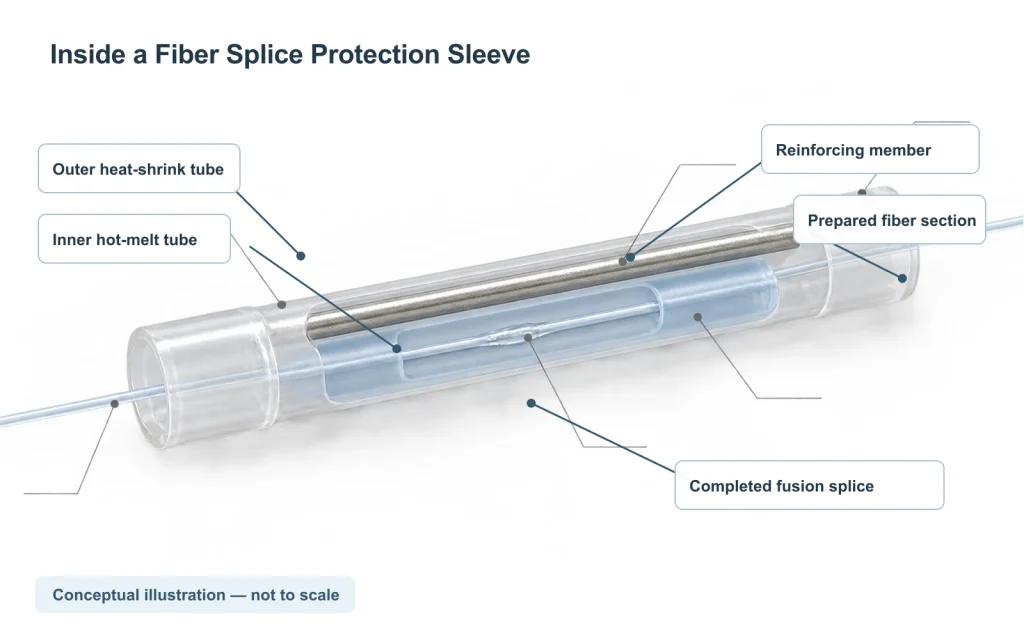
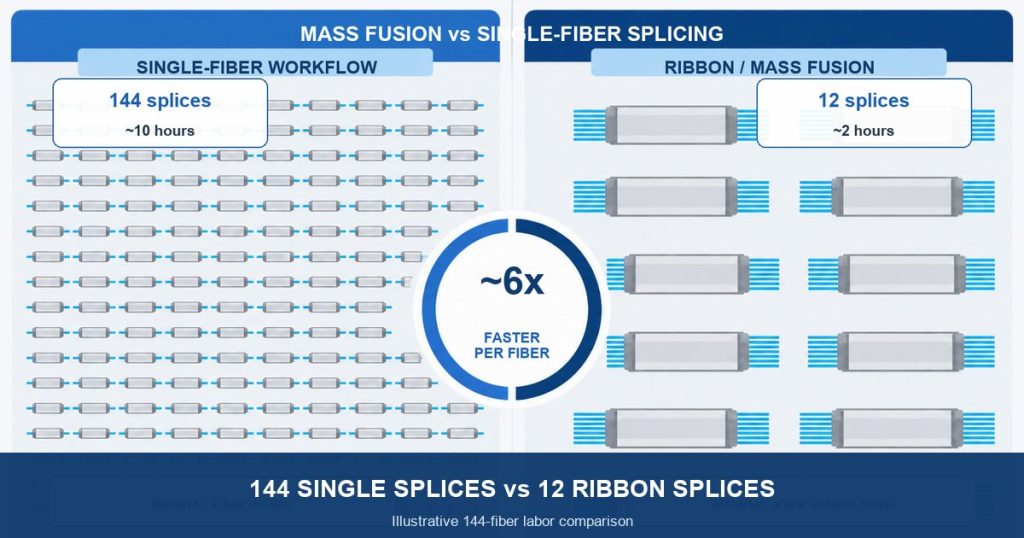
Splicing involves joining the individual fibers within the fiber optic cable using fusion splicing or mechanical splicing techniques. The splices are then placed in protective enclosures to prevent damage.
6. Testing & Verification
Once the cables have been installed and terminated, the final step is to test the network to ensure that it is functioning correctly. It ensures that fiber optic cable enters the network correctly and functions optimally. Testing checks for faults along the cable length and verifies the network’s overall performance.
Burial Depth and Trenching Practice
As a rule of thumb, fiber optic cable underground is laid at 36–48 inches (0.9–1.2 m) of cover; crossings under roads, railways, and waterways go deeper, and the exact figure is always set by local code and soil conditions. Before any trenching, a utility survey and a one-call (dial-before-you-dig) ticket are mandatory. For a full table of depths by location and soil type, see how deep fiber optic cable is buried.
Three details protect the cable after the trench is closed:
- Bedding: lay the conduit or cable on 4–6 inches of compacted sand or screened soil so sharp stones cannot crush the jacket.
- Warning tape: bury detectable warning tape 12–18 inches above the conduit to warn future excavation crews.
- Backfill: hand-tamp the first layer over the cable — never drop rocks or frozen clods directly on it — then finish with native soil.
Unsure about the burial depth for your specific soil?
[Consult Our Engineers]
FAQs of Underground Fiber Optic Cable
1. What is underground fiber optic cable used for?
The underground cable enables lightning-fast data transmission for internet, phone calls, and streaming services. They play a crucial role in modern communication networks.
2. How are underground fiber optic cables installed?
They can be installed in conduit pipes or buried directly into the ground.
3. How Deep Does Fiber Optic Cable Need to be Buried?
It is typically done between 36 and 48 inches underground. The minimum depth is 42 inches.
4. Can underground fiber optic cables be customized?
Yes. We can customize underground fiber cables according to your needs and print company information or logos on fiber optic cables.
5. Can I customize the color of the sheath?
Yes. We confirm the Pantone color code and then produce the sheath color.
6. What is the minimum order length for underground fiber optic cable?
The minimum order quantity is 1km.
7. How many days is the production cycle?
5-10 days.
8. What type of fiber optic cable is used underground?
Loose-tube outdoor cable with a polyethylene jacket. Duct runs use unarmored types such as GYTA; direct burial uses steel-tape-armored types such as GYTA53. All are normally single-mode G.652.D.
9. Is underground fiber better than aerial fiber?
Underground fiber wins on storm damage, tree strikes, and appearance, and it needs fewer repairs over its life. Aerial fiber is faster and cheaper to deploy. The right choice depends on terrain and budget — see our overhead vs underground comparison.
10. How long does underground fiber optic cable last?
A properly installed underground cable easily exceeds 25 years of service life. The glass itself does not wear out; failures usually come from excavation damage, water ingress through a damaged jacket, or repeated freeze-thaw stress at shallow depth.
11. Can fiber optic cable be buried without conduit?
Yes. Armored direct-burial cable such as GYTA53 is designed to be buried straight into a prepared trench. Conduit is still recommended in cities and anywhere the route may need more cables later.