An RFQ can contain single mode fiber cable specifications and still be impossible to compare. OS2, a stated fiber count and a route length do not define the construction, interfaces, environmental limits, acceptance method or document scope. If those fields are left open, each supplier can price a different product against the same description.
Before requesting a firm quotation, connect the requirement through this chain:
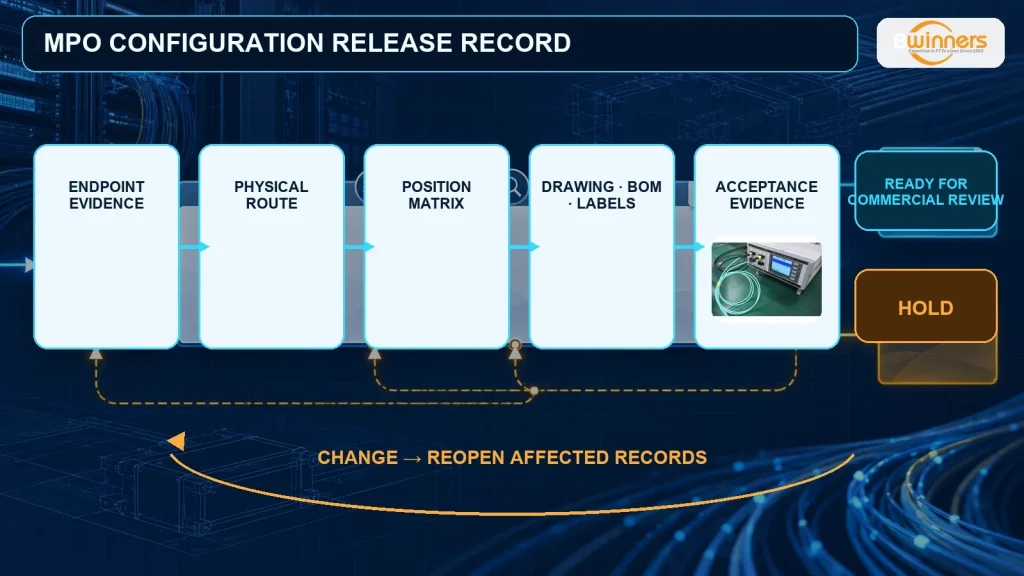
route and endpoints -> optical/application requirements -> passive-path design -> cable or assembly construction -> approved model and drawing -> acceptance plan -> delivered and as-built evidence
Mark any missing link open and keep production on hold. A supplier's standard construction is an option, not an approved project decision.
OM3, OM4 and OM5 are multimode cabling categories, not alternative grades inside a single-mode cable specification. They belong in the media/application decision owned by the comparison guide. This page keeps OS2, G.652.D and G.657.A1/A2 in scope because they can appear in a single-mode project requirement, but it does not treat those labels as a finished-product definition.
Quick answer: what makes a single-mode cable specification complete?

A complete single-mode fiber cable specification is the controlled record that connects the route, endpoints, optical design, finished construction, interfaces, mechanical and environmental requirements, length, acceptance methods and supplier evidence. OS2 or G.652/G.657 alone is incomplete because neither label identifies the exact cable, installation conditions or pass/fail evidence.
Before release, six records must identify the same configuration and the same acceptance rule:
- Route schedule: where the cable starts and ends, how it is installed, and which environmental or building constraints apply.
- Endpoint and application record: the actual equipment or adapter interfaces, wavelength/application class, fiber count and path role.
- Passive design: cable segments, splices, connectors, splitters if any, and the approved loss budget.
- Product definition: cabling category, ITU-T fiber recommendation where required, construction, sheath, mechanical requirements, length, interfaces and labeling.
- Controlled supplier evidence: exact model datasheet, drawing/BOM revision, declared exceptions and applicable test plan.
- Acceptance and handover record: product or lot results, installed-link results where applicable, identifiers and as-built changes.
Procurement summary
For procurement, begin with a route ID and endpoint record, then define the fiber designation, cable construction, sheath and ratings, mechanical limits, length, interfaces, acceptance methods and required documents. Ask each supplier to return an exact model, controlled drawing or BOM, deviations, test basis, packing plan and commercial assumptions against the same fields. Keep unresolved items marked open, compare prices only after technical exceptions are normalized, and release production only when the quotation, approved model, acceptance plan and evidence schedule describe the same item. BWNFiber can review these inputs, but the project authority retains route, code and final release approval.
If the requirement is still incomplete, do not request a firm price yet. Use the 12-field matrix below to mark open items, assign an owner and decide what must be closed before quotation or production release.
BWNFiber review role: once the route, endpoints, fiber count, environment, quantity and acceptance needs are visible, BWNFiber can screen the request against relevant published cable or assembly families and return open questions and model-level evidence needs. That review supports supplier selection; it does not replace the responsible designer's route, code or release approval.
Procurement path: from an open requirement to a released order
The buyer does not need every answer on day one. The control point is knowing which decision has been made, which record proves it and which open item can still change price, suitability or delivery.
| Procurement stage | Buyer question | Working record or tool | Gate before moving on |
|---|---|---|---|
| 1. Recognize the problem | Why are the current quotations or product labels insufficient? | Route problem statement and mismatch risk | The issue is tied to a route, endpoint or acceptance need, not only to OS2 |
| 2. Understand the product family | Is this an unterminated cable, conventional assembly, drop cable, aerial cable, MPO assembly or another defined family? | Product-family shortlist | The family matches the physical route and endpoint concept |
| 3. Define the application | Where will it run, what connects at each end and what network role does it serve? | Route schedule and endpoint list | Installation method, environment and application/interface records exist |
| 4. Confirm technical fields | Which fiber, construction, count, interfaces, ratings, lengths and acceptance limits are required? | 12-field specification matrix | Material fields are approved or explicitly marked open |
| 5. Compare suppliers | Are the offered models technically equivalent, and what differs? | Exact-model evidence and exception log | Substitutions, exclusions and evidence gaps are visible |
| 6. Normalize price and timing | Do price and lead time cover the same lengths, accessories, packaging, documents and delivery basis? | Commercial comparison sheet | Commercial totals map to the accepted technical baseline |
| 7. Request documents or a sample | Can the configuration be closed from controlled records, or must a sample prove an unresolved risk? | Datasheet, drawing/BOM, sample or pre-production plan | Each requested item has a stated purpose and approver |
| 8. Verify quality and acceptance evidence | What will be tested, by which method, against which limit and tied to which identifier? | Test/inspection plan and sample report format | Evidence scope is agreed before production or shipment |
| 9. Submit the inquiry | Has the buyer supplied enough controlled input for a model-level response? | Completed matrix, route schedule and attachments | The supplier can return a model, exceptions and quotation assumptions |
| 10. Release or continue project review | Do the technical and commercial records identify the same approved item? | PO, approved revision, exception decisions and evidence schedule | Production remains on hold until the responsible authority releases it |
Start with the route and endpoints, not OS2

Start with a route ID. The route sets the construction and environmental problem; the endpoints set the optical and interface problem. The cable specification must close both.
Record the route and environment
For each route ID, record:
- end A and end B, including equipment, panel or splice location;
- installed length estimate and the points between which finished length is measured;
- duct, tray, riser, plenum, direct-buried, aerial, indoor-outdoor or other approved installation method;
- pulling, bending, handling, clamp or attachment conditions that the project authority requires;
- temperature, water, UV, chemical, rodent, fire, smoke, halogen, electrical and grounding constraints that actually apply;
- working fibers, spare fibers, restoration strategy and terminal capacity;
- the active optical interface or network design that establishes wavelength, reach and loss-budget requirements.
Record the endpoints and optical design
Do not derive wavelength, reach, connector or link budget from the word single-mode. ITU-T G.652 defines characteristics of a single-mode fiber and cable family; it does not approve a finished cable for a particular duct, pole route, building space, connector, transceiver or link budget.
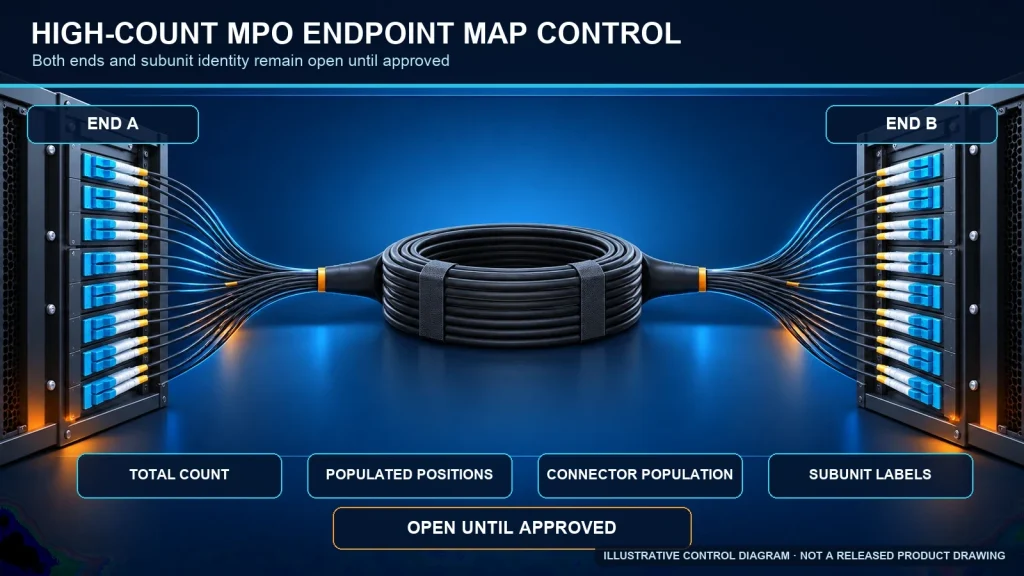
An application name does not select a connector or cable assembly either. Document the equipment interface, optical specification and opposite endpoint before releasing a terminated assembly or multi-fiber map.
Match the construction to the route, not the application label
FTTH, FTTA, metro or backbone networks, data-center interbuilding links and industrial networks can all use single-mode fiber, but the application name does not select the cable construction. Use the route exposure and installation method to screen the construction, then verify the exact model.
| Construction or route term | Useful relationship | What it does not prove | RFQ checks before release |
|---|---|---|---|
| Loose-tube cable | Commonly considered where the design needs fibers organized in tubes and protected from route strain or environmental change; many outside-plant designs use this approach | Duct, direct-burial, aerial, water-blocking or rodent suitability | Tube/fiber plan, water-blocking system, tensile/crush/bend limits, temperature range and route-specific rating |
| Tight-buffered cable | Often used where individual buffered fibers support indoor handling, breakout or termination | Indoor code compliance, flame performance, LSZH behavior or outdoor suitability | Buffer and strength construction, termination method, exact fire/smoke/halogen rating and any indoor-outdoor transition |
| Duct cable | Intended for an approved duct route; IEC 60794-3-10 is a family specification that includes duct and directly buried applications | Direct-burial approval merely because the same standard family mentions both routes | Pulling or blowing method, duct size/fill, pulling tension, sidewall/bend conditions, water exposure and reel plan |
| Direct-buried cable | Selected for a defined soil route and burial method | That any outdoor or armored cable is suitable for burial | Soil/moisture conditions, crush and impact exposure, rodents/biotic attack, metallic-component corrosion/grounding where applicable, depth/protection method and repair access |
| Self-supporting aerial or ADSS cable | A self-supporting design carries the span load without a separate messenger; ADSS is all-dielectric and is used in defined aerial designs | A universal span, fitting set or approval for every telecom or power-line route | Pole/tower context, whether the route follows power lines, span, sag, wind, ice, temperature, allowable tension, fittings and electrical environment. ITU-T L.102 (11/2025) separates aerial application classes; the project authority must select the applicable utility/telecom requirements |
| Drop cable | Connects a customer to an optical access network; bend-loss-insensitive G.657.A fiber is often considered where the approved route has constrained bends | That one drop construction is suitable both outdoors and inside the building | Aerial/duct/facade/indoor segments, support method, bend requirement, entry transition, UV/water exposure and the applicable indoor rating. ITU-T L.105 treats drop cable as an access connection whose environment can cross outdoors and indoors |
| Armored cable | Armor can address specified mechanical or biotic risks | Direct-burial approval, water blocking, UV resistance, flame performance or rodent protection for every species and route | Armor material/type, threat model, corrosion, grounding/bonding and lightning implications for metallic elements, bend/handling limits and exact route approval |
For aerial work, a span value copied from another project is not a design input. Span, sag, level change, wind, ice and temperature affect tension, as described in ITU-T L.163. Confirm the installation method and approved hardware together with the cable model.
Keep sheath material and performance claims separate
LSZH, PE, flame retardant, UV resistant, water blocked and rodent protected answer different questions:
- LSZH addresses defined smoke and halogen behavior; it does not by itself prove a required flame-propagation rating, outdoor durability or code acceptance.
- PE jacket identifies a sheath material option; it does not by itself prove UV exposure duration, flame behavior, low-smoke/halogen performance or permission for an occupied building space.
- Flame, smoke and halogen requirements must name the required test, classification or governing code rather than rely on a material nickname.
- UV and water performance require their own construction and evidence. A black jacket, outdoor label or armor layer is not a water-blocking test result.
- Rodent protection requires a stated threat and an approved protective design. Metallic armor, non-metallic reinforcement and chemical deterrence have different installation, safety and evidence implications.
IEC 60794-1-1:2023 establishes generic geometrical, transmission, material, mechanical, ageing and climatic requirement categories for optical fiber cables. It does not make one declared property evidence for all the others. Keep each required property in a separate RFQ field and tie it to the exact model and test basis.
Use representative field-risk patterns without inventing a customer case
The following are review scenarios, not claims about a named BWNFiber deployment:
- The route length fits, but the reel plan does not. A long duct route can still require a planned splice or a different pulling section because the approved reel length, access points or pulling limits do not match the route.
- The outdoor cable reaches an indoor termination area. The outdoor portion may satisfy weather exposure while the building entry and indoor run require a different construction, transition point or fire classification.
- The cable is aerial, but the accessories were selected independently. Cable, clamps, suspension/dead-end hardware, pole/tower geometry and loading assumptions must be reviewed as one system.
- The cable is armored, but the threat is undefined. Armor may address one crush, impact or biotic risk while introducing metallic bonding, corrosion, lightning or handling questions.
- The reel passed a factory check, but the record cannot be reconciled at site. Reel IDs, route IDs, fiber mapping, test records and as-built changes must remain linked through receiving, installation and acceptance.
These scenarios add practical review logic, but they are not a substitute for BWNFiber first-party project records. A publishable first-person case requires a named internal owner, approved facts and permission to disclose.
Complete the 12-field specification matrix
Use one row per route or assembly line item. If a value is not approved, write open — hold for engineering confirmation rather than guessing.
| # | Specification field | What to define | Hold the request when |
|---|---|---|---|
| 1 | Route ID and function | End A, end B, network role and drawing reference | The item has only a product nickname or room-to-room description |
| 2 | Active/application requirement | Equipment/interface record, wavelength/application class, reach and approved loss budget | The cable is expected to prove transceiver compatibility by itself |
| 3 | Cabling and fiber designation | Project cabling category plus exact ITU-T fiber recommendation/subcategory when required | The request says only single-mode, 9/125 or a jacket color |
| 4 | Fiber count and mapping | Working, spare and total fibers; duplex or multi-fiber map; intentionally unused positions | Fiber totals do not match panels, closures, splitters or endpoints |
| 5 | Cable construction | Tight-buffered, loose-tube, ribbon, drop, breakout, distribution, armored or another approved design; strength and water-blocking elements where required | Construction is inferred from indoor, outdoor or armored |
| 6 | Installation and environment | Duct, direct burial, aerial, tray, riser, plenum or indoor-outdoor route; installation and service conditions | Route conditions are absent or conflict with the offered design |
| 7 | Mechanical requirements | Product-specific tensile, crush, bend, impact, diameter and handling requirements with methods/conditions | Generic catalog numbers are copied across different constructions |
| 8 | Sheath and ratings | Material and every required flame, smoke/halogen, UV, water, chemical or regional code/rating field | LSZH, PE, plenum, riser or outdoor is used as a substitute for the others |
| 9 | Interfaces and mapping | Connector family, APC/UPC, pinning/gender/keying where applicable, end A/end B orientation and polarity | Connector appearance or color is the only evidence |
| 10 | Length, tolerance and identification | Finished/reel length, measurement reference, tolerance, labels, reel/drum or packaging plan | Route length is copied as finished length without allowance or reference points |
| 11 | Optical acceptance | Wavelengths, maximum permitted loss, reference method, direction, instruments/records and pass/fail rule | A test name is listed without an acceptance rule |
| 12 | Commercial and document control | Quantity, delivery point/timing request, drawing/BOM revision, datasheet, certificates actually required, test-report scope and exception log | Price is compared before technical exceptions and evidence scope are normalized |
The matrix stays product-neutral because a conventional patch cord, an MPO trunk, an outdoor drop cable and a high-count loose-tube cable need different values, methods and documents. Once the route is defined, send the line item to the appropriate product owner, such as fiber cable assemblies, FTTH drop cable or MPO cabling.
Separate reference values from quote-specific values
Many search results present a clean specification table for one fiber family or one finished product. That table can be useful evidence for that item, but it is not a universal purchase specification. Use this ownership table to decide where each value must come from:
| Parameter | Reference layer | What the supplier must return | Why a generic value is insufficient |
|---|---|---|---|
| Fiber category and geometry | Adopted ITU-T/IEC/TIA fiber specification | Exact fiber designation used in the offered model | 9/125 or single-mode does not identify the complete category or finished cable |
| Cabled-fiber attenuation | Applicable fiber/cable requirement at stated wavelengths | Maximum offered value, wavelength, method and model/reel or design evidence | Values vary by fiber option, construction and evidence level |
| Cable diameter and mass | Exact finished construction | Controlled datasheet/drawing value and tolerance where required | Fiber category does not set cable OD or weight |
| Tensile, crush and impact | Applicable cable test method plus route requirement | Limit, short-/long-term or test state, method, optical-change criterion and post-test condition | One force value without conditions cannot be compared |
| Bend | Fiber recommendation plus finished-product design | Installation/dynamic and installed/static cable limits for the offered model | Fiber macrobend qualification is not the finished-cable handling limit |
| Temperature | Route conditions and product test basis | Installation, operation and storage ranges as applicable | One temperature range may not cover all states |
| Insertion loss and return loss | Defined assembly/link interfaces and reference method | Per-assembly or installed-path limits, wavelengths, method and report scope | Patch-cord, reel and installed-link values answer different questions |
| Sheath and environmental performance | Governing code/contract and route exposures | Exact material, classification, test basis and model applicability | LSZH, PE, flame, UV, water and rodent claims are not interchangeable |
| Reel/drum and finished length | Route schedule and logistics plan | Offered manufacturing lengths, tolerance, reel IDs, packaging and splice implications | Route length alone does not define a deliverable cable length |
Do not reject a supplier merely because its value differs from a familiar catalog table. First determine whether the two values describe the same layer, method, wavelength, cable state and construction. If they do not, record an exception instead of forcing a false comparison.
Separate OS2, G.652/G.657 and the finished cable

Cabling category, fiber recommendation and product are different layers
| Layer | What it helps describe | What it does not prove |
|---|---|---|
| Cabling category, such as OS2 | A project/structured-cabling category used in the cabling specification | Exact fiber subcategory, route construction, connector, mechanical limits, ratings or installed-link performance |
| ITU-T fiber recommendation, such as G.652.D or a G.657 subcategory | Geometrical, mechanical and transmission attributes at the fiber/cable recommendation level | That a particular finished model is approved for the route or meets the purchase contract |
| Finished cable or assembly | The actual construction, dimensions, interfaces, ratings, limits and product test scope | The performance of an installed link without the route, workmanship, interfaces and acceptance results |
Treat a G.652/G.657 change as a controlled technical decision
ITU-T G.657 (08/2024) distinguishes category A from category B. Category A is compliant with G.652. Category B is not necessarily G.652-compliant, although the recommendation describes system compatibility with G.657.A and G.652.D fibers in the stated access-network context. The 2024 edition also merged the former B2 category into A2.
That matters when an RFQ says G.652/G.657 compatible without naming the exact category. Ask what is being claimed: fiber-category compliance, system compatibility, splicing practice, installed-plant acceptance or permission to substitute an offered product. These are not the same approval.
A bend-insensitive fiber category also does not release a finished cable to an arbitrary bend. The completed cable, buffer, strength system, armor, jacket, connector boot and installation method still have product- and route-specific limits. Request the exact finished-product requirement and the applicable drawing or datasheet.
Select the applicable cable standard and contract edition
For cable construction and environmental testing, the project should identify the applicable member of the IEC 60794 family and the contract edition. IEC 60794-3:2022, for example, covers outdoor communication-cable applications including duct, direct-buried and aerial routes, but its scope and exclusions do not make every product marked outdoor suitable for every one of those routes.
For premises cabling, a contract may also adopt ANSI/TIA-568.3-E or a relevant part of ISO/IEC 11801. Those structured-cabling references do not replace the applicable outside-plant, utility, fire/building-code or exact product requirements. Record the governing document, edition, jurisdiction and acceptance hierarchy instead of writing only TIA compliant or IEC compliant.
Make supplier quotations comparable
Treat equivalent, standard, or similar and subject to factory confirmation as unresolved exceptions, not approved configuration fields.
Normalize every exception before comparing price
Use an exception log:
| RFQ field | Requested | Offered | Status | Evidence | Decision/owner |
|---|---|---|---|---|---|
| Fiber subcategory | Exact project requirement | Supplier value | Match / exception / open | Datasheet and drawing revision | Project optical authority |
| Construction | Approved route design | Supplier construction | Match / exception / open | Cross-section and product record | Cable/route engineer |
| Mechanical limit | Requirement plus method/condition | Offered declared limit | Match / exception / open | Model test record or controlled datasheet | Engineering |
| Interface/mapping | End-A/end-B definition | Offered interface/map | Match / exception / open | Drawing and map | Network/commissioning owner |
| Acceptance evidence | Method, wavelength, limit, report scope | Supplier test scope | Match / exception / open | Test plan/sample report | QA/project authority |
Screen suppliers by evidence and change control
A polished datasheet is not the same as a controlled offer. Use pass/open/reject states instead of a weighted marketing score:
| Supplier review gate | Evidence to request | Open or reject signal | Pass condition |
|---|---|---|---|
| Exact offer identity | Model code, datasheet and drawing/BOM revision | Only a family page or option list is supplied | One controlled configuration matches the quoted line |
| Route and construction fit | Cross-section plus declared installation/application scope | Outdoor, armored or standard is the only route evidence | Construction is tied to the approved route and installation method |
| Exception transparency | Field-by-field deviation and assumption log | Substitutions are hidden in notes or described as equivalent | Every deviation has evidence, owner and decision state |
| Test traceability | Method, condition, limit, sampling/report scope and identifiers | A generic certificate or factory tested statement | Required records can be tied to the offered and delivered item |
| Change control | Revision control and notification/approval process | Model, material or drawing may change without review | Approved revisions and change authority are defined before release |
| Commercial completeness | Quantity basis, reel/length plan, included accessories, documents, packaging, destination and schedule assumptions | Low unit price omits technical or delivery scope | Commercial total maps to the accepted technical baseline |
| Handover support | Packing/reel records, test files, labels and as-built input requirements | Evidence format and delivery timing are undefined | Handover package, owner and due point are stated in the order |
Reject five specification shortcuts
OS2, 9/125, outdoorwithout an exact fiber category, construction, route and model.Armored for direct burialwithout soil, water, crush/impact, corrosion, grounding and biotic-risk review.ADSS for aerialwithout span/loading, fittings and telecom-versus-power-line context.Factory testedwithout method, wavelength, result, limit, sampling/report scope and item identity.Equivalent acceptedwithout a declared difference, supporting evidence and responsible approver.
Example: the same OS2 label can hide two different offers
Assume a line item says only OS2 outdoor cable with a fiber count and route length. The following is a representative bid-normalization exercise, not a BWNFiber customer case and not a recommendation of either construction.
| Comparison field | RFQ state | Offer A | Offer B | Buyer decision |
|---|---|---|---|---|
| Installation route | Outdoor only | Declared as duct use | Declared as direct-buried/duct option | Confirm the approved route; neither offer can define it for the buyer |
| Construction | Open | Non-armored loose-tube | Metallic-armored loose-tube | State the actual mechanical/biotic threat and any bonding, corrosion or lightning constraints |
| Water exposure | Open | Water-blocking wording without an agreed test basis | Water-blocking wording plus a different construction | Define the route exposure, applicable method and evidence required from the exact model |
| Length and reel plan | Route length only | One proposed drum plan | A different drum plan | Reconcile access points, pulling sections, manufacturing lengths, tolerance and planned splices |
| Test/document scope | Factory tested | Routine scope not identified | Additional report offered without item identifiers | Define method, limits, report scope, identifiers and whether extra evidence is required |
| Commercial total | Price requested | Excludes unspecified extras | Includes different packaging/evidence scope | Normalize accessories, packaging, documents, destination and schedule before comparing total cost |
Both offers can repeat the RFQ label, but they are not technically or commercially equivalent. The comparison must pause until route, exposure, drum plan, document scope and acceptance requirements are fixed.
Only compare commercial totals after required exceptions have been accepted, rejected or priced as alternatives. A lower unit price may exclude connectors, pulling hardware, test reports, labeling, reels, export packaging, spares or site-specific ratings. Record those differences; do not bury them in email.
Move the line item through five controlled release states
Use this release sequence:
- Open: at least one design or evidence field is unresolved.
- Quoted with exceptions: the supplier has identified substitutions, omissions and options.
- Technically accepted: the responsible authority has accepted the exact configuration and evidence plan.
- Commercially approved: price, quantity, terms and delivery scope match the accepted technical baseline.
- Released: the PO references the controlled model, drawing/BOM revision, exceptions and required evidence.
Separate price and lead-time drivers from technical compliance
Ask each supplier to state the basis of its commercial offer:
- quantity and any price-break basis;
- finished lengths or drum/reel plan;
- connectors, pulling hardware, labels, spares and packaging included;
- drawing, sample or pre-production approval steps;
- production or lot test scope and chargeable optional evidence;
- destination, delivery term and requested schedule;
- assumptions that could trigger a re-quote or schedule change.
A unit price or lead-time statement without that basis is not supplier-comparable. Commercial approval should follow technical normalization, not replace it.
Define testing and acceptance before ordering
Factory tested is not an acceptance plan. Define what is tested, at which level, by which method, at which wavelengths, against which limits and how the result is identified to the product or installed route.
Do not mix attenuation, insertion loss and return loss
- Fiber attenuation coefficient describes loss per unit length at a stated wavelength and under a stated method. Use the applicable fiber recommendation plus the exact cabled-fiber/model requirement; do not copy an uncited catalog value into every cable construction.
- Insertion loss describes loss through a defined assembly, segment or installed path under a stated reference method. Its limit must match the connectors, splices, length and loss budget included in that measurement.
- Return loss or reflectance concerns reflected optical power at an interface, event or defined path. It is not another name for insertion loss, and its acceptance method depends on the interface and contract.
Similarly, a tensile or crush value is incomplete without the test method, load duration or state, sample/configuration, permitted optical change and post-test condition. A cable bend requirement must distinguish installation/dynamic handling from the installed/static condition. The minimum design radius stated for a fiber category is not automatically the bend radius of the finished cable.
| Evidence level | Question answered | Typical record | Boundary |
|---|---|---|---|
| Fiber/cable design evidence | What does the declared design cover? | Standard reference, model datasheet, type/design test or approved technical record | Does not prove every delivered length or installed route |
| Production or lot evidence | Did the supplied product meet the agreed production checks? | Reel, lot or assembly report tied to identifiers | Scope depends on the approved test plan |
| Installed end-to-end loss | Does the installed passive path meet its calculated acceptance loss? | Light source and power meter / OLTS result with method, wavelengths, direction and route ID | Includes the installed path under the stated reference method |
| OTDR trace | Where are events, length, reflectance or installation anomalies located? | Trace plus instrument/settings, launch/receive conditions and route/fiber ID | Indirect measurement; not a substitute for end-to-end insertion-loss acceptance |
| As-built record | What was actually installed and changed? | Route, splice, port, label, result, drawing and revision records | Must reconcile deviations from the released design |
The FOA installation standard calls for installed fibers to be tested for insertion loss with a source and power meter/OLTS and compared with the calculated loss budget; it treats OTDR as useful for troubleshooting. FOA's OTDR guidance also explains that OTDR is an indirect trace-based method. The contract standard and project test plan govern the final method, but the two records should not be treated as interchangeable.
For terminated assemblies, define whether results apply per channel, per connectorized assembly or to the installed link. For reels or unterminated cable, define which factory measurements are required and how installed splices and connectors will be accepted later. Do not copy a patch-cord insertion-loss number into a high-count cable or installed-link specification.
Keep a result open if the record does not identify the model, reel/lot/assembly or route, test method, wavelength and settings where applicable, measured result and acceptance limit. A pass label without that chain is not enough to release the item.
Control the document chain from RFQ to as-built record

Documents have different authority. Keep the hierarchy visible:
- Project requirement and route schedule define the need.
- Approved technical specification defines the controlled requirements and applicable standards/editions.
- Exact model datasheet and drawing/BOM revision define what the supplier proposes to build.
- Exception log and approval record show which differences were accepted.
- Production and acceptance plan defines methods, limits, sampling/report scope and identifiers.
- Delivered product/lot records show what was checked before shipment.
- Installation and as-built records show what was installed, changed and accepted.
A certificate with no model, lot, method, scope or issuing authority cannot close a product-specific claim. A catalogue option list cannot prove that every combination is available in one model. A test report for one assembly cannot be transferred to another construction without an approved basis. Do not copy a fiber qualification test radius into the finished-cable bend requirement; use the exact cable model and installation condition.
For international orders, state the destination country, installation location, project-specified codes/standards, document language, labeling, packing, delivery point and required declarations. Market labels alone are not technical requirements, and one sheath descriptor does not prove every regional fire or building rating.
Add an international procurement addendum
A continent is not a cable specification. Climate, building rules, utility practices and import requirements vary within every region. Use the project location, route survey, contract, authority having jurisdiction and importer instructions; treat the regional prompts below as questions, not default requirements.
| Market context | Route and environment questions to close | Standards and document questions to close | Commercial and delivery questions to close |
|---|---|---|---|
| North America | Is the route premises, campus, outside plant, duct, buried or aerial? Which building-entry, fire and utility conditions apply? | Which contract edition, authority and required listing/mark apply? If premises cabling uses ANSI/TIA-568.3-E, where does its scope stop and another route requirement begin? | Required units, label language, reel limits, destination, delivery term, inspection and on-site date |
| Europe | Which indoor, outdoor, underground, aerial, coastal or industrial exposures apply at the actual site? | Does the offered product fall within an applicable construction-product/harmonized specification scope? If so, which declared performance, CE/DoP or other records does the contract require under the applicable transition rules? | Destination language, importer/contracting party, reel/packaging limits, declarations and delivery point |
| Middle East | What are the site-specific ambient-temperature, solar/UV, sand/dust, salt/coastal, duct, burial or aerial conditions? | Which operator, utility, civil-defense, building or project specification governs? Do not substitute a generic Middle East standard. | Port/inland handoff, storage exposure, drum protection, inspection, document legalization if contractually required and schedule contingency |
| Southeast Asia | Does the route have humidity, standing-water, flood, coastal, rodent, chemical, duct-capacity or aerial-loading risks? | Which national, operator and project requirements apply, and in which language must labels and records be supplied? | Port and inland routing, moisture protection, reel handling, customs/importer documents, phased deliveries and site storage |
| Latin America | Does the actual route introduce high-altitude, coastal, UV, rainfall/flood, duct, burial or aerial constraints? | Which country, utility/operator and project editions apply? Is Spanish or Portuguese documentation required? | Named delivery point, importer requirements, reel dimensions/weights, split shipments, spares and translated packing/technical records |
| Africa | Which route-specific heat/UV, coastal/moisture, dust, flood, long-span aerial, burial, wildlife/biotic or security/repair-access conditions apply? | Which national, operator, lender/EPC and project specifications govern, and what evidence must accompany the shipment? | Port-to-site distance, storage duration, reel recovery/handling, spares/restoration plan, phased delivery and document originals/copies |
For European construction-product requirements, confirm the applicable product scope and transition with the project authority rather than copying a CPR compliant phrase. Regulation (EU) 2024/3110 introduced updated harmonized rules and declaration requirements; applicability still depends on the offered product, relevant technical specification, date and destination.
Add eight international fields before commercial release
- Destination and route: country, installation address/coordinates where permitted, route ID, indoor/outdoor transitions and environment.
- Governing requirements: contract hierarchy, authority, operator/utility requirements, named standards and editions, required listings/marks or declarations.
- Language and identification: technical-document, label, cable-print, drum-mark and packing-list languages.
- Product and quantity basis: exact model/revision, finished lengths, quantity, spare policy, drum/reel plan and permitted split shipments.
- Delivery basis: named place and selected Incoterms® rule/version, responsibility split, importer/consignee and requested on-site date. The delivery term allocates defined tasks, costs and risks; it does not replace the technical specification.
- Packing and handling: reel dimensions/weight limits, lifting/rolling instructions, cable-end sealing, moisture/storage protection and container or truck constraints. If regulated wood packaging or wooden reels are used, confirm destination implementation of ISPM 15 and the required compliant treatment/mark.
- Evidence package: datasheet/drawing revision, exception approvals, declarations/certificates actually required, inspection/test scope, report identifiers, packing list and origin/customs documents specified by the buyer/importer.
- Schedule gates: technical clarification, sample/pre-production approval, production, inspection/document release, booking/transit, customs/inland delivery and float. Do not present one factory lead time as the complete delivered-project schedule.
Use the international addendum supplied with this guide to keep these fields beside the technical matrix. Any blank field remains open; regional familiarity is not evidence that a requirement can be assumed.
Decide when to request documents, a sample or a custom review
More evidence is not automatically better. Request the item that closes the next material risk, and define the decision it must support.
| Buyer situation | Request now | What it should close | Do not assume |
|---|---|---|---|
| A published standard configuration appears to fit | Controlled datasheet, drawing/BOM revision and declared exceptions | Exact model, construction, interfaces, limits and revision | A catalogue option list proves the offered combination |
| Labels, interfaces, packaging, handling or evidence format are material to acceptance | Reviewed sample or pre-production item plus approval criteria | Fit, identification, workmanship or record-format risk that documents cannot close | Sample approval validates a different bulk configuration or later revision |
| Marking, labels, artwork, packaging, drum plan, termination or another configuration field differs from the published option | Custom/OEM feasibility review tied to the completed matrix | Whether the requested configuration can be quoted and which new evidence or approval step is needed | Every custom request is available, compliant or commercially viable |
| Quantity or schedule may change the commercial basis | Model-level quotation with quantity, length/reel plan, destination and requested timing | MOQ/price-break, production and delivery assumptions for this inquiry | A generic lead time or bulk-supply statement applies to the order |
| The project requires certificates, declarations or test records | Document and test schedule identifying item, method, scope and delivery stage | Which applicable records will be supplied for the offered model/order | A company-level certificate proves every model, rating or market requirement |
BWNFiber's fiber optic cable review page asks buyers to define route, fiber/count, construction, environment, mechanics, length/quantity, packaging and documents before a controlled product response. For assembly work, the fiber cable assemblies page adds project-specific BOM and interface review. Use those pages as product-family handoffs after this guide has made the requirement comparable.
For a BWNFiber inquiry, any custom marking, label, artwork, packaging, drum or OEM/ODM request should be stated as a requested scope, not a presumed capability. Exact feasibility, manufacturing and test scope, MOQ, lead time, certifications and delivery terms must be confirmed for the offered model and order.
Copy-ready release checklist and sample RFQ

Before sending the request, confirm:
- Every line has a route or assembly ID and controlled end points.
- The active/application requirement and passive loss budget are recorded separately from the cable category.
- The exact fiber recommendation/subcategory is stated where the project requires it.
- Fiber count, working/spare allocation and mapping match both endpoints.
- Construction and installation method are named independently.
- Mechanical and environmental requirements include methods/conditions or remain open.
- Sheath material and each required rating are separate fields.
- Both interfaces, polish and any pinning/keying/polarity are explicit.
- Length reference points, tolerance, labels and packaging are defined.
- Acceptance method, wavelengths, limits, direction and report scope are stated.
- The quotation must list substitutions, exclusions and evidence gaps.
- The PO will reference the approved model, drawing/BOM revision and exception log.
Sample RFQ line
Questions buyers ask
Is OS2 a complete single-mode cable specification?
No. It is one designation within the cabling specification. The RFQ still needs the route, application, exact fiber requirement where applicable, fiber count, construction, environment, mechanical requirements, interfaces, length, ratings, acceptance and controlled evidence.
Should I specify G.652.D or G.657.A1/A2?
Use the fiber subcategory required by the approved network and route design. G.652 and G.657 describe different recommendation scopes and subcategories. Do not select solely from a generic claim that one is standard and the other bends more tightly; confirm the system context and finished cable.
Can a supplier substitute another G.657 category?
Treat it as a technical exception. Ask the supplier to identify the exact category and provide the applicable model evidence. The responsible project authority should assess compatibility, splice/plant context, installed-route requirements and contract wording before acceptance.
Which values must come from the exact model datasheet or drawing?
Dimensions, construction, fiber count/tube plan, materials, bend limits, tensile/crush/impact limits, temperature range, water/UV/fire or other ratings, connector details and product-level optical limits must be tied to the exact offered model and its test conditions.
Is an OTDR trace enough for acceptance?
Not by itself for end-to-end link loss. OTDR is valuable for length, events and troubleshooting. Use the contract-defined insertion-loss method and loss-budget acceptance, then add OTDR evidence where the route and project require it.
What belongs in a quotation exception log?
Every substitution, omitted requirement, assumed value, alternative model, test-scope change, document limitation and commercial exclusion. Link each item to an owner and a decision state.
Which documents and test records should be delivered?
The contract may require the approved model datasheet, drawing/BOM revision, exception approvals, packing/reel schedule, product or lot test records, identifiers and declarations. Each test record should identify its item, method, conditions, result and limit. Installed-link and as-built records are created during installation and acceptance.
When should the order remain on hold?
Keep it on hold when route conditions, endpoints, construction, fiber count/map, interfaces, ratings, model evidence, acceptance limits/methods or supplier exceptions can still change the item or its fitness for use.
Does jacket color prove the fiber grade?
No. Color is an identification aid, not the approval record. Use the print legend, controlled model record, identifiers and test/installation documentation.
What is the difference between a fiber specification and a cable specification?
A fiber specification identifies the optical-fiber recommendation or category and its applicable attributes. A cable specification adds the construction, fiber count, strength system, sheath, dimensions, mechanical and environmental limits, route, interfaces, length, identification and evidence required for the finished item.
How do I compare two OS2 cable quotations?
Compare them against the same 12-field matrix, not the OS2 label alone. Record each supplier's exact model, construction, fiber subcategory, dimensions, mechanical and environmental limits, interfaces, test scope, documents, exclusions and delivery scope; then resolve technical exceptions before comparing the commercial total.
When should I request a sample or pre-production approval?
Request one when the construction, interfaces, labeling, packaging or acceptance evidence cannot be closed from controlled documents alone, or when a custom configuration creates material mismatch risk. Define what the sample or pre-production item must prove and who can approve it before bulk release.
Request a model and specification review
Use the matrix above as the inquiry attachment. The primary next step is to submit one controlled requirement for review, not to send separate generic requests for a datasheet, sample and price. Mark every unresolved field open rather than copying a familiar value from another project.
Send: route IDs, endpoints, application/interface records, fiber count and mapping, installation environment, required ratings, lengths, quantity, test/report requirements and destination.
Request back: a relevant published product-family or model candidate, input gaps, controlled-document questions, declared exceptions, applicable evidence scope, quotation assumptions and the next approval step.
BWNFiber can use those inputs to review the requirement against its published cable and assembly families and, when the request is sufficiently defined, prepare a model-level commercial response. A requested datasheet, drawing, sample, test format, custom marking/packaging scope, MOQ or delivery date is not confirmed until it appears in the applicable quotation or controlled order record. Final route design, code compliance and engineering release remain with the responsible project authority.
Submit the completed specification for review
Technical reference disclaimer: This guide is for specification planning and sourcing reference only. It is not a guarantee that a product family, value, rating or standard applies to a particular route. Final requirements are subject to the approved project design, exact model datasheet and drawing, applicable contract/code, test plan and responsible technical authority.