An unused patch cord can still be wrong for the next project. Before transferring custom-length stock, compare it with the receiving project’s approved requirements, establish what happened to it in storage and obtain a destination release decision. A warehouse transfer changes ownership or allocation; it does not establish technical suitability.
Our recommendation is to review surplus assemblies before committing them to the new installation schedule. This guide addresses assemblies that have not entered service. Cords recovered from an operating link, items with uncertain use history and leads assigned to measurement work need the relevant condition or role-specific review instead.
Confirm that the stock is actually available to transfer
Start with the original project’s owner, not the warehouse shelf. Confirm that the assemblies are surplus, identify any remaining reservation and record who can authorize their release. A carton that is physically present may still be needed for an unfinished phase or held for an unresolved receiving issue.
Record the original order line, supplier part reference, available item or lot identifiers, quantity and storage location. Retain original labels and documents. If an internal transfer label is added, it should point back to the original identity rather than replace it. Avoid describing a carton as “new stock” simply because no installation issue is visible in the inventory system.
Ask how “unused” was established. Was the carton unopened, opened for counting, unpacked for a fit check or issued to a team and returned? These conditions are different. Record the known history without upgrading uncertainty into a claim that the assembly has never been handled or connected.
The FOA network design guide treats documentation and component selection as parts of the same project. The transfer review below is an editorial purchasing method based on that principle, not a FOA certification procedure or a universal stock-acceptance rule.
Compare the destination requirements before checking price savings
Use the new project’s approved drawing or purchase specification as the acceptance baseline. A match to the old order is useful evidence of identity, but the destination requirements decide whether the assembly can be reassigned. A correct connector family alone is not enough.
| Destination requirement | Evidence to compare | Action if unresolved |
|---|---|---|
| Fiber type and connector interfaces | Original order, assembly labels and approved destination design | Ask the responsible engineer to resolve the mismatch |
| Polish and duplex arrangement | Specified end configuration and polarity information | Keep the stock unallocated pending confirmation |
| Installed route and assembly length | Destination route review and original length definition | Confirm fit without assuming all surplus length is manageable |
| Jacket and installation environment | Order-specific product documentation and destination requirements | Obtain the applicable engineering approval |
| Identification and required records | Original traceability plus the receiving project’s document list | Recover the evidence or define an approved alternative |
| Quantity and spare allocation | Available stock count and destination work package | Transfer only the authorized quantity |
Do not infer jacket suitability from a photograph, connector color or a general product-family title. If the new project has a required fire classification or another regulatory condition, compare the actual supplied assembly documentation with that requirement. Do not turn a warehouse label into evidence of certification.
Some differences can be accepted through a documented project change; others require different stock. The transfer record should name the person authorized to decide. A buyer should not silently substitute the surplus item and rely on the installer to discover the difference later.
Recheck custom length against the actual route
Review the route, connection points and length definition before treating a custom-length assembly as a match. A nominal length on a bag does not show whether the new path includes routing changes, equipment movement or a different service-loop arrangement.
Use the patch cord length and measurement-endpoint guide to clarify what the original length represents. Then compare it with the destination route and the project’s allowed routing space. Do not create a universal percentage allowance or minimum bend radius from the nominal length alone; use the actual product requirements and approved installation plan.
Hypothetical example: Project A has eight unused assemblies ordered for a particular panel-to-equipment route. Project B needs six assemblies with the same documented interfaces, but the new route passes through a different organizer. The engineer first reviews the full path and slack location. Only after that review confirms fit should the buyer reserve six units and release the other two from the proposed transfer. Matching the old and new order descriptions would not have answered the route question.
If the assembly is too short, a transfer does not solve the shortage. If it is longer, determine where the additional length would sit and whether that arrangement is acceptable. Avoid assuming that an improvised tight coil is an approved solution.
Review storage and handling history without inventing a shelf life
Use the manufacturer’s instructions for the supplied assembly and assess the conditions actually known. An arbitrary age limit cannot replace the review. Equally, an unopened package does not demonstrate that every storage or handling condition stayed within the product’s requirements.
Record the storage locations, known moves, packaging condition and any reported event such as crushing, water exposure or loss of connector protection. These are review inputs, not automatic findings of failure. An unknown history calls for a decision by the responsible owner; it should not be rewritten as a clean storage record.
For opened stock, establish who handled it and why. Keep connector protection in place during ordinary stock handling. The FOA connector-cleaning guidance recommends protective caps and cleaning before mating; those are separate precautions. If inspection or testing is required before release, let trained personnel follow the relevant connector-care and project procedures. A dust cap or apparently intact bag does not establish end-face cleanliness or optical performance.
Do not invent a generic retest interval, storage temperature range, insertion-loss limit or warranty reset. The applicable requirements depend on the actual assembly, the destination project and the supplier’s documented terms. Ask the supplier to clarify missing product information rather than substituting a value from another cable family.
Decide what evidence must follow the transfer
Carry the original identity into the new project and add the transfer decision as a new record. Preserve original reports as originally issued. Do not relabel a report with the new project name in a way that suggests a new test occurred.
A compact transfer pack should include:
- Original order and item references, plus the quantity selected.
- Known receipt, packaging and storage history, with uncertainty stated plainly.
- A destination requirement comparison and the route-length review.
- Any inspection or test evidence required by the destination acceptance plan.
- The authorizing owners, release decision, new reservation and remaining quantity.
When a label or part reference cannot be reconciled, the patch cord part-number and label guide provides a separate identity workflow. Resolve that question before attempting to approve the transfer; an unknown assembly cannot be made suitable by a new project sticker.
If the destination requires a report that does not exist, there are only explicit choices: obtain acceptable evidence, secure an authorized change to the requirement or select different stock. A shortage of documentation should remain visible until one of those choices is approved.
Use the product page to start a configuration discussion
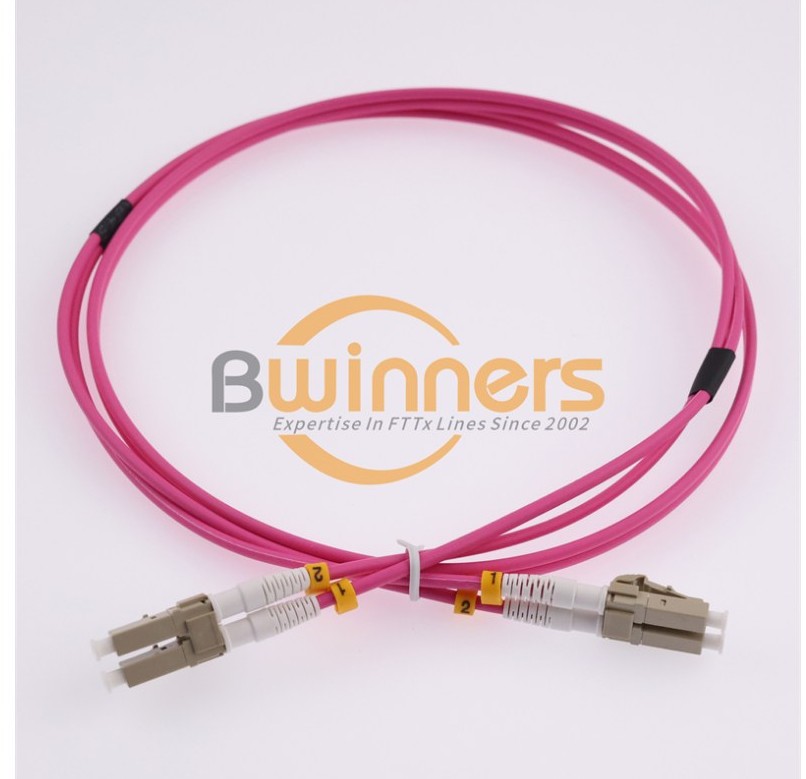
The LC-to-LC duplex OM4 violet patch cord is a product-family example for a transfer review. Its published photograph does not establish that a particular stored cord has the same supplied configuration or meets the destination’s requirements.

Provide the original order reference when asking about stored BWNFiber assemblies. Explain the destination interfaces, route, length definition, environment and required evidence. Product-family similarity is a starting point for the conversation, not approval to transfer.
Release the stock once, to a named destination
Complete the transfer by updating both projects’ reservations and recording the actual stock movement. The original project should no longer count the transferred quantity as available, and the new project should know exactly which assemblies were released. Keep any rejected or unresolved units outside the approved issue.
Does unused stock automatically remain acceptable?
No. Unused describes a use status. Suitability still depends on the destination requirements, identity, known handling history and the applicable acceptance decision.
Does a transfer start a new warranty period?
Do not assume so. Obtain the supplier’s applicable terms and a written clarification where needed. An internal stock movement does not establish a new commercial agreement.
Must every transferred cord be tested again?
Follow the destination’s acceptance plan and the condition review. This guide does not prescribe a universal test requirement or allow existing evidence to waive a required test.
To discuss a documented assembly transfer or request stock suited to the new route, contact [email protected] or +86-13615744790 with the original item references and destination requirements. Ask BWNFiber to confirm the product information available for that specific order.


