I was inspecting a shipment of fiber splice sleeves for a Middle East telecom project when I noticed the steel rods were already showing surface rust. The supplier had used uncoated carbon steel to save a few cents per piece. In a desert climate with daily temperature swings and occasional humidity, those rods would corrode inside the sleeve and eventually lose their grip. We rejected the lot.
Material selection in a PE fiber splice protection sleeve is not a small detail. It decides whether the splice survives five years or twenty. Below: what the sleeve is actually made of, how to pick the right rod, and which standards your tender will really ask for.
Short on time? Browse BWNFiber splice sleeves — or forward the RFQ checklist at the end straight to your supplier.

What You Will Learn
- The difference between PE, polyolefin, transparent, and colored outer tubes
- How the EVA hot melt adhesive seals the splice
- When to use steel, stainless steel, ceramic, or quartz strength member rods
- What RoHS, REACH, Telcordia GR-1380, Bellcore, MIL-PRF-24623, and SAE AMS-DTL-23053 really mean
- Why a single sleeve cannot be IP68-rated
- What to put on your RFQ so suppliers cannot hide behind vague specs
- Common material mistakes that cause field failures
What Is a PE Fiber Splice Protection Sleeve?
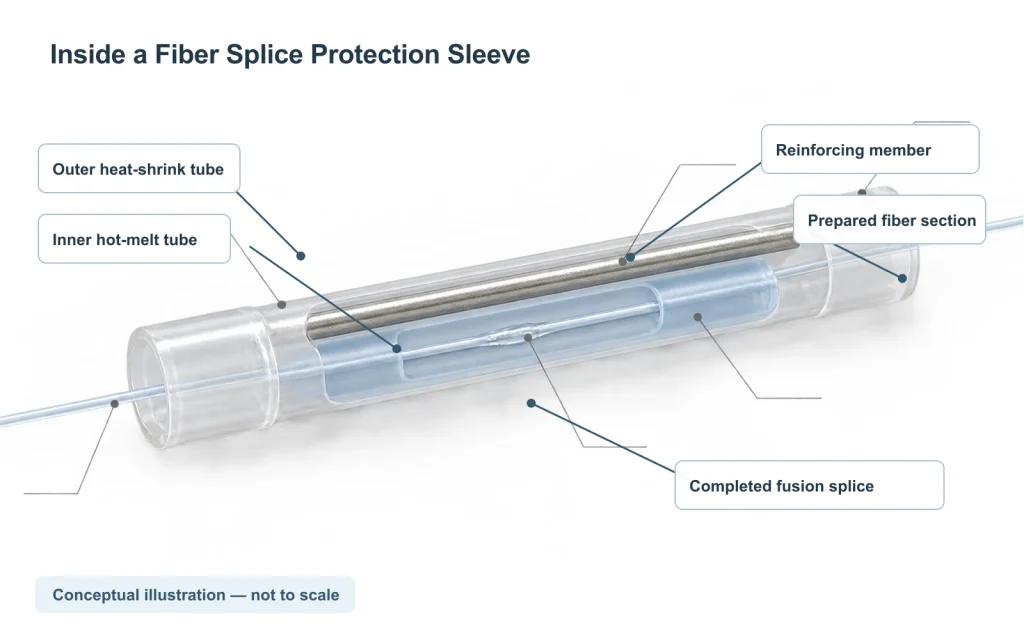
A PE fiber splice protection sleeve is a small heat-shrink tube placed over a fusion splice to restore mechanical strength and seal the joint against moisture. It is typically built from three layers: a cross-linked polyethylene or polyolefin outer tube, an inner EVA hot-melt adhesive layer, and a steel, ceramic, or quartz strength member rod.
If one datasheet says “polyolefin” and another says “PE,” they usually mean the same tube — the outer layer is a PE-based polyolefin blend. The sleeve itself is fiber-type agnostic: it works the same on G.652.D single-mode and on multimode, because the tube is sized to the coating diameter — 250 μm bare fiber or 900 μm buffered fiber — not to the glass inside it.
I have used these sleeves on FTTH drops, aerial trunk lines, and data center fiber runs. The cheap ones fail the same way every time: the rod rusts, the adhesive does not flow, or the wall shrinks so thin that it offers no real protection. The right sleeve starts with the right materials.
Outer Tube Materials: PE, Polyolefin, Transparent & Colored
The outer tube shrinks around the splice and holds the rod and adhesive in place. Most are made from polyolefin, and PE is the most common polyolefin used in this application. The terms are often used interchangeably in datasheets, but it pays to confirm the exact grade, wall thickness, and UV stability for outdoor work.
| Material | What it is | Best for | Notes |
|---|---|---|---|
| PE (polyethylene) | A polyolefin polymer with excellent moisture resistance | Outdoor, direct-burial, aerial closures | Common for outer heat-shrink tubes |
| Polyolefin | Broad family that includes PE, PP, and cross-linked blends | General-purpose telecom and FTTH sleeves | Most common industry term |
| Transparent / Clear | Uncolored polyolefin/PE outer tube | QC, training, repair, splice inspection | Lets the technician see the splice after shrinking |
| Colored | Pigmented polyolefin/PE outer tube | High-count splice trays, customer/batch identification | Does not change mechanical or optical performance |
One thing I tell buyers: when a supplier says “polyolefin sleeve,” they usually mean a cross-linked PE or PE-blend outer tube. PE is a type of polyolefin, not a separate material family. For outdoor or buried work, ask for the moisture resistance grade, UV resistance, and wall thickness, not just the brand name.
Typical polyolefin/PE outer tube parameters:
| Parameter | Typical range |
|---|---|
| Shrink ratio | 2:1 to 3:1 |
| Operating temperature | -45 °C to +100 °C, or -55 °C to +110 °C for higher grades |
| Tensile strength | ≥ 12 MPa typical; many sleeve datasheets claim ≥ 18 MPa per ASTM D2671 — ask for the test report value |
| Wall thickness after recovery | 0.5 mm – 1.0 mm |
| UV resistance | Required for aerial and direct-burial use |
Browse BWNFiber fiber optic splice sleeves for single-fiber and ribbon options. Clear and colored versions both come in standard lengths — the choice between them is operational, and I cover it below.
Inner Adhesive: EVA Hot Melt
Inside the sleeve is a layer of EVA (ethylene-vinyl acetate) hot-melt adhesive. When heated, the adhesive melts and flows around the fiber and the splice. After cooling, it forms a solid seal that blocks moisture and stabilizes the splice. Without a properly formulated EVA hot melt layer, even a high-quality outer tube will not protect the splice long term.
A good EVA hot-melt adhesive:
- Flows evenly at the recommended temperature, usually around 120 °C
- Fills gaps without trapping bubbles
- Stays flexible after cooling so it does not crack under vibration or thermal cycling
- Does not ooze out of the sleeve ends after recovery
Cheap sleeves sometimes use low-grade adhesive that does not flow well. The result is a dry-looking splice with poor sealing. If you cut open a failed sleeve and see no adhesive around the splice, that is the problem. On one African ISP rollout in 2023, we traced intermittent moisture failures to sleeves whose adhesive never fully melted — the heater profile was wrong, not the adhesive. We corrected the heater profile and the moisture failures stopped.
Strength Member Materials: Steel vs Ceramic vs Quartz Rod
The rod inside the sleeve keeps the splice straight and protects it from bending. For single-fiber sleeves, stainless steel rod is the default. For ribbon or high-density applications, ceramic rod or quartz rod is more common. The choice depends on corrosion risk, electrical isolation needs, and whether the sleeve will be bent during installation.
| Factor | Steel Rod | Ceramic Rod | Quartz Rod |
|---|---|---|---|
| Typical use | Single-fiber sleeves | Ribbon/multi-fiber sleeves | Ribbon, high-temp, or UV-sensitive applications |
| Cost | Lowest | Higher | Higher |
| Corrosion resistance | Good with 304/316 SS, poor with carbon steel | Excellent | Excellent |
| Flexibility | More flexible | Rigid | Rigid |
| Electrical conductivity | Conductive | Non-conductive | Non-conductive |
| Brittleness | Low | Higher — can crack if bent sharply | Low to moderate |
| Best for | General FTTH, indoor trays | Outdoor, high-voltage, harsh environments | Ribbon splicing, precision alignment |
Steel Rod: Carbon vs 304/316 Stainless Steel
Standard carbon steel rods are the cheapest option. They are strong and flexible, and they work fine in controlled indoor environments. However, they rust.
For outdoor or humid environments, specify stainless steel rod, ideally 304 stainless steel or 316 stainless steel for coastal or chemical exposure. The small price difference is worth it for buried, aerial, or coastal projects. I stopped using carbon steel rods on outside-plant work years ago. The callbacks were not worth the savings.
Two things buyers miss on steel rods. First, some budget sleeves use SS201 rod — it costs less than 304 and corrodes noticeably sooner. If the datasheet just says “stainless steel,” ask which grade. Second, steel expands and contracts with temperature far more than glass fiber does. In climates with large daily swings, that cycling stresses the splice for years — quartz and ceramic rods exist largely because their thermal expansion matches the fiber, not just because they resist rust.
Ceramic Rod
Ceramic rods are corrosion-proof, rigid, and non-conductive. They are ideal for high-voltage environments where metal could conduct, coastal or chemical exposure, and applications where galvanic corrosion is a concern. The downside is brittleness. I have seen ceramic-rod sleeves arrive intact from the factory and still fail because the tech bent the sleeve sharply while routing it into the tray — the rod cracked silently, and nobody knew until the splice lost support months later.
Quartz Rod
Quartz rods offer excellent thermal stability and low expansion. They are often used in ribbon fiber splice sleeves or applications where dimensional stability under temperature cycling matters. They are also non-conductive and chemically inert — so when a project needs ceramic’s insulation and corrosion immunity but the installation crew is rough on the cable, quartz is the rod I specify.
Single-Rod vs Double-Rod Designs
Rod count is a separate decision from rod material. A single-rod sleeve carries one round strength member and shrinks to a small profile — roughly 2.4–2.8 mm after recovery. It is the default for single-fiber FTTH work. A double-rod sleeve (“double needle”) holds two parallel rods that form a flat support plane, giving up to 50% higher tensile strength (around 25 N versus 10–15 N) and a wider interior cavity that keeps ribbon fibers from pinching each other during shrink. The trade-off is size: double-rod sleeves recover to about 2.9–3.1 mm and take more tray space.
| Design | Post-shrink profile | Tensile | Best for |
|---|---|---|---|
| Single-rod | ~2.4–2.8 mm | ~10–15 N | FTTH drops, indoor trays, static routes |
| Double-rod | ~2.9–3.1 mm | ≥25 N | Ribbon mass fusion (4/8/12F), vibration-prone or outdoor routes |
My selection rule: single-rod unless I am mass-fusing ribbon or the route sees vibration. Double-rod everywhere would waste tray space and money.
Compliance Standards: RoHS, REACH, Telcordia GR-1380, Bellcore, MIL-PRF-24623 & SAE AMS-DTL-23053
Not every project needs every standard. The key is knowing which certificate your customer or tender actually requires. Most telecom projects need RoHS as a baseline, European projects add REACH, carrier-grade North American work often asks for Telcordia GR-1380 or the older Bellcore name, and military or aerospace work may require MIL-PRF-24623 or SAE AMS-DTL-23053/5.
| Standard / Regulation | What it covers | When you need it |
|---|---|---|
| RoHS | Restricts lead, cadmium, mercury, and other hazardous substances in electrical/electronic products | Most telecom and EU projects |
| REACH | EU regulation on chemical safety and SVHC registration | European projects and global customers shipping to Europe |
| Telcordia GR-1380 | Generic requirements for fusion splice protectors (dimensions, materials, strength, temperature cycling, moisture) | Carrier-grade and North American telecom projects |
| Bellcore | Older name for Telcordia standards; Bellcore GR-1380 is the historical predecessor | Legacy specs or older tenders |
| MIL-PRF-24623 | General specification for fiber optic cable splices, including protection sleeves | Military, defense, or ruggedized industrial contracts |
| SAE AMS-DTL-23053/5 | Aerospace spec for cross-linked polyolefin heat-shrinkable tubing | Aerospace, aviation, or satellite ground station projects |
| UL 94 / LSZH | Flammability rating and low-smoke halogen-free tube material | Rail tunnels, building risers, indoor public spaces |
RoHS
RoHS (Restriction of Hazardous Substances) limits lead, cadmium, mercury, and other hazardous materials in electrical and electronic products. Treat it as the baseline: if a sleeve supplier cannot produce a RoHS declaration on request, that tells you more about their paperwork discipline than about the sleeve.
REACH
REACH (Registration, Evaluation, Authorisation and Restriction of Chemicals) is the EU regulation on chemical safety. REACH compliance is increasingly required for European projects and for global customers who ship to Europe. A supplier should provide an SVHC declaration or a REACH certificate if the project asks for it.
Telcordia GR-1380 / Bellcore
Telcordia GR-1380-CORE defines requirements for fusion splice protection sleeves used in telecommunications networks. It covers dimensions, materials, strength, temperature cycling, and moisture resistance. Bellcore is the older name for the same standard family. For carrier-grade projects, request a GR-1380 test report from your supplier.
MIL-PRF-24623
This is a U.S. military specification for fiber optic cable splices, including splice protection sleeves. It applies to sleeves used in defense, aerospace, and ruggedized industrial applications. MIL-spec sleeves are overkill for standard FTTH but necessary for military contracts. Note that MIL-PRF-24623 is not a general heat-shrink tubing specification; that role belongs to MIL-DTL-23053 and its SAE successor.
SAE AMS-DTL-23053
SAE AMS-DTL-23053 is an aerospace standard for heat-shrinkable electrical insulation tubing. The /5 slash sheet covers flexible cross-linked polyolefin tubing, which is the material family most commonly used for fiber splice sleeve outer tubes. You may see it listed as SAE AMS-DTL-23053/5 Class 2 on datasheets.
Flammability: LSZH and UL 94
One property buyers forget to ask about: what the tube does in a fire. Standard PE/polyolefin sleeves are not low-smoke or halogen-free by default. For rail tunnels, building risers, and indoor public spaces where smoke toxicity matters, specify an LSZH (low smoke zero halogen) outer tube and ask for its UL 94 flammability rating. This is a different requirement from IP68 — a sleeve can seal perfectly against water and still burn dirty.

Clear vs Colored Fiber Splice Sleeve
The choice between clear and colored sleeves is operational, not optical. If the wall thickness and material are the same, mechanical and optical performance are identical — color is traceability, not strength.
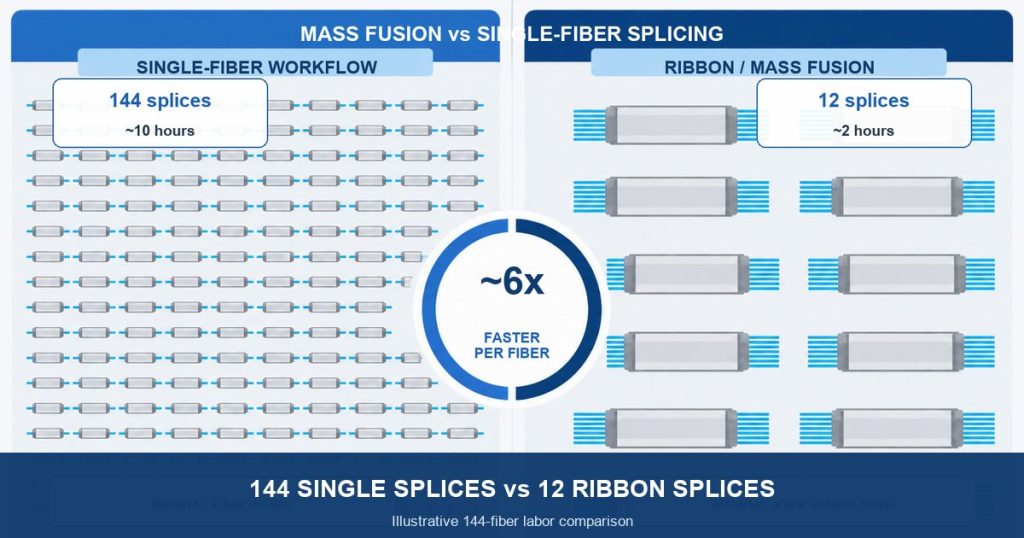
A transparent sleeve lets the technician inspect the splice after shrinking: whether it is centered, whether the adhesive flowed cleanly, whether a bubble is trapped at the fusion point. That is why clear is the default in training, QC, and repair work. A colored sleeve does the opposite job — it hides the splice but tells you which fiber it is. Colored sleeves usually follow the TIA-598 fiber color sequence — blue, orange, green, brown — so the sleeve can match the fiber’s position number in the tray or a customer circuit in a shared closure. In a 144-fiber tray, color is the difference between a ten-minute locate and an hour of guessing.
| Use case | Clear / Transparent | Colored |
|---|---|---|
| Splice inspection | Best — technician can see the splice | Not visible |
| Training and QC | Ideal | Less useful |
| Fiber identification in dense trays | Limited | Excellent |
| Customer or batch color-coding | None | Excellent |
| Standard FTTH field work | Most common default | Optional |
My rule of thumb: use clear sleeves for general field work and training, and colored sleeves when you need to trace or identify fibers in a high-density tray.
IP68 Fiber Splice Protection Sleeve
Some suppliers market sleeves as IP68-rated. Be careful. A sleeve itself cannot be IP68. The IP68 rating applies to the whole splice closure or enclosure assembly, tested under IEC 60529. However, a high-quality sleeve with good EVA hot-melt adhesive is a critical part of achieving IP68-level moisture protection inside the closure.
When a customer asks for IP68 splice sleeves, I clarify that they need an IP68-rated splice closure with properly installed sleeves inside. The sleeve is one component; the closure is the system.
Common Material Mistakes
Most field failures I have seen trace back to one of these material choices.
- Carbon steel rods outdoors. They rust. Use 304/316 stainless steel, ceramic, or quartz.
- Low-grade EVA adhesive. It does not flow or seal properly.
- Thin-walled sleeves. They shrink too thin and offer less mechanical protection.
- No compliance docs. Many tenders require RoHS, REACH, or Telcordia/Bellcore paperwork.
- Confusing IP68 with sleeve-level rating. Verify the closure rating separately.
- Specifying “polyolefin” without defining wall thickness or grade. Not all polyolefin tubes have the same moisture resistance or recovery ratio.
What to Put on Your RFQ
If you send a one-line RFQ saying “quote fiber splice sleeves,” you will get apples-to-oranges prices. A complete RFQ should list fiber diameter, sleeve length, rod material, outer tube color, required standards, and target environment. The more detail you give, the fewer surprises you will see in the first sample batch.
- Fiber coating diameter — 250 μm bare fiber or 900 μm buffered fiber
- Sleeve length — 25 mm, 30 mm, 40 mm, 45 mm, 60 mm
- Pre-shrink and after-shrink outer diameter
- Strength member rod material — carbon steel, 304/316 stainless steel, ceramic, or quartz
Outer tube color — clear/transparent or 12-color option
Compliance required — RoHS, REACH, Telcordia GR-1380, Bellcore, MIL-PRF-24623, SAE AMS-DTL-23053/5, plus UL 94 / LSZH for tunnels, risers, and indoor public spaces
- Test reports or certificates — especially for GR-1380 and RoHS/REACH
- Packing quantity — 100 pcs/bag is common
- Application environment — indoor, aerial, direct-burial, coastal, high-voltage
- Target delivery window and project country — standard clear sleeves are usually stock items; 12-color or custom-length runs add production days. Naming the project country lets the supplier match certificates and export documents to your tender requirements.
On price, the materials in this guide are exactly where the cost differences hide. Rod material is the biggest lever — carbon steel, then SS201, then 304/316 stainless, then ceramic or quartz — followed by wall thickness and certificates. If one quote lands far below the others, ask what was value-engineered out. It is almost always the rod.
To compare suppliers on materials, I ask three things: the rod grade in writing, a current GR-1380 or RoHS/REACH report with a test date and lab name, and a sample lot I can cut open myself. A supplier who answers all three quickly is usually the one whose paperwork survives a tender audit.
For project-based quotes, contact BWNFiber and send these details. It saves both sides time and reduces the risk of a spec mismatch.
Frequently Asked Questions
Q: What material is a fiber splice protection sleeve made of?
A: A typical sleeve has a polyolefin or PE outer tube, an EVA hot-melt adhesive inner layer, and a steel, ceramic, or quartz strength member rod.
Q: Is PE the same as polyolefin in a splice sleeve?
A: PE is a type of polyolefin. Most “polyolefin” splice sleeves use a cross-linked polyethylene or PE-blend outer tube.
Q: What is the difference between steel rod, ceramic rod, and quartz rod splice sleeves?
A: Steel rods are flexible and low-cost. Ceramic rods are corrosion-proof and non-conductive but more brittle. Quartz rods offer excellent thermal stability and are common in ribbon sleeves.
Q: What is the difference between single-rod and double-rod (“double needle”) splice sleeves?
A: A single-rod sleeve has one round strength member and a compact ~2.4–2.8 mm profile after shrinking — the standard for single-fiber FTTH. A double-rod sleeve has two parallel rods forming a flat support plane, with roughly 50% higher tensile strength and a wider cavity that keeps ribbon fibers from pinching during shrink. Use double-rod for ribbon mass fusion or vibration-prone routes.
Q: Is 304 stainless steel rod better than carbon steel for splice sleeves?
A: For outdoor, buried, or humid environments, yes. Carbon steel can rust and lose strength. 304 or 316 stainless steel resists corrosion far better.
Q: When should I use a transparent vs colored fiber splice sleeve?
A: Use clear sleeves when you need to inspect the splice. Use colored sleeves for fiber identification and color-coding in dense trays.
Q: What does Telcordia GR-1380 / Bellcore mean for splice sleeves?
A: It is a telecom industry standard that covers dimensions, materials, strength, temperature cycling, and moisture resistance of fusion splice protectors. Bellcore is the older name for Telcordia.
Q: Does MIL-PRF-24623 apply to fiber splice sleeves?
A: Yes, it is a U.S. military specification for fiber optic cable splices, including splice protection sleeves. It is not the same as general heat-shrink tubing specs.
Q: What is SAE AMS-DTL-23053/5 in splice sleeve terms?
A: It is the aerospace slash sheet for flexible cross-linked polyolefin heat-shrinkable tubing, the material family commonly used for the sleeve outer tube.
Q: What determines how long a fiber splice protection sleeve lasts?
A: The rod and the adhesive. With a stainless steel, ceramic, or quartz rod and properly melted EVA adhesive, the sleeve protects the splice for the full service life of the cable — 20 years or more in outside plant. The failures I see usually trace back to rusted carbon steel rods or adhesive that never flowed, and those show up within the first few years.
Q: Are RoHS and REACH compliance required for fiber splice sleeves?
A: RoHS is widely required for telecom and electronics. REACH is required for EU projects and for products shipped into Europe. Always confirm with the tender.
Q: Can a fiber splice sleeve itself be IP68 rated?
A: No. IP68 applies to the splice closure or enclosure. The sleeve is a component that helps the closure achieve moisture protection.
Q: What shrink ratio and operating temperature should I specify?
A: A typical shrink ratio is 2:1. Operating temperatures commonly range from -45 °C to +100 °C or -55 °C to +110 °C depending on the grade. Always check the datasheet for your environment.
Q: What documents should I request from a splice sleeve supplier?
A: Ask for RoHS/REACH certificates, Telcordia GR-1380 or Bellcore test reports, dimensional drawings, tensile/shrink data, and a sample lot for evaluation.
Related Reading
- Fiber Optic Splice Sleeve: The Complete Buying & Specification Guide
- Fiber Splice Sleeve Size Guide: Diameter & Length Selection
- Single Fiber vs Ribbon Fiber Splice Protection Sleeve Guide
- How to Install, Heat Shrink & Use Fiber Splice Protection Sleeves
- Fiber Splice Sleeve Troubleshooting & Technical FAQ

Need Compliant Splice Sleeves?
BWNFiber manufactures RoHS- and REACH-compliant fiber optic splice protection sleeves in bulk. We supply polyolefin, PE, transparent, and colored tubes with carbon steel, 304 stainless steel, ceramic, or quartz strength member rods, provide test reports on request, and support OEM/ODM requirements.
Related BWNFiber products:
– Standard and custom fiber optic splice sleeves
– Request a quote or sample
– Request a specification sheet or compliance test reports
We supply ISP and FTTH projects in the Middle East and Africa — the same environments as the field cases in this guide — so we know what their tenders ask for and which documents pass a bid review.
📧 [email protected]
📞 +86-13615744790 (WhatsApp)
🌐 Visit our website
Data verified against manufacturer datasheets as of September 2026.
BWNFiber · Business Intelligence Excellence