The newest cables in the data center connect the oldest connector — MPO — to the smallest: CS, SN, MDC, and MMC, the very-small-form-factor (VSFF) family. 400G and 800G modules adopted VSFF interfaces to double faceplate density, and the breakout assembly that maps an MPO trunk onto those tiny ports is now a standard line item on cluster orders.
This guide explains the VSFF landscape, which modules use which interface, and how to order MPO-to-VSFF breakouts without an interface mismatch.
What VSFF Is and Why It Exists
VSFF connectors shrink the duplex footprint to roughly half of an LC duplex — letting transceiver faceplates carry twice the ports per slot, and letting 400G/800G modules present multiple independent duplex links on one module body. The driver is simple: 400G-DR4 and 800G modules want to break into duplex sub-links (2 × 100G, 4 × 100G, 2 × 400G), and LC duplex ports physically cannot fit that many on one faceplate.
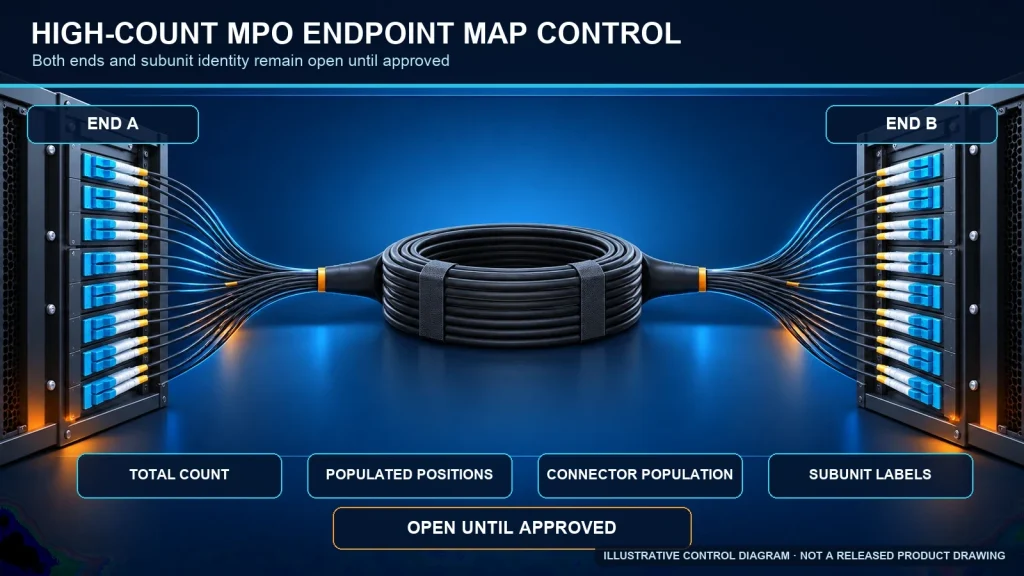
The cabling consequence: a breakout assembly with MPO on one end and four (or eight) VSFF duplex legs on the other is now the standard way to land these modules on an MPO trunked plant.
The Four Interfaces: CS, SN, MDC, MMC
| Interface | Fibers per connector | Origin | Typical module association |
|---|---|---|---|
| CS | 2 (duplex) | SENKO | 400G-DR4 (2×100G), some 800G-DR8 |
| SN | 2 (duplex) | SENKO | 400G/800G DR-class variants |
| MDC | 2 (duplex) | US Conec | 800G-DR8 and OSFP ecosystem |
| MMC | 2 (duplex) | US Conec | newer 800G/1.6T modules |
Two engineering notes: the four are not intermateable (different footprints), and each exists in standard and tool-less/push-pull variants for dense panels. The transceiver datasheet — not the salesperson — names the interface.
For the connector-family view of VSFF beyond breakouts, see our VSFF connectors guide (companion piece covering MU and the full family).
Which Modules Use Which Interface
| Module class | Common interfaces | Breakout pattern |
|---|---|---|
| 400G-DR4 | MPO-12 native, or CS/SN duplex ×2 | MPO trunk → 2 VSFF duplex legs |
| 400G-SR8 | MPO-16 native | no VSFF (parallel MMF) |
| 800G-DR8 | MPO-16 native, or MDC/CS ×4 | MPO trunk → 4 VSFF duplex legs |
| 800G-DR4 (2×) | dual MPO-12 or VSFF variants | per module datasheet |
Vendor conventions shift fast (as of August 2026); the module's mechanical drawing is the only authority. If the datasheet says "4 × CS duplex," the assembly ends in four CS legs — no LC substitute exists.
MPO-to-VSFF Breakout Mapping
| Assembly | MPO end | VSFF legs | Use |
|---|---|---|---|
| MPO-12 → 4 × CS/SN/MDC duplex | 12F, APC (SM) | 4 duplex | 400G-DR4 to four 100G-FR links |
| MPO-16 → 4 × MDC/CS duplex | 16F, APC | 4 duplex | 800G-DR8 to four 200G-class links |
| MPO-16 → 2 × MPO-12 (classic) | 16F → 12F | none (classic) | the non-VSFF alternative for DR8→2×DR4 |
Mapping rules are the same discipline as any breakout: lane order documented per leg, polish per end (APC on the MPO for DR-class; UPC on VSFF legs per module), gender per mating hardware, and leg lengths measured to the port layout — uniform or staggered.
Ordering MPO-to-VSFF Assemblies
- Module part numbers on both ends — the module names the VSFF type (CS/SN/MDC/MMC); there is no interchangeable substitute.
- VSFF variant — standard vs push-pull/tool-less per panel density.
- Leg mapping — lane order per duplex leg, documented on the drawing.
- Polish per end — APC on single-mode MPO; UPC on VSFF legs as the module requires.
- Gender — MPO end per mating hardware (trunk/panel/transceiver).
- Loss grade — low-loss ≤ 0.35 dB on the MPO pair; VSFF legs per module budget.
- Leg geometry — lengths uniform or staggered to the port map; jacket ratings.
- Test documentation — per-assembly IL/RL + polarity report covering every leg.
FAQ
What is a VSFF connector?
Very-small-form-factor duplex connectors — CS, SN, MDC, and MMC — roughly half the LC duplex footprint. 400G/800G modules use them to fit multiple independent duplex links on one faceplate. The four types are not intermateable.
What is the difference between CS, SN, MDC, and MMC?
All are duplex VSFF interfaces from two connector families (SENKO's CS/SN, US Conec's MDC/MMC). They differ in footprint and latching, are not intermateable, and appear on different transceiver models — the module datasheet names which one you need.
Why do 800G modules use MDC or CS connectors?
Faceplate physics: an 800G module presenting four independent duplex links cannot fit four LC duplex ports in its slot, but fits four VSFF duplex ports. MDC/CS make multi-duplex 800G modules mechanically possible.
Can I adapt between VSFF types or between VSFF and LC?
Not practically — the footprints differ and there are no passive cross-adapters of consequence. Match the assembly legs to the module interface named in the datasheet.
What breakout cable do I need for 800G-DR8 to four 200G links?
An MPO-16 (APC, low-loss) to 4 × duplex VSFF breakout with the VSFF type named by your module (MDC or CS commonly), lane mapping documented per leg.
Is MPO-to-CS the same as MPO-to-SN?
No — CS and SN are different VSFF footprints and not intermateable. Order the legs your module specifies; the MPO end and mapping logic are the same either way.
What polish do VSFF legs use?
Per the module requirement — typically UPC on the VSFF legs with APC on the single-mode MPO end for DR-class links. State polish per end on the RFQ, not per assembly.
Do VSFF connectors come in APC?
VSFF implementations on DR-class modules are generally UPC-based today; the APC requirement lives on the MPO side of single-mode links. Confirm against the module datasheet as the ecosystem evolves.
Get VSFF Breakouts Matched to Your Modules
BWNFiber manufactures MPO-to-VSFF breakout assemblies: MPO-12/16 to CS/SN/MDC/MMC duplex legs, APC/UPC per end, lane-documented mapping, standard or push-pull VSFF variants, low-loss ≤ 0.35 dB MPO grade, and per-assembly IL/RL + polarity reports covering every leg.
How to engage: send the module part numbers on both ends and your port layout. We confirm the VSFF type, mapping, and leg geometry before quoting — so the legs fit the faceplate the first time.
👉 Browse the MPO cabling hub → · Or contact our engineering team →
References & standards: IEC 61754-7 (MPO interface); vendor VSFF interface specifications (SENKO CS/SN, US Conec MDC/MMC); IEEE 802.3 (400G/800G specifications). Interface-to-module associations current as of August 2026; confirm against module datasheets.