MPO cable jacket specification: listing, route and evidence

An MPO cable jacket specification is a controlled set of route, regulatory, material, construction and acceptance requirements for a finished MPO assembly. It does not treat LSZH, OFNP and OFNR as interchangeable grades. Approval depends on the pathway, destination rules, exact assembly identifier, supporting documents and a separate optical acceptance plan.
| Approval field | What the buyer records | What the supplier returns |
|---|---|---|
| Route segment | Start and end points, room or pathway type, and drawing reference | A configuration mapped to that segment |
| Governing requirement | Destination, adopted code or project standard, facility rule, and approver | The applicable cable type, listing or regional classification |
| Jacket requirement | Material, smoke, halogen, UV, moisture or handling requirement, where specified | Datasheet and relevant report for the proposed construction |
| Fiber and link design | Single-mode or multimode grade, fiber count, application interface and link requirement | The exact fiber designation used in the quoted construction |
| Assembly configuration | MPO interface, fiber type and count, polarity, pinning, end face, length and quantity | Drawing and bill of materials for the quoted assembly |
| Acceptance record | Required inspection and optical test method, limits and deliverables | The agreed production and acceptance records |
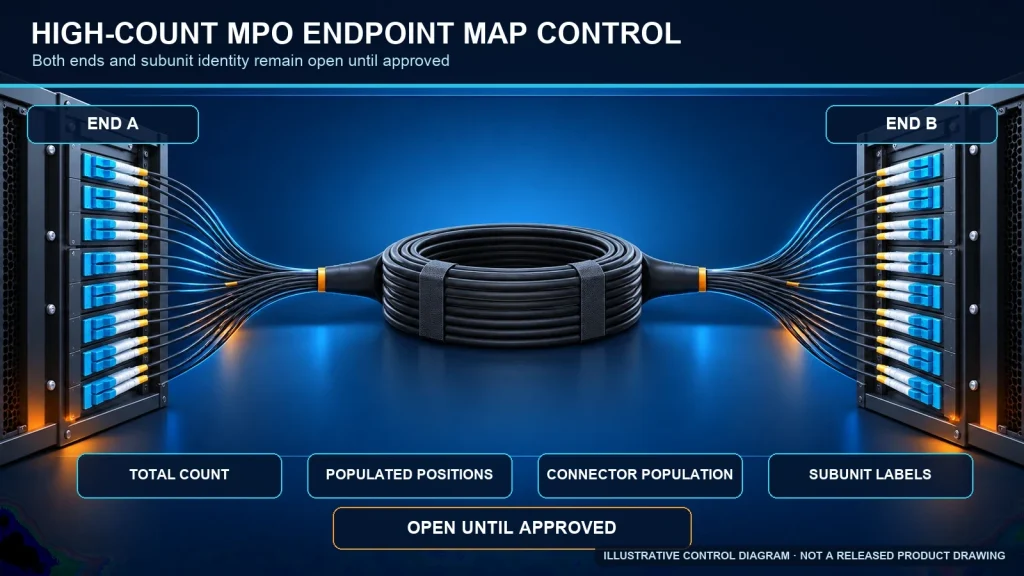
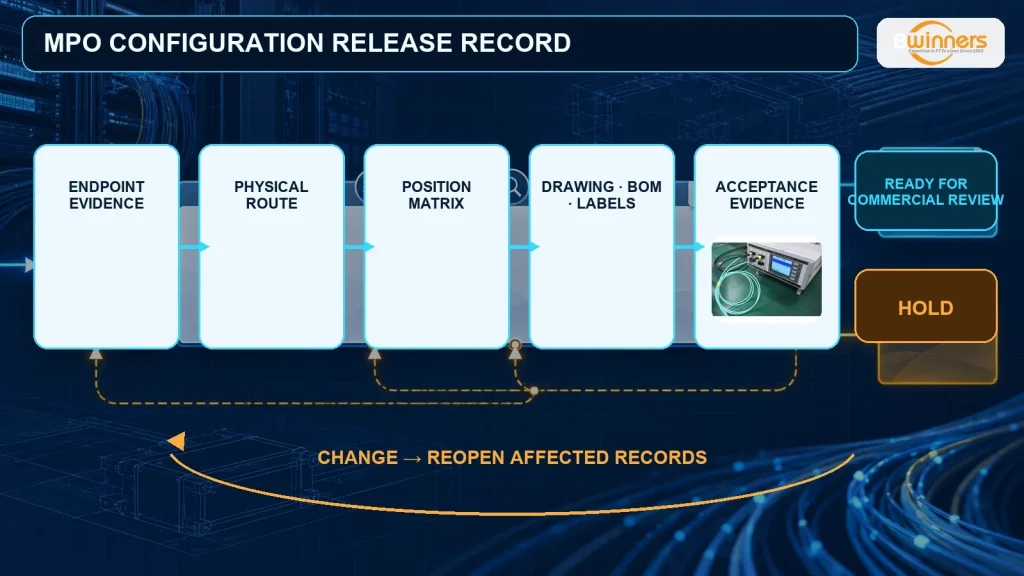
Buyer summary: First classify each route segment and governing authority. Then freeze the MPO interface, fiber grade and count, polarity, pinning, end face, length, quantity, jacket material and requested cable class. Ask the supplier to return a controlled drawing and bill of materials plus evidence whose product identifier, construction, revision and scope match the quoted assembly. Define inspection and optical test methods separately. Compare price and schedule only after bids use the same technical, evidence, packaging and delivery basis. Put unresolved document or construction differences on HOLD, with a named owner, before sample or production release.
This separation prevents a common RFQ error: using one label to answer several different questions. An LSZH description does not authorize a cable for a plenum pathway. An OFNP marking does not prove zero-halogen construction. Neither one establishes that a listing or test report covers the assembly being quoted.
Preparing an MPO RFQ? Copy these six approval fields into the requirement sheet before asking for a price. A supplier can then respond to the same route, construction and evidence scope instead of guessing from a jacket acronym.
30-second decision path: classify every route segment; freeze the exact MPO configuration and evidence list; compare suppliers only after technical and commercial scope is aligned. Release the order only when open discrepancies have an owner and disposition.
Module navigation: classify the route · check the evidence · prepare the RFQ · localize the order · settle release questions
Classify the route before naming the jacket
Mark every change in pathway on the route drawing. A cabinet run, room pathway, riser, space used for environmental air, building entrance and outdoor segment may need separate review. Do not classify a space from a phrase such as "under the raised floor" or "above the ceiling." The mechanical or electrical drawings and the project authority need to identify how the space is used.
Use a schedule that can survive the handoff from design to purchasing:
| Segment | Drawing reference | Space or pathway evidence | Governing requirement | Requested cable type or class | Material requirement | Approver and status |
|---|---|---|---|---|---|---|
| 01 | Enter reference | Enter document and location | Enter adopted rule or project clause | Hold until reviewed | State separately | Name owner; Open / Approved / Hold |
| 02 | Enter reference | Enter document and location | Enter adopted rule or project clause | Hold until reviewed | State separately | Name owner; Open / Approved / Hold |
For a US project, record the NEC edition adopted by the jurisdiction and any facility requirements. NFPA identifies the 2026 edition of NFPA 70 as the current edition, but a project may operate under an earlier adopted edition. The applicable pathway rules and the authority having jurisdiction control approval. A blog comparison cannot make that decision (NFPA 70).
For an EU project, do not convert OFNP or OFNR into a CPR Euroclass. Ask for the classification and market documents that apply to the destination and proposed product. The European Commission explains the Declaration of Performance or Conformity and CE marking framework for covered construction products (European Commission CPR guidance).
Treat environmental and mechanical requirements as separate checks
A jacket label does not establish tensile strength, crush resistance, minimum bend radius, water resistance, UV resistance or rodent protection. Low-smoke, halogen, flame-propagation and environmental claims also need their own applicable evidence. IEC 60794-1-1 sets generic requirements for optical fiber cable properties that include transmission, material, mechanical, ageing and climatic characteristics (IEC 60794-1-1). The project still needs values and test evidence for the proposed product and installation condition.
The same rule applies to shorthand such as PE, armored or indoor-outdoor. A PE jacket does not, by itself, prove every outdoor exposure requirement. Armor describes a protection system, not automatic direct-burial approval. State the actual route risk, installation method and required product properties.
Check the evidence against the proposed assembly
Start with the identifier on the quotation or assembly drawing. Trace it through the documents that support approval:
- drawing and bill of materials;
- supplier datasheet;
- cable or product marking;
- applicable listing, certificate or Declaration of Performance;
- fire, smoke or halogen report where required;
- polarity and optical acceptance records agreed for the order.
The scope matters more than the document count. IEC 60754-1 covers halogen acid gas testing of cable materials, while IEC 61034-2 covers smoke-density measurement under defined conditions (IEC 60754-1; IEC 61034-2). These references do not turn a compound report into proof of every property of a finished MPO assembly.
UL identifies UL 1651 as the safety standard for optical fiber cable (UL telecommunications cable testing). Citing the standard is not the same as showing that a particular BWNFiber construction is listed. The submitted listing or certificate must support the claim made for the quoted product.
Use an evidence ladder, not a document pile
Not every document can approve the same claim. Classify each submission by what it can actually establish, then trace the exact quoted identifier through the set.
| Evidence level | What it may establish | What it cannot establish by itself | Buyer action |
|---|---|---|---|
| Marketing page or catalogue | Candidate options and terminology | Availability, listing scope or order-specific construction | Use for discovery only |
| Datasheet | Declared construction and performance fields for the named product | Third-party listing status or order-specific configuration | Match product code and revision |
| Drawing and bill of materials | The proposed assembly configuration | Fire, smoke, halogen or optical-test compliance without supporting records | Freeze the approved revision |
| Listing, certificate or Declaration of Performance | The classification and scope stated by the issuing scheme | Unstated materials, a related model or every property of the finished MPO assembly | Check holder, identifier, construction, scope and status |
| Test report | Result for its named specimen, method and conditions | Transfer to another specimen, revision or complete assembly without a documented basis | Match specimen and method to the claim |
| Production or acceptance record | Results for the identified order or sample | A pathway classification outside the record's scope | Match serial, lot or order reference and acceptance plan |
If the identifier, revision, specimen or construction changes between levels, the evidence chain is open. Record the discrepancy; do not fill the gap with a family-level statement.
For a BWNFiber review request, use one repeatable sequence: route → configuration → evidence → acceptance. Send the route schedule and draft MPO configuration first, then ask BWNFiber to identify the documents available for the exact proposed construction. An unavailable or mismatched record remains an open item; it is not implied compliance.
Do not use jacket approval as fiber approval
The jacket does not determine whether an assembly should use single-mode or multimode fiber. ITU-T G.652 defines characteristics for single-mode fiber and cable, including G.652.D. ITU-T G.657 covers bend-loss-insensitive single-mode fiber and cable. Category A fibers are compliant with G.652, while category B is not necessarily compliant with G.652 (ITU-T G.652; ITU-T G.657). Record the exact G.652.D, G.657.A1, G.657.A2 or other approved designation instead of writing only "single-mode."
OM3, OM4 and OM5 are 50/125 micrometre multimode fiber categories covered by IEC 60793-2-10. They are bandwidth grades, not jacket ratings (IEC 60793-2-10). The network interface and link design need to select the fiber grade before the supplier fixes the assembly bill of materials.
Match the test method to the test object
State whether the order requires factory testing of an MPO assembly, acceptance testing of installed cabling, or troubleshooting of a completed route. These are not interchangeable test objects.
IEC 61300-3-35 covers visual inspection of connector end faces and states that inspection does not replace measurements such as attenuation and return loss (IEC 61300-3-35). IEC 61280-4-5 applies to attenuation measurement and determination of polarity and length for installed multimode or single-mode cabling terminated with MPO connectors and tested through MPO interfaces (IEC 61280-4-5). Its scope does not automatically define factory acceptance for every MPO-to-LC harness or other mixed-interface assembly.
An OTDR can support installed-link characterization or fault location when the acceptance plan calls for it. It should not replace the agreed insertion-loss, polarity, end-face or return-loss records simply because an OTDR trace is available. Define the test object, method, reference condition, wavelength, direction, limit and record format before comparing supplier reports.
When the documents do not agree
Put the item on hold. Record the conflicting model, revision, construction or marking, then ask the supplier for a corrected document set or a formal substitution proposal. Purchasing should not resolve a mismatch by choosing the most favorable value from several documents.
A substitution proposal should state what changes, why it changes, which approvals it affects, and which records will be replaced. Release the order only after the named technical or compliance owner accepts the change.
Keep pathway review and optical release separate
A jacket change does not automatically cause an optical failure. It can, however, change cable diameter, flexibility, bend behavior, routing or termination conditions. Review those effects and retain the approved MPO interface, fiber, polarity, length definition, end-face requirement and agreed optical acceptance plan.
Put approval fields in the RFQ
An approvable quotation needs more than a jacket name. Send the supplier the route schedule and assembly configuration, then require a response against the same fields.
| Buyer sends | Supplier returns | Release condition |
|---|---|---|
| Destination, project location, adopted requirement and facility rule | Proposed cable type or regional class with supporting document | Requirement and evidence refer to the proposed construction |
| Route drawing with every transition marked | Cable construction mapped to each segment | No unresolved pathway segment |
| MPO interface, fiber, polarity, pinning, end face, finished length and quantity | Controlled drawing and bill of materials | Configuration matches the RFQ |
| Material, smoke, halogen, UV, moisture and handling requirements that actually apply | Datasheet and scoped reports | No unsupported transfer from a related model or raw material |
| Inspection and optical acceptance requirements | Agreed record set and submission timing | Test object, method, limits and records are defined |
| Sample or first-article requirement, when the project uses one | Sample configuration, report set and deviation record | Approved sample matches the production configuration or every difference is dispositioned |
| Substitution rule and approval owner | Written exception or substitution request | No unapproved change to construction, marking, connector, polarity or evidence scope |
Price comparison starts after this normalization. If two suppliers quote different cable constructions or evidence scopes, their prices are not yet comparable.
Compare suppliers on one technical and commercial basis
A lower unit price is not a saving if the quote excludes required records, uses a different construction or cannot meet the project schedule. Level the bids before selecting a supplier.
| Comparison field | What a comparable response contains | Hold condition |
|---|---|---|
| Technical scope | Exact assembly code, controlled drawing, fiber, MPO interface, polarity, length definition and jacket construction | Family name or incomplete configuration |
| Compliance evidence | Document identifier, issuer, scope, status and proposed-product relationship | Certificate or report cannot be tied to the quoted construction |
| Quality and acceptance | Sample or first-article plan, inspection/test records, limits and submission timing agreed for the order | Generic “tested” statement without method, object or record |
| Commercial basis | Currency, agreed delivery term, quantity break, quote validity and included packaging or documentation | Prices use different quantities, delivery bases or inclusions |
| Schedule | Sample timing, production lead time and delivery assumption stated separately | One unqualified delivery promise |
| Change control | Written rule for material, marking, connector, polarity, document or production changes | Supplier may substitute without approval |
MOQ, production lead time, shipping time and sample availability are order-specific. Ask each supplier to state the assumptions in writing; do not carry a value from another model, quantity or destination into the comparison.
When to request a sample or customized design review
Request a sample, first article or engineering review when the route crosses different environments, the required construction is not covered by the submitted documents, the assembly uses a project-specific length or branch layout, or the order needs special marking, packaging or private-label treatment. The review should identify what is standard, what changes, which evidence is affected and whether the sample matches the planned production BOM.
A customization request is not an approval or a capability promise. Ask BWNFiber to return a written status for the proposed construction: supported as submitted, clarification required, engineering review required, or unavailable. OEM/ODM scope, bulk quantity, MOQ, lead time, export documentation, packaging, marking and test deliverables should remain order-specific until they appear in an approved quotation or project record.
If a specification worksheet is needed, copy the route schedule and RFQ table from this module into the tender pack. Attach the route drawing and configuration sheet rather than sending a generic request for “LSZH MPO cable.”
Localize the RFQ by destination, not by continent
“International standard” is not an approval category. Record the destination country, project owner, authority, adopted requirement and contract documents. Climate and logistics also need project values; a continent name cannot define temperature, UV, water, dust, salt, rodent or handling exposure.
| Destination market | Minimum requirement check | Site and delivery questions to add |
|---|---|---|
| North America | Locally adopted code, AHJ/facility rule, pathway classification and exact listing scope | Building use, environmental-air spaces, entry transition, delivery term and destination |
| Europe/EEA | CPR applicability, required declaration/marking, classification and national or project requirement | Smoke, droplet and acidity sub-class where specified; language and document version required by the contract |
| Middle East | Country, authority, consultant and project fire/cabling specification | Measured heat, UV, dust, salt or indoor cooling conditions; import and handover documents |
| Southeast Asia | National rule, building/owner specification and accepted test documentation | Actual humidity, flooding, water ingress, UV and route conditions; sea-freight packing and storage plan |
| Latin America | Country, utility/operator or tender requirement and accepted document language | Actual UV, elevation, rainfall, lightning/grounding interface and customs-document needs |
| Africa | Country, operator/utility or tender requirement and accepted conformity evidence | Actual heat, UV, dust, flooding, rodent and handling risks; reel size, spares and inland-logistics constraints |
These rows are question prompts, not claims that every project in a region has the same climate, code or buying practice. Ask the supplier to identify each requested document by product, construction, revision and destination. Confirm OEM/private-label marking, export packaging, bulk quantity, sample plan and delivery schedule in the written quotation rather than inferring them from a regional label.
Record the release decision
Keep one short decision record with the purchase file. This turns a verbal approval into a traceable disposition without pretending that every reviewer approves every attribute.
| Field | Required entry |
|---|---|
| Submitted assembly identifier | Exact quoted part number and revision |
| Route and requirement reference | Drawing segment plus adopted code, project clause or facility rule |
| Evidence reviewed | Document title, issuer, identifier, revision and date |
| Open discrepancy | Model, construction, marking, scope or test-object mismatch |
| Disposition | Approved / Approved with condition / Hold / Rejected |
| Decision owner | Named technical, compliance or project authority |
| Production condition | Approved sample, record set and substitution restriction |
Do not release a held item because the delivery date is approaching. Close the discrepancy with corrected evidence or a formally accepted exception.
Questions buyers should settle before release
Does a raw cable OFNP listing cover a finished MPO assembly?
Do not assume that it does. Check what product or construction the listing covers, then review the connectorized assembly against its drawing, bill of materials, polarity and optical acceptance requirements. Describe the finished assembly as certified only when the evidence supports that scope.
Which identifiers need to match?
The quotation or assembly identifier should be traceable across the drawing, bill of materials, datasheet, marking, applicable listing or certificate, reports and order record. Stop the approval if the supplier switches to a family name or a different revision without explaining the relationship.
Does a jacket change require full optical requalification?
Not automatically. First review the effect on dimensions, routing, termination and handling. Then apply the optical acceptance process agreed for that order. A compliance document does not replace polarity, end-face or insertion-loss records, and an optical test does not approve the pathway classification.
Technical notice: This module is for technical reference only, not code approval, product certification, or a performance guarantee. The adopted requirements, facility rules, authority having jurisdiction, listing limitations, product documents and agreed acceptance plan control the release decision.
Use the MPO cabling hub to compare assembly roles, the MPO breakout and harness family for relevant configurations, and the fiber optic patch cord category for other connectorized links.
For a project-based document and BOM review, send BWNFiber the route schedule, destination, governing requirement, MPO configuration, quantity, required date and record set through the engineering contact form. Request a written response that separates the proposed construction, available evidence, open items, sample requirement and commercial assumptions. BWNFiber should confirm these points before quotation or production release.