Quick answer: An LC fiber connector is a standardized small-form-factor interface built around a 1.25 mm ferrule. LC identifies the mating family, not the fiber category, UPC/APC polish, simplex/duplex arrangement, polarity, cable construction, or acceptance limit. A purchase specification must define both endpoints and bind the selected assembly to a drawing and test requirement. IEC 61754-20.
The FOA connector reference also identifies the 1.25 mm ferrule.
On this page
- Choose the LC assembly
- Qualify both endpoints
- Compare simplex, duplex and Uniboot
- Build a controlled RFQ
- Move from review to production release
- Add international procurement requirements
- Inspect and accept the assembly
- Review common questions
Procurement summary: Start with controlled equipment or panel records for End A and End B. Confirm the connector family and polish at each mating interface, then verify the optic, wavelength plan, fiber category, link format, mapping, construction, length, route, labels, quantity, destination, and acceptance evidence. Normalize those fields before comparing suppliers, price, or lead time. The quotation, datasheet, controlled drawing, approved sample, test record, and purchase order must describe the same build. If any record conflicts, request clarification and keep production on hold.
Five conclusions that control the order
- LC identifies an interface family, not a complete cable assembly.
- LC/APC and LC/UPC are separate mating requirements; do not approve a direct mismatch.
- Fiber category and link architecture come before simplex, duplex, Uniboot, or boot selection.
- A generic specification or test statement cannot replace exact-build evidence.
- A quotation, payment, or purchase order does not release an unresolved configuration for production.
How do you choose an LC fiber connector assembly?

Work from the equipment outward. Do not choose the cord from its housing color or a product photograph.
- Identify the connector family and port format at both endpoints from controlled equipment or panel records.
- Confirm the polish at each directly mated interface; treat UPC and APC as separate requirements.
- Verify the optic, wavelength plan, and required single-mode or multimode fiber category.
- Define the link format and mapping: simplex, conventional duplex, BiDi, breakout, or another documented architecture.
- Select the cable construction only after the link is known, including conventional duplex, Uniboot, push-pull access, boots, and legs.
- Specify finished length, tolerance, pathway, jacket or fire requirement, labels, quantity, and packaging needs.
- Set the acceptance evidence: approved drawing, sample status, inspection method, optical limits, test wavelength, reporting scope, and lot or serial traceability.
Already have controlled records for both endpoints? Use the RFQ table below to turn them into a reviewable assembly requirement. If either endpoint is still inferred from a photograph, color, or generic cable name, resolve that gap before requesting a part number.
Stop the release when the records do not agree
- End A or end B is listed only as "fiber" or has been inferred from a photograph.
- The port record and cable record disagree on UPC or APC polish.
- The optic, fiber schedule, and cable label point to different fiber categories.
- A duplex order has no approved A/B or Tx/Rx mapping.
- The quotation, drawing, sample, and test report describe different builds.
An incomplete configuration can still be sent for technical review, but it should not be released for production.
Worked configuration conflict: hold the order until the evidence agrees
The following is an illustrative review scenario, not a BWNFiber customer case. An equipment record calls for an LC/APC single-mode port. The RFQ says only "LC-LC duplex." The supplier drawing shows LC/UPC ends and an OM4 cable. None of those records can safely override the others.
| Review item | Recorded information | Disposition |
|---|---|---|
| Equipment port | LC/APC, single-mode | Treat as the current endpoint requirement, subject to equipment-owner confirmation |
| Buyer RFQ | LC-LC duplex | Incomplete; add polish, fiber, mapping, length, environment, and acceptance fields |
| Supplier drawing | LC/UPC, OM4 | Configuration conflict; do not approve or release |
| Correct next action | Reconcile the endpoint record, link design, RFQ, and drawing | HOLD until one controlled configuration is approved |
The lesson is not that one document type always wins. The lesson is that the approved equipment requirement, link design, order, and supplier record must describe the same build before production release.
What does an LC connector specify?
IEC 61754-20 defines the standard interface dimensions for the LC connector family. That makes "LC" useful for identifying the mechanical mating family. It does not define the complete cable assembly or prove that two LC-labeled items belong in the same link. The current IEC publication describes its scope as interface dimensions.
| Identity layer | What LC can tell you | What still needs confirmation |
|---|---|---|
| Connector family | The mating family is LC | End-face polish, fiber category, simplex/duplex arrangement, boot and latch geometry |
| Optical path | One or more fibers terminate at LC interfaces | Single-mode or multimode, wavelength plan, loss budget, and optic compatibility |
| Cable assembly | An LC termination appears at one or both ends | Opposite-end interface, fiber count, polarity, construction, jacket, length, labels, and tolerances |
| Performance | Nothing universal about the delivered unit | Acceptance limits, test wavelength, method, sampling or per-unit record, and lot traceability |
| Environment | Nothing by itself | Indoor, outdoor, wet, UV, crush, tensile, fire-rating, routing, and handling requirements |
If the decision is really between connector families, use the SC vs LC vs Mini-SC comparison. If the connector family is already LC, remain on this page and qualify the rest of the assembly.
How do you qualify both endpoints before choosing an LC assembly?

Start from port evidence, not the cable label
For each end, capture the equipment name, port identifier, connector family, polish, optic or service, fiber category, and any keying or access constraint. "LC-to-LC cable" is not a complete requirement because it says nothing about the two end faces or the optical path between them.
| Endpoint evidence | Decision it controls | Why the field cannot be guessed |
|---|---|---|
| Connector family and port format | LC simplex, LC duplex, or another interface | An adapter or transceiver image may not show the full port identity |
| Polish at both directly mated interfaces | UPC-to-UPC or APC-to-APC mating | Different end-face geometries are separate configurations, even within the LC family |
| Optic and fiber specification | Single-mode or multimode assembly | LC hardware is used with more than one fiber category |
| Link architecture | Simplex, duplex, BiDi, breakout, or other mapping | Fiber count and connector count do not prove the transmit/receive relationship |
| Panel and rack access | Standard latch, push-pull, or other handling design | Dense access may change the boot or removal method without changing the optical interface |
Treat UPC and APC as separate interface requirements
UPC and APC describe different end-face geometries. Do not approve a direct mating pair merely because both connectors are LC or because an adapter accepts the same outer body. Record the polish on the equipment side, the patch-panel side, and both ends of any assembly.
Performance numbers also belong to the exact product and acceptance contract. For example, Corning publishes distinct LC UPC and LC APC configurations with product-specific values rather than one universal number for every LC connector. Use the approved BWNFiber model datasheet, drawing, and order requirements to set the supplied unit's limits; a generic "typical" value is not a substitute. Corning product-family specification.
Do not infer fiber type from color alone
Housing and jacket colors can help with identification, but they are not sufficient release evidence. Existing plants, hybrid cords, customer color schemes, replacement boots, and supplier conventions can defeat a color-only assumption. Confirm the fiber and polish from the port specification, jacket legend, controlled drawing, datasheet, and test record.
Keep the connector, fiber category, and cable construction separate
An LC interface can terminate different optical-fiber and cable constructions. These layers answer different questions and must remain separate in the specification.
| Specification layer | Examples | What controls the choice |
|---|---|---|
| Connector interface | LC/UPC or LC/APC | The two ports and directly mated interfaces |
| Single-mode fiber | G.652.D, G.657.A1, or G.657.A2 when the exact assembly specifies it | Link design, wavelength plan, bend exposure, and controlled product evidence |
| Multimode category | OM3, OM4, or OM5 when required by the link | Exact optic, reach, channel design, and project cabling specification |
| Assembly construction | Simplex, conventional duplex, Uniboot, boots, legs, and jacket | Fiber mapping, rack access, pathway, environment, and approved drawing |
ITU-T G.652 and ITU-T G.657 define different single-mode fiber characteristics. G.657 addresses bend-loss-insensitive single-mode fiber and cable, but that does not create one universal minimum bend radius for every finished LC cord. Use the exact assembly drawing and installation rule. Likewise, OM3, OM4, and OM5 do not become interchangeable because all three assemblies use LC connectors.
Separate data rate from interface identity
"LC" is not a speed rating. The same connector family can appear on different optics and network architectures. Conversely, a given data rate can use more than one optical interface depending on the exact module. Approve the assembly against the exact module or equipment specification, not a generic statement such as "LC is used from 1G to 800G."
Simplex, duplex and Uniboot: choose the construction after the link is known
Simplex LC
A simplex LC assembly carries one fiber termination at an end. It may be appropriate for a single-fiber service such as a BiDi design, but the word "simplex" does not establish wavelength pairing, direction, polish, or fiber category. The optic and link design remain the authority.
Conventional duplex LC
A conventional duplex LC assembly presents two LC connectors as a paired link. The clip or housing keeps the pair together, but the project still needs a defined A/B or Tx/Rx relationship. Record that relationship in the drawing and labels so an installer does not have to infer it at the rack.
LC Uniboot
An LC Uniboot assembly carries two fibers in one shared cable construction. It can reduce cable bulk or change handling in a dense patching field, but it does not automatically provide reversible polarity, a specific cable diameter, a push-pull tab, or a particular fiber grade. Those are model and project fields.
| Construction | Decision it helps solve | Fields it does not solve |
|---|---|---|
| Simplex | One-fiber physical connection | Wavelength plan, direction, polish, fiber, acceptance limits |
| Conventional duplex | Paired two-fiber link with separate or joined legs | Polarity definition, optic compatibility, boot access, optical limits |
| Uniboot duplex | Shared cable construction for a two-fiber link | Reversibility, fiber category, polish, exact diameter, labels, test scope |
| Push-pull LC design | Access in dense ports | Optical interface, polarity, fiber, cable rating, acceptance evidence |
For a model-specific decision, use the LC/UPC single-mode duplex Uniboot guide. For broader assembly selection, use the fiber patch cord selection guide. This owner page deliberately does not reproduce those pages' product and construction detail.
Match the LC assembly to the application without using shortcuts
The application name does not settle the interface. It tells the buyer which records to check first.
| Application | Start with | Common release error |
|---|---|---|
| Equipment and data-center patching | Exact transceiver or equipment port, fiber category, pair mapping, panel path, and channel criteria | Choosing Uniboot or a push-pull boot before checking port fit and removal clearance |
| Telecom equipment and optical distribution frames | Frame and equipment port polish, service format, labels, and traceability | Assuming an LC adapter proves that both end faces and fibers match |
| PON, access, and mixed-interface links | OLT, splitter, terminal, ONT, adapter, and patching records for the actual path | Treating every access interface as the same connector family or polish |
| Field termination | Exact connector model, compatible cable, preparation method, tools, and acceptance procedure | Applying one model's installation steps or performance values to another model or to a factory-terminated cord |
An intentionally hybrid cord can be valid. Each end still has to match its own port, and the drawing must identify the difference.
ADSS, duct, direct-burial, armored, and drop cable are cable-system or route decisions, not LC connector types. If an LC-terminated assembly crosses into an outdoor or mechanically exposed route, specify the transition point and the applicable cable construction, water, UV, fire, tensile, crush, bend, and protection requirements in the cable-system design. Do not infer them from the LC endpoint.
Decide between a factory-terminated assembly and a field-installable connector
Do not choose the termination method from a generic installation video. The decision depends on the pathway, pulling access, restoration plan, available tools, technician qualification, connector model, compatible cable, and required acceptance evidence.
| Decision input | Factory-terminated assembly | Field-installable connector |
|---|---|---|
| Route and access | Consider when the finished connector can be protected and passed through the route | Consider when the route or repair condition prevents installation of a finished assembly |
| Build control | Configuration, dimensions, mapping, and optical records can be tied to the approved assembly | Cable preparation, cleave, assembly, and inspection depend on the exact connector system and field process |
| Site resources | Requires pathway planning and connector protection during handling | Requires the approved tools, consumables, work instruction, trained personnel, and inspection/test equipment |
| Acceptance | Reconcile the delivered unit with its drawing and ordered test evidence | Record connector model, cable compatibility, installer/process evidence, inspection, and project-required optical results |
| Stop condition | Connector cannot be protected or the ordered length/build is unresolved | Exact connector-to-cable compatibility, work instruction, tools, or acceptance method is missing |
Use the installation procedure for the exact connector model. A procedure for one adhesive, mechanical-splice, pre-polished, or factory-polished system must not be transferred to another system merely because both products are called LC.
Turn the selection into a controlled LC assembly RFQ

The RFQ should describe one build that can be quoted, approved, and checked at receipt.
| RFQ field | Minimum input | What goes wrong when it is missing |
|---|---|---|
| End A | Equipment/port reference, connector family, polish, simplex or duplex | Supplier interprets the port from a generic cable name |
| End B | Same endpoint fields as end A | A hybrid or matching assembly is chosen without evidence |
| Fiber | Single-mode or multimode category required by the link | Color or a prior order becomes an unsafe proxy |
| Link format | Simplex, duplex, BiDi, mapping or polarity requirement | The assembly mates but the optical path is wrong |
| Construction | Conventional duplex, Uniboot, push-pull, leg and boot needs | The cable does not fit the rack, panel, or handling method |
| Length | Finished length, reference points, breakout lengths, and tolerance | Nominal length is measured differently by buyer and supplier |
| Environment | Indoor/outdoor, pathway, jacket/fire requirement, mechanical exposure | A patch-cord description is applied to an unsuitable route |
| Identification | End labels, serial or lot format, port map, packaging labels | Delivered cords cannot be reconciled to the BOM or rack plan |
| Optical acceptance | Limits, wavelengths, method, sample/per-unit scope, report format | A generic website value is mistaken for the purchase requirement |
| Quantity and release | Sample quantity, production quantity, lot split, approval owner | A sample or quotation is treated as permission for production |
The BWNFiber fiber patch cord range can be used to find candidate constructions after the endpoint requirements are complete. The fiber adapter and coupler range is the better destination when the unresolved decision is the panel mating sleeve or mounting format.
Which variables can change an LC assembly quotation?
Price and lead-time differences are meaningful only after the technical and documentary scope is aligned. The table does not predict which option costs more; it identifies fields that must be normalized before comparison.
| Quote variable | Scope to normalize |
|---|---|
| End configurations | Connector family, polish, simplex/duplex format, opposite-end connector, boots, and access features |
| Fiber and construction | Single-mode or multimode category, conventional duplex or Uniboot, cable diameter, legs, and protective construction |
| Length and tolerance | Finished-length reference points, breakout lengths, tolerance, and unit system |
| Jacket and route | Indoor/outdoor use, applicable fire requirement, pathway, mechanical exposure, and project-specific material requirement |
| Mapping and identification | Polarity or pair map, end labels, serial/lot format, packaging labels, and port schedule |
| Test and documentation | Limits, wavelengths, method, sampling or per-unit scope, report format, drawing, and sample approval |
| Quantity and logistics | Sample and production quantities, lot split, packaging, destination, delivery terms, and requested schedule |
| Change control | Drawing revision, approval owner, substitution rule, and treatment of post-sample changes |
Compare quotations on the same scope
Normalize the two endpoints, cable construction, finished-length definition, tolerances, pair mapping, labels, optical limits, test method, report scope, sample approval, packaging, delivery destination, and commercial terms before comparing price or lead time. A lower price is not a like-for-like offer if the test report, labeling, sample stage, or packaging has been omitted.
How should buyers compare LC assembly suppliers?
A supplier comparison should test whether each offer can be traced from requirement to delivered unit. Do not award points for a generic certification logo or a typical value that is not tied to the quoted build.
| Supplier review area | Evidence to request | Warning sign |
|---|---|---|
| Configuration control | Quote and drawing that identify both ends, fiber, construction, mapping, length, labels, and revision | Product name changes across the quote, drawing, sample, and report |
| Product evidence | Datasheet or approved family record for the exact candidate configuration | A broad category page is presented as proof of every option |
| Sample and change control | Sample status, approval owner, frozen revision, and substitution process | Production is released before the sample or drawing is approved |
| Test scope | Method, wavelengths, limits, sample/per-unit scope, report fields, and traceability | "Tested" appears without object, method, limit, or record scope |
| Nonconformance handling | Quarantine, rework, retest, concession, rejection, and lot-identification process | Failed or changed units cannot be separated from accepted stock |
| Commercial parity | Quantity, packaging, destination, delivery terms, documentation, and schedule | A lower price omits a technical or delivery requirement |
The result is a documented comparison, not a universal supplier score. Weight each area according to the project's failure consequences, contract, and acceptance plan.
Use each document for one job
| Evidence item | Primary job | It should not be used as |
|---|---|---|
| Requirement or port schedule | Define what the project needs | Proof of what the supplier delivered |
| Supplier datasheet | Describe a product or approved family | Proof that every configurable option is present in one unit |
| Controlled drawing | Bind the quoted build to endpoints, dimensions, mapping, labels, and materials | A substitute for optical test results |
| Approved sample record | Confirm a physical build before volume release | Automatic approval of later changed lots |
| Production or lot test record | Show recorded results for the agreed scope | Proof of unmeasured environmental or mechanical properties |
| Incoming inspection record | Reconcile received units to the order and acceptance plan | A redesign of an incomplete requirement |
If these records describe different configurations, stop the release until the revision conflict is resolved. A test report for one build cannot approve a different drawing.
When should you request a project-specific or customized LC assembly?
A nonstandard request is justified by a documented project constraint, not by the word "custom." Put the constraint in the RFQ and require the quoted configuration to show how it is handled.
| Project trigger | What the buyer should define | Release boundary |
|---|---|---|
| Unlike endpoints | End A and End B interface, polish, port reference, and adapter path | Do not approve a hybrid build from connector names alone |
| Restricted rack access | Boot envelope, latch access, pull-tab need, leg length, and routing direction | Confirm fit against the approved drawing or sample |
| Project-specific mapping | A/B or Tx/Rx relationship, labels, port schedule, and continuity method | Freeze the mapping and label revision before production |
| Exact length or breakout | Measurement reference points, finished length, tolerance, breakout, and units | Do not compare quotations that use different length definitions |
| Route or jacket constraint | Indoor or outdoor route, applicable fire requirement, pathway, mechanical exposure, and material constraint | Require the quoted construction to match the approved route requirement |
| Controlled evidence or packaging | Sample stage, inspection and optical records, lot or serial traceability, packaging labels, and report format | Do not assume every evidence or packaging option is available until it is quoted |
If one of these triggers applies, send it as a project constraint rather than assuming a standard or customized BWNFiber build is available. Availability, materials, performance, testing scope, packaging, quantity, and schedule must appear in the approved quotation, datasheet, drawing, sample record, or commercial confirmation.
For this page, a BWNFiber configuration-review inquiry follows one discipline: two ports, one controlled build, one evidence chain. Send the two port records, link and fiber requirement, mapping, physical constraints, quantity, destination, requested schedule, and required documents. The first useful response is a list of resolved and unresolved fields, not an unsupported part-number promise.
Ask BWNFiber to identify missing LC configuration fields
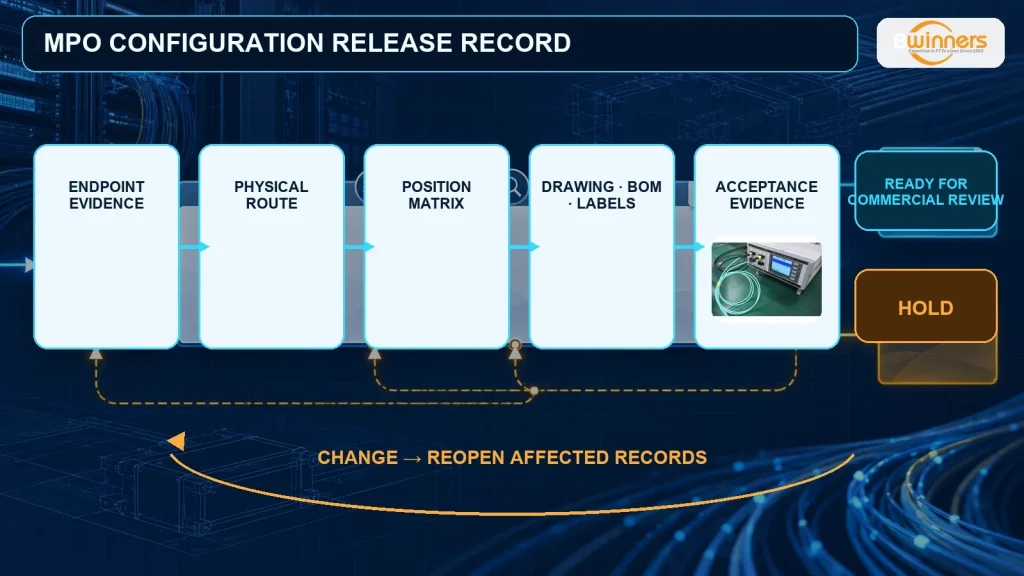
From technical review to production release
An inquiry, quotation, sample, and purchase order are different control points. The project should move forward only when the output of one stage is sufficient for the next.
| Decision stage | Buyer input | Supplier or project output | Gate before moving on |
|---|---|---|---|
| Configuration review | Both port records, link format, fiber, construction, length, route, quantity, destination, schedule, and evidence needs | Missing-field list and candidate configuration, when available | Technical conflicts are identified; no production release |
| Quotation review | One normalized technical and documentary scope | Quoted configuration, exclusions, price basis, delivery basis, and schedule basis | Competing offers describe the same scope |
| Datasheet and drawing review | Exact candidate model and project constraints | Exact datasheet where available, controlled drawing, revision, and stated exceptions | Generic family literature is not treated as exact-build approval |
| Sample review | Approved drawing and defined sample acceptance checks | Sample status and recorded deviations or approval | Sample approval is tied to a frozen revision |
| Commercial approval | Quantity, lot split, packaging, destination, delivery terms, payment terms, and requested schedule | Accepted commercial terms and order record | Technical scope and commercial scope agree |
| Production release | Approved order, drawing, sample status when required, and named approval owner | Explicit release against one controlled configuration | A quote, payment, or generic purchase order does not cure unresolved technical fields |
| Receipt and acceptance | Purchase order, approved drawing, required test records, and receiving plan | Accept, quarantine, rework, retest, concession, or reject disposition | Delivered units remain traceable to the ordered build |
Request a sample when fit, mapping, labels, packaging, or another physical feature needs verification before volume release. Request an exact datasheet and controlled drawing with the quotation when those records are required for approval. Do not present either action as a download or assured deliverable unless the exact asset and configuration are available.
What should international buyers confirm before an LC assembly quotation?
An LC interface does not change by sales region, but the installation contract, route, documentation, packaging, import process, and delivery risk can. Do not convert a regional label into a technical assumption. Record the destination country, installation environment, governing project documents, and named delivery place in the RFQ.
| Destination context | Questions to resolve before quotation | Unsafe shortcut |
|---|---|---|
| North America | Which project cabling standard and local code apply? Is a specific jacket, fire classification, label format, unit system, or third-party listing required? | Writing "North America compliant" without identifying the product, installation, code, and evidence |
| European Economic Area | Does the intended use fall within a construction-product or reaction-to-fire requirement? Which declaration, material-substance information, language, and importer record are required? | Assuming every LC patch cord needs the same CPR, RoHS, REACH, or CE document set |
| Middle East | Which country, authority, operator, EPC specification, indoor/outdoor route, temperature, dust, UV, language, and document-legalization requirement apply? | Treating the Gulf states and the wider Middle East as one standard or climate |
| Southeast Asia | Which national or customer specification applies? Will storage or routing expose the assembly to humidity, heat, water, or UV, and what packaging or delivery window protects the approved build? | Treating regional humidity as proof that a standard indoor cord is suitable outdoors |
| Latin America | Which country, importer, tax or product identifier, language, label, packing list, and delivery point are required? | Using one Spanish document set or one customs assumption for the whole region |
| Africa | Which country, operator, funder, EPC, or utility specification controls? What inland route, storage, environmental exposure, spare quantity, and receiving evidence are needed? | Treating the continent as one market or using destination risk to justify an unspecified cable construction |
International RFQ addendum
Add these fields when the assembly will cross a border or support a multi-country project:
- Destination country, consignee, importer-of-record responsibility, and final delivery point.
- The selected Incoterms rule, named place or port, and version. The ICC Incoterms 2020 rules allocate delivery tasks, costs, and risks; a three-letter rule without a named place is incomplete commercial scope.
- Sample quantity, production quantity, lot split, spare policy, requested ship window, and whether partial shipments are allowed.
- Carton, reel or tray format, moisture protection if required, maximum package size or weight, outer marks, barcodes, and packing-list fields.
- Whether raw-wood pallets, crates, dunnage, drums, or reels will be used. ISPM 15 covers regulated raw-wood packaging used in international trade; processed wood such as plywood is treated differently within its scope.
- Required document language and exact document list: quotation, commercial invoice, packing list, certificate of origin when required, datasheet, controlled drawing, declaration, sample record, and test report scope.
- The exact standard, regulation, certification, test method, report fields, and product configuration to which each document must apply. For European construction uses subject to reaction-to-fire requirements, the official EU listing identifies EN 50575 for relevant power, control, and communication cables; determine applicability from the intended use rather than from the LC connector name. Official Journal reference.
- Any project label, private-label artwork, packaging, BOM, revision, or serialization requirement. Treat OEM/ODM as a scope to verify, not an assumed BWNFiber capability.
Lead time should be split into technical clarification, drawing approval, sample approval when required, production, inspection and document preparation, export handling, main transport, import clearance, and inland delivery. A single unqualified number hides the dependency that is most likely to delay the project.
The destination table is a procurement prompt, not legal, tax, customs, certification, or code advice. The buyer, importer, project owner, and responsible authority must confirm the applicable requirements. BWNFiber capability and document availability remain subject to the exact quoted configuration and commercial confirmation.
How should you inspect and accept the delivered LC assembly?

- Reconcile the purchase order, approved drawing, labels, quantity, length definition, and packaging record.
- Check connector family, polish identification, simplex or duplex format, boot and cable construction, and end labels against the controlled drawing.
- Inspect the accessible connector end faces with the correct probe and criteria. IEC 61300-3-35:2022 covers visual inspection and classification of contamination and defects. IEC 61300-3-35:2022.
- Clean only with the approved procedure and reinspect when cleaning is required. Keep both sides of a mating interface in scope.
- Run the optical acceptance tests defined by the order or project method. The IEC standard explicitly notes that visual inspection does not replace attenuation, return-loss, or end-face parameter measurement. IEC inspection scope and limitation.
- Record pass, quarantine, rework, retest, concession, or rejection against the lot or serial identity. Do not mix failed or unverified units back into accepted stock.
Match the test method to the object being accepted
Inspection, assembly testing, and installed-cabling testing do not prove the same thing.
| Object under review | Suitable evidence role | Boundary |
|---|---|---|
| Connector end face | IEC 61300-3-35 visual inspection for contamination and defects | Visual inspection does not replace attenuation, return loss, or end-face parameter measurement |
| Finished LC assembly | The purchase specification, exact model method, wavelengths, limits, and unit or lot report | A generic web value or another model's report is not acceptance evidence |
| Installed multimode cabling | The project method, which may reference IEC 61280-4-1 for attenuation measurement | It is an installed-cabling method, not a universal factory patch-cord limit |
| Installed single-mode cabling | The project method, which may reference IEC 61280-4-2 for attenuation and optical return loss | It applies to installed cabling and does not establish every component's standalone limit |
| Event location or link diagnosis | OTDR when the approved project method requires it | An OTDR trace should not silently replace the ordered assembly or link acceptance method |
The IEC 61280-4-1 publication covers installed multimode cabling attenuation measurement. IEC 61280-4-2:2024 covers attenuation and optical return loss measurement for installed single-mode cabling. Apply the edition and method named by the project; neither title proves compliance of a BWNFiber product.
ANSI/TIA-568.3-E is the current TIA optical fiber cabling component standard announced by TIA. Reference it only when the project requires it and the applicable clauses have been reviewed; the standard's name alone does not create a product claim. TIA announcement for ANSI/TIA-568.3-E.
Common LC connector specification mistakes
- Ordering "LC-LC" without polish, fiber, pair mapping, length definition, labels, and acceptance criteria leaves the supplier to interpret the build.
- Housing or jacket color can help identify a cord, but it cannot override the port record, drawing, or jacket legend.
- Uniboot describes the cable and boot arrangement. It does not set the fiber, polish, polarity, or optical limits.
- A typical value from a web page is not a purchase limit. Bind the order to the approved model and test method.
- A sample cannot control production unless its drawing and revision are frozen. Similar-looking units may differ in mapping, dimensions, labels, or materials.
- End-face inspection and optical testing answer different questions. One cannot replace the other.
LC connector FAQ
What is an LC fiber connector?
LC is a small-form-factor fiber connector family standardized by IEC 61754-20. The interface uses a 1.25 mm ferrule, but the LC name alone does not specify polish, fiber type, simplex/duplex format, polarity, cable construction, or performance acceptance. IEC LC interface family and FOA connector reference.
Is an LC connector single-mode or multimode?
LC is used with both. Confirm the fiber category from the equipment and link specification, the controlled assembly record, and the test evidence. Do not infer it from connector or jacket color alone.
Can LC/APC connect directly to LC/UPC?
Do not approve that direct mating. APC and UPC are different end-face configurations. Match each cable end to its actual port specification, and record any intentional hybrid assembly end by end.
What is the difference between LC simplex and LC duplex?
Simplex presents one fiber termination; duplex presents a paired two-fiber arrangement. Neither term defines polish, fiber category, wavelength plan, or acceptance limits.
Is LC Uniboot a different optical interface?
No. Uniboot describes a two-fiber shared cable and boot arrangement. The interfaces are still specified separately, including connector family, polish, fiber, polarity, and port fit.
Does a push-pull tab change optical compatibility?
It changes handling and access, especially in dense panels. It does not by itself change fiber type, polish, polarity, or optical acceptance.
What insertion-loss value should I order?
Use the limit, wavelength, method, and reporting scope approved for the exact model and link. Do not convert a generic typical value into a universal purchase specification.
Is end-face inspection enough to accept an LC assembly?
No. IEC 61300-3-35 covers visual inspection and states that inspection does not replace optical performance measurement. Use both when the project acceptance plan requires them. IEC 61300-3-35:2022.
What should I send for an LC assembly review?
Send both equipment or panel port references, connector family and polish at each end, fiber category, simplex/duplex or wavelength architecture, polarity or pair mapping, cable construction, length definition, environment, quantity, labels, and acceptance/test requirements.
How do I verify LC duplex polarity?
Start with the transceiver or channel Tx/Rx requirement, then compare the port map, controlled assembly drawing, connector A/B labels, and the project's continuity or polarity test method. Do not infer polarity from the duplex clip position alone.
What is the difference between LC and SC?
LC and SC are different connector families with different physical interfaces; LC uses a 1.25 mm ferrule, while connector-family choice must follow the actual equipment and panel ports. The FOA connector reference identifies the ferrule size. Use the SC vs LC vs Mini-SC comparison for the full space, handling, and application decision.
What documents should buyers request with an LC assembly?
Request the approved quotation or datasheet for the exact configuration, a controlled drawing, sample-approval record when required, production or lot test records for the agreed scope, and receiving records that tie the delivered units to the purchase order. One document should not silently substitute for another.
Ask BWNFiber to review the configuration
Send the two port references and the fields in the RFQ table. State whether the immediate need is a configuration-gap review, a quotation, an exact datasheet and drawing, or a sample-stage discussion. BWNFiber can compare the request with an available candidate record and identify missing fields; it should not be read as confirmation that a product, document, sample, capacity, or schedule is available.
Include the fiber and link requirement, polish, mapping, construction, finished-length definition, route or fire constraint, labels, quantity, destination, requested schedule, and acceptance evidence. Exact performance, materials, test documentation, capacity, price, and delivery terms remain subject to the approved configuration and commercial confirmation.