If you need to know how to clean MPO connectors, start with a decision: does the connector need cleaning, and what evidence will show that the work is complete? Identify the interface, make the fiber safe to inspect, check the full rectangular ferrule and the individual fibers, use a compatible method only when cleaning is required, then inspect again. A passing image describes end-face condition. It does not prove insertion loss, return loss, polarity, or link acceptance.
On this page

- Quick answer
- Why MPO inspection is different
- Identify the interface
- Choose inspection and cleaning tools
- Prepare a comparable tool RFQ
- Follow the cleaning procedure
- Apply stop rules
- Record the result
- Review the FAQs
- Request a tool-set review
Quick answer: the MPO inspect-clean-reinspect workflow
Make the link safe and identify the connector, pin state, polish, and access condition. Inspect both mating sides. If either side fails the specified criteria, clean it with a documented method that fits the interface, then inspect it again. Stop if the defect persists or the ferrule appears damaged.
Use this sequence whenever an MPO plug, bulkhead connection, or equipment port is opened for installation, maintenance, or troubleshooting:
- Record the cable or port ID, fiber count, pin state, polish, and access condition. Follow the site laser-safety procedure before inspection.
- Use an MPO-compatible probe, tip, adapter, and analysis profile. Check the full rectangular ferrule, then the required zones on each fiber.
- If the interface passes the specified inspection criteria, leave it alone. If it shows removable contamination, continue.
- Match the cleaner and consumable to the connector geometry and access condition. Follow the current cleaner and connector instructions.
- Inspect the interface again. A click or wipe is an action, not proof that the contamination is gone.
- Check the mating side, then mate or protect the accepted interface. Save the before-and-after result when the job requires traceability.
Preparing a tool RFQ? Keep the interface identity, access condition, inspection rule, and required record beside the port schedule. Those fields determine whether a supplier can propose a reviewable tool set rather than a generic cleaner.
Why MPO inspection is different

MPO connector cleaning is a controlled inspect-clean-reinspect process for a rectangular multi-fiber ferrule. The technician identifies the interface, makes it safe, inspects the complete ferrule and required fiber zones, cleans only when necessary with a compatible method, reinspects both mating sides, and records the result. Visual acceptance does not prove optical link performance.
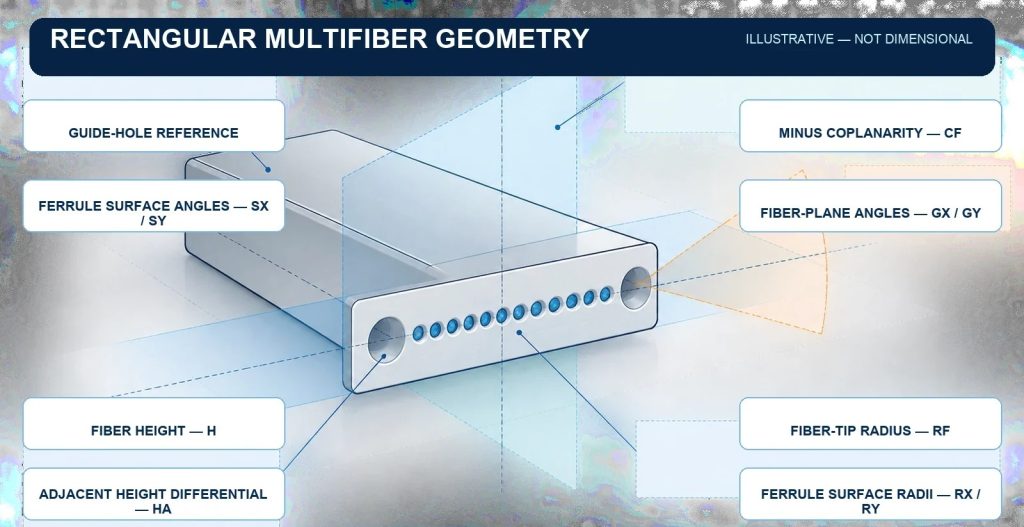
MPO is not a row of LC connectors. Its rectangular multi-fiber ferrule creates two inspection tasks:
- check the complete ferrule contact area for contamination that may transfer or migrate during mating; and
- evaluate the required zones on each individual fiber end face using the correct analysis profile.
The two views answer different questions. A narrow view can miss contamination elsewhere on the ferrule. A full-ferrule image cannot establish the condition of every fiber zone. IEC 61300-3-35:2022 added a cleanliness specification for the complete rectangular ferrule while retaining quantitative image analysis for the fiber zones. The IEC publication description confirms that scope. Use the licensed standard and the project's cited inspection rule for the acceptance criteria.
Tool access changes with the installation. The connector may be exposed, behind an adapter, or recessed in equipment. Pins and polish also affect fit. A probe tip or cleaner that reaches one configuration may not fit another.
For the single-fiber workflow, use the LC connector cleaning guide. Do not transfer its tool geometry or technique to MPO without checking the tool documentation.
Where contamination control changes across the job
The connector does not arrive with a permanent cleanliness status. Handling, storage, mating, and repatching create new decision points.
| Project stage | Field risk | Required control |
|---|---|---|
| Receiving, transport, and storage | A dust cap protects the interface but does not certify its condition. Cap removal and handling can change what is on the ferrule. | Keep the connector protected, then inspect it before the first controlled mating. |
| First installation | One side may be clean while the adapter, equipment port, test cord, or mating connector is not. | Identify and inspect every surface that will participate in the connection. |
| Repatching or maintenance | A previous pass result no longer describes an interface after it has been disconnected, capped, stored, or handled. | Treat the reopened connection as a new inspection decision. Retain the old result as history, not current acceptance. |
| Acceptance | An image without the asset ID, side, criteria, tool setup, and disposition cannot be audited. | Save the result against the exact cable or port and the cited acceptance method. |
| Fault isolation | A clean end face can coexist with loss, polarity, continuity, transceiver, or event-location faults. | If inspection passes, move to the test method that addresses the remaining symptom. |
Corning's Fiber Cleanliness in the Data Center shows contamination movement during cap cycles and after a clean MPO connector is mated to a contaminated connector. That evidence supports reinspecting after exposure. It does not establish a universal contamination rate.
Country or region does not determine the cleaner. The governing contract does. Record the exact standard edition, customer acceptance plan, site laser-safety rules, required documentation language, and report format. If a project cites IEC, TIA, ISO/IEC, or a customer specification, review the cited document rather than replacing it with a generic "industry standard" statement.
Identify the interface before choosing tools
Before opening the cleaning kit, capture the fields that control tool fit.
| Field to identify | Why it controls the method |
|---|---|
| Connector family and fiber count | The cleaner, guide cap, probe tip, adapter, and analysis profile must cover the actual ferrule and fiber layout. |
| Fiber system and inspection profile | Record the single-mode or multimode system when the specified analysis profile or downstream test plan requires it. Do not select the cleaner by OM grade or fiber category alone. |
| Pinned or unpinned | Guide pins change physical access and may require a tool or procedure designed for that geometry. |
| UPC or APC | Angled and flat interfaces can require different tips, alignment, and handling instructions. |
| Exposed plug, bulkhead, or equipment port | Each access condition needs a compatible inspection and cleaning path. |
| Cable, transceiver, panel, or test-cord side | The mating side and test setup determine which interfaces must be controlled together. |
| Project inspection rule | The analysis profile and retained evidence must match the cited procedure and edition. |
| Required record | A visual check for maintenance is not the same deliverable as an acceptance image tied to a cable ID. |
If any field is unknown, stop model selection. The fiber cleaner product routes can help identify candidates, but the final choice needs current model documentation and written compatibility confirmation.
If the interface is known but the required tool combination is not, ask BWNFiber to review the interface schedule and equipment part number against the available model documentation. The output should remain a candidate shortlist until the exact cleaner, probe tip, adapter, consumables, and representative interface have been validated.
MPO inspection and cleaning tools by task
Choose each tool by the decision it must support. Confirm the exact tip, adapter, analysis profile, and accessory set rather than relying on a broad multifunction label.
| Task | Primary tool or evidence | Compatibility inputs | Limitation |
|---|---|---|---|
| View the complete rectangular ferrule | MPO-capable video inspection probe and full-ferrule view | Ferrule format, access, pin state, polish, field of view | An overview does not replace individual-fiber analysis. |
| Grade individual fiber end faces | Probe, correct MPO tip, and approved analysis profile | Fiber type, project rule, software/profile revision | A pass/fail image does not prove optical loss or polarity. |
| Remove routine removable contamination | Purpose-designed MPO dry cleaner or approved cleaning surface | Plug or bulkhead access, pins, polish, fiber count, instructions | One actuation is not proof of cleanliness; reinspect. |
| Address residue not removed by the dry method | Approved wet-to-dry system or another method allowed by the controlled procedure | Connector and cleaning-product instructions, site rules | Do not improvise a solvent or apply fluid directly to an optic. |
| Preserve acceptance evidence | Saved before/after images and a controlled work record | Asset ID, end, operator, date, tool, attempt, result | A photo without identity and criteria is not an auditable acceptance record. |
| Measure link performance | The method specified by the project, such as an optical loss test set (OLTS) for end-to-end loss | Fiber, wavelength, reference method, limits, instruments | This belongs to optical testing, not cleaning. |
MPO one-click cleaner vs cassette cleaner
| Cleaner format | Best-fit access | Selection advantage | Check before approval |
|---|---|---|---|
| Purpose-designed MPO one-click cleaner | Compatible exposed plugs or recessed adapter/equipment ports | Guided, repeatable access when the exact model matches the interface | Supported MPO format, pin state, polish, plug/bulkhead access, actuation limit, and current instructions |
| Approved cassette cleaning system | Accessible unmated ferrules that can be presented to the cleaning surface | A controlled fresh cleaning surface and visible cloth advance | Whether the procedure covers the rectangular ferrule, pins, permitted stroke/pressure, and cassette condition |
The choice is driven by access and documented compatibility. The word "MPO" on a product-family label is not enough. Corning's Cleaning Basics guide shows separate one-click, cassette, and wet-to-dry procedures. For another product, follow that product's current instructions.
What to confirm before buying an MPO cleaning and inspection kit
A quote that says only "MPO cleaner" is not ready for technical comparison. Ask each supplier to complete the same fields.
Procurement summary for buyers
Before buying an MPO cleaning and inspection kit, send every supplier the same interface schedule: connector format, fiber count, pin state, polish, exposed or recessed access, inspection rule, report format, quantity, destination, and required date. Require exact model and option codes, included tips and adapters, compatible consumables, current instructions, a compatibility statement, software or licence conditions, replenishment details, and a representative validation route. Treat brochures and an unqualified "supports MPO" claim as incomplete evidence. Keep unavailable or unverified items marked TBC until engineering and procurement close the exceptions.
| Procurement field | What the supplier should identify | Why it matters |
|---|---|---|
| Supported interfaces | Connector format, fiber count, pinned or unpinned, UPC or APC, exposed plug, bulkhead, and equipment-port access | Confirms that the cleaner and probe can reach the actual interface. |
| Inspection configuration | Probe or camera model, tip, adapter, field of view, analysis profile, and report-export option | Defines what can be inspected and what evidence can be retained. |
| Cleaning configuration | Cleaner model, guide cap or adapter, cassette or one-click method, and permitted wet-to-dry consumables | Prevents a family-level claim from being mistaken for exact compatibility. |
| Use environment | Exposed or recessed access, port depth, workspace clearance, site contamination controls, storage, and safety restrictions | Confirms that the method can be used at the actual location, not only on a bench. |
| Consumables | Included quantity, replacement part numbers, rated uses where documented, storage conditions, and shelf life where applicable | Supports cost comparison and replenishment planning. |
| Documentation | Current instructions, compatibility statement, datasheet, safety information, and report sample | Gives engineering and quality teams reviewable evidence. |
| Validation plan | Representative plug, adapter, or equipment port; sample or demonstration method; inspection criteria; before-and-after record | Defines how the selected kit will be accepted before wider deployment. |
| Support and maintenance | Inspection-system verification or calibration route, software or licence requirements, updates, and repair path where applicable | Exposes operating requirements that the tool price alone does not show. |
| Commercial details | Pack quantity, quotation validity, lead time, destination, warranty terms, and substitutions | Allows like-for-like quote comparison. Mark any missing field TBC. |
Treat the supplier response as technically complete only when it names the exact model and option code, maps that configuration to the representative interfaces, provides current instructions and compatibility evidence, identifies every required tip, adapter, consumable, licence, and report function, and labels exceptions or substitutions. A product-family brochure or an unqualified "supports MPO" statement is not enough for approval.
Use the fiber test equipment and tools guide to build a shortlist. Then compare the exact option codes, included accessories, evidence package, replenishment route, and commercial assumptions. The product name alone is not enough.
From problem recognition to an approved purchase
| Procurement stage | Decision to make | Required output or evidence |
|---|---|---|
| 1. Recognize the problem | Is the task routine contamination control, acceptance, or troubleshooting after a link failure? | Named asset, symptom, work stage, safety state, and reason for action |
| 2. Understand the tool types | Does the job need inspection, dry cleaning, controlled wet-to-dry cleaning, saved reports, or separate optical testing? | Task-to-tool list without treating one device as proof of every result |
| 3. Define the application | Is the interface an exposed plug, bulkhead, equipment port, test cord, installation point, maintenance point, or acceptance point? | Access and lifecycle map for every surface that will be controlled |
| 4. Confirm technical inputs | Which MPO format, fiber count, pin state, polish, port depth, field of view, analysis profile, and project rule apply? | Completed interface schedule and acceptance-document reference |
| 5. Compare suppliers | Which exact models cover the same interfaces, accessories, reporting needs, and exceptions? | Like-for-like comparison using the procurement matrix above |
| 6. Evaluate price and delivery | What is included, what must be replenished, and what software, licence, verification, repair, lead-time, destination, or substitution conditions apply? | Total acquisition assumptions, not cleaner unit price alone |
| 7. Request documents or representative validation | Are the current datasheet, instructions, compatibility statement, safety information, report sample, and sample or demonstration route available? | Controlled documents plus a representative validation plan; availability marked TBC where unconfirmed |
| 8. Verify quality and records | Can the proposed setup produce the before-and-after evidence and final disposition required by the project? | Representative result, tool setup, inspection criteria, reviewer, and exception record |
| 9. Submit the inquiry | Has the buyer supplied the interface, access, quantity, destination, required date, and evidence format? | Qualified RFQ that a supplier can answer without guessing |
| 10. Release the order or project discussion | Are exact part numbers, included items, open deviations, commercial assumptions, and acceptance responsibilities closed? | Approved quotation or documented technical follow-up; unresolved fields stay on hold |
BWNFiber applies an interface-first review rule on this page: identify the interface before naming the product, and request evidence before approving the order. This is a review method, not a promise that every configuration, sample, document, or delivery date is available.
International procurement and localization controls
Use the region as a planning prompt, not as a technical selection rule. The actual site, contract, equipment, governing documents, importer requirements, and delivery route control the decision.
| Market or project context | Confirm before supplier approval | Do not assume |
|---|---|---|
| North America | Customer procedure and cited standard edition, site safety rules, required electronic report format, destination, replenishment route, and required date | That one customer or data-center specification applies across every operator or jurisdiction |
| Europe | Contract language, required document language, buyer-specified conformity evidence, safety information, chemical or consumable transport conditions, packaging, and importer responsibilities | That a general conformity statement proves every model, accessory, or consumable meets the buyer's exact requirement |
| Middle East | Actual dust controls, operating and storage temperatures, recessed-port access, site logistics, spare-consumable plan, document language, and destination | That the region alone determines a cleaner, storage method, or delivery time |
| Southeast Asia | Actual humidity and condensation controls where relevant, storage conditions, import route, local-language documents, consumable replenishment, and destination | That every site has the same indoor environment or import process |
| Latin America | Customer acceptance format, document language, customs and destination details, local replenishment path, site conditions, and required date | That one lead-time or documentation package covers every country |
| Africa | Actual dust and temperature exposure where relevant, remote-site logistics, spare and consumable availability, importer documents, destination, and required date | That all sites have the same climate, access, infrastructure, or procurement process |
For every international RFQ, ask for the exact model and option code, included accessories, controlled instructions, compatibility statement, safety information, report sample, unit and master-pack details, shipment destination, quotation validity, lead time, and substitution policy. Request lot or batch traceability where the buyer's quality plan requires it. If OEM or private-label packaging is requested, define artwork control, label language, instruction ownership, traceability, and approval samples; supplier capability and availability remain TBC until confirmed in writing. For bulk orders, close the replenishment plan, spare-consumable quantities, phased-delivery assumptions, and acceptance responsibilities before release.
If inspection shows that an MPO assembly must be replaced or a new cable schedule is required, move the configuration decision to the MPO cabling owner. Cleaner selection should not be expanded into an unsupported custom-cable claim.
Step-by-step MPO cleaning procedure
1. Make the link safe and establish identity
Follow the site laser-safety procedure before inspection. Optical energy may be outside the visible range, so never look into a fiber or use a direct-view microscope on a potentially active interface. A video probe keeps the eye out of the optical path, but isolation, power verification, and the equipment maker's instructions still apply. The FOA inspection safety guidance explains the risk of direct-view microscopes.
Record the cable or port ID, near or far end, connector format, fiber count, pin state, polish, and whether the interface is exposed or behind an adapter. If the connector identity is uncertain, do not force a tip or cleaner onto it.
2. Inspect both sides before mating
Inspect the plug and the mating interface. Include any test cord, instrument adapter, or panel side that will touch the connection. Cleaning one side and mating it to an uncontrolled side can transfer contamination back to the cleaned ferrule.
A dust cap or sealed bag is not inspection evidence. New connectors can acquire contamination during manufacturing, packing, transport, or cap removal. Some documented pre-cleaned connection systems use a different first-install method. In that case, follow the system instructions.
3. Decide whether cleaning is required
If the interface passes the specified inspection criteria, follow the job procedure and continue. Do not add a cleaning step merely because the kit is open. If inspection finds removable contamination, select a documented method for that condition.
Record the decision as pass, clean and reinspect, or escalate. The word cleaned records an action but not the result.
4. Clean with the compatible method
For removable contamination, use a cleaner documented for the actual MPO geometry and access condition. Follow its guide-cap, adapter, stroke, pressure, and use-limit instructions. An LC pen does not cover the rectangular MPO ferrule, and a cleaner described broadly as "MPO" may not fit every pin, polish, fiber count, plug, bulkhead, or equipment port.
For persistent residue, use wet-to-dry cleaning only when the connector, cleaning product, and site method permit it. Follow the named fluid and sequence. A concentration listed in one supplier's method is not a universal MPO rule. Corning's current Cleaning Basics guide is one documented example.
5. Reinspect and control the disposition
Inspect the full ferrule and the required fiber zones again. Save the result when the job requires it. If the interface still fails, change one variable at a time, such as a fresh cleaning surface, another documented method, or a verified tip. Record each attempt.
Stop cleaning when the same feature remains, the ferrule or guide-pin area appears damaged, access is unsafe, results are not repeatable, or the job's attempt limit is reached. Engineering or quality should then classify the issue as contamination, damage, a setup problem, or a replacement case.
6. Mate promptly or protect the accepted interface
When both sides pass, mate them promptly. If they must remain unmated, protect them using the specified cap and storage method. Record the final disposition as mated, protected, quarantined, or replaced.
Stop rules and failure triage
| Observation | Likely decision class | Next controlled action |
|---|---|---|
| Loose contamination disappears and the reinspection passes | Removable contamination | Mate or protect; save the final result if required. |
| Film or residue remains after the approved dry method | Persistent residue | Use only an approved alternate or wet-to-dry procedure, then reinspect. |
| The same feature remains in the same location after controlled attempts | Possible embedded defect or physical damage | Stop repetitive cleaning; escalate under the project procedure. |
| The ferrule, guide-pin area, or fiber face appears chipped, scratched, or mechanically damaged | Damage | Quarantine the interface and request technical disposition. |
| The image passes but the link still fails | Not proven to be a cleaning problem | Move to the specified loss, polarity, continuity, transceiver, or event-diagnostics workflow. |
| Results vary with the tip, adapter, or operator | Setup or repeatability issue | Verify the tip, profile, calibration/status, adapter cleanliness, and controlled method. |
If the link still fails after cleaning, move to the evidence that answers the next question. Repeating the same cleaning action cannot diagnose the cable, transceiver, polarity, or loss budget.
Common MPO cleaning mistakes and their controls
| Mistake | Why it creates risk | Control |
|---|---|---|
| Selecting a cleaner because the label says only "MPO" | The tool may not fit the fiber count, pin state, polish, plug, bulkhead, or equipment-port depth. | Approve the exact model and option code against the interface list. |
| Inspecting only the fiber row or only the wider ferrule | Either view can miss a condition visible in the other. | Capture the complete rectangular ferrule and the required zones on every fiber. |
| Cleaning one side of a mated pair | The uncontrolled side can transfer contamination back to the accepted surface. | Inspect both mating sides and any test-cord or instrument interface that will touch them. |
| Treating a click or wipe as a pass | It records an action, not the resulting end-face condition. | Reinspect and record the disposition. |
| Adding an improvised solvent, air source, stick, or wipe | The material or technique may leave residue, damage the surface, or conflict with the equipment procedure. | Use only the documented method and named consumables for the actual configuration. |
| Repeating the same action on a fixed feature | A scratch, pit, embedded particle, damaged pin area, or setup problem will not be diagnosed by more identical cleaning cycles. | Apply the project attempt limit, change one controlled variable, and escalate persistent features. |
| Recording only "cleaned" | The record cannot show which side was treated, which criteria were used, or whether the final condition passed. | Tie before-and-after evidence to the asset, side, tool setup, attempt, result, operator, and date. |
| Using a clean image as the link-acceptance result | End-face condition does not establish loss, return loss, polarity, continuity, or event location. | Complete the separate optical and polarity evidence required by the project. |
Go/no-go gate before mating
Proceed only when the interface identity is known, the correct inspection configuration was used, both mating sides meet the cited inspection rule, no unresolved damage or persistent feature remains, and the required evidence is attached to the correct asset. If any condition is missing, do not convert uncertainty into a pass. Protect the interface or quarantine it, then resolve the missing identity, compatibility, inspection, or disposition evidence.
What cleaning proves and what it does not
| Evidence | What it can establish | What it cannot establish by itself |
|---|---|---|
| Full-ferrule and individual-fiber inspection | Observed end-face condition against the selected inspection procedure | Insertion loss, return loss, continuity, polarity, or event location |
| Before/after cleaning record | The controlled action and resulting inspected condition | That the installed link meets its optical budget |
| Insertion-loss result | End-to-end loss under the stated reference method and conditions | Where a failing event is located |
| Polarity or continuity result | Fiber-position mapping or gross continuity under the method used | End-face cleanliness or calibrated loss |
| OTDR trace | Event and distance information under the selected settings and launch/receive arrangement | A substitute for every project's end-to-end loss method |
IEC 61300-3-35:2022 states that visual inspection does not replace attenuation, return-loss, or other optical performance measurements. A clean image is not a link-acceptance certificate. For loss, polarity, continuity, or event location, use the fiber optic testing workflow and the project's acceptance method. See the official IEC publication scope.
MPO cleaning record template
The record should let another reviewer identify the exact interface, reproduce the method, and understand the disposition.
| Record field | Entry |
|---|---|
| Project / site / rack | |
| Cable, port, or assembly ID | |
| Near end / far end | |
| Connector family and fiber count | |
| Pinned / unpinned; UPC / APC | |
| Exposed plug / bulkhead / equipment port | |
| Inspection system, tip, adapter, and profile | |
| Governing procedure and revision | |
| Initial result and image reference | |
| Cleaning tool, consumable, and method | |
| Attempt number | |
| Final result and image reference | |
| Final disposition | Mated / protected / quarantined / replaced |
| Operator, reviewer, date, and exception |
For a new assembly or replacement decision, connect this record to the correct MPO cabling configuration and its separate product and optical evidence.
Frequently asked questions
How do you clean an MPO connector?
First identify and make the interface safe, then inspect the full ferrule and each required fiber with an MPO-compatible probe setup. Clean only with a method approved for the exact plug, bulkhead, or port, and reinspect before mating. Record attempts and escalate persistent defects instead of cleaning indefinitely.
Should you inspect an MPO connector before cleaning?
Yes, unless a controlled product or site procedure explicitly specifies another first-install process. Inspection shows whether cleaning is needed and creates a before condition. Cleaning a passing interface can add contamination rather than remove it.
Can an LC cleaner be used on MPO?
No, unless the cleaner documentation explicitly covers the required MPO configuration. LC and MPO use different ferrule geometries and access arrangements. Check the MPO format, pin state, polish, plug or bulkhead access, and fiber count.
Do new MPO connectors need inspection?
A cap or sealed bag is not proof of cleanliness. Inspect new interfaces under the project method unless the connector system documents a different first-install process.
Should both sides of an MPO connection be inspected?
Control both mating interfaces and any test-cord or instrument surface that will touch them. Otherwise an uncontrolled side can contaminate the side that was just accepted.
Does a clean MPO end face prove that the link will pass?
No. Inspection addresses visible end-face condition. The link may still require separate insertion-loss, return-loss, polarity, continuity, or OTDR evidence under the project method.
When should an MPO connector be replaced instead of cleaned again?
Stop when a feature persists, damage is visible, access is unsafe, results vary, or the attempt limit is reached. Engineering or quality should decide whether the connector needs replacement. One failed image is not enough to make that decision.
What is the difference between an MPO one-click cleaner and a cassette cleaner?
A purpose-designed one-click cleaner uses a guided mechanism for a supported plug or recessed port. A cassette presents a cleaning surface to an accessible unmated ferrule. Check the exact interface, pin state, polish, access, instructions, and cleaning-surface condition before selecting either format.
How do you clean a pinned MPO connector?
Use a method and cleaner whose current documentation explicitly covers the pinned MPO geometry. Inspect around the guide-pin area as well as the required ferrule and fiber zones. Do not force a generic tip or cleaning surface around the pins.
How do you clean an MPO connector inside a bulkhead or equipment port?
Use a compatible inspection probe tip and a cleaning tool approved for recessed access. Confirm that both tools reach the actual adapter or port without contacting unsupported surfaces, then inspect, clean if required, and reinspect before mating.
Can canned air be used to clean an MPO connector?
Only if the connector, equipment, and site instructions explicitly permit it. Air or aerosol cleaning is not part of the verified workflow in this guide, so do not add it as an improvised step.
What should an MPO cleaning record contain?
Record the asset and end, connector format, pin state, polish, access condition, inspection system and profile, governing procedure, initial image/result, cleaner and method, attempt number, final image/result, disposition, operator, reviewer, and date.
Request an MPO tool-set review
Send a compatibility request, not a generic "MPO cleaning kit" inquiry. Include the connector or equipment part number, fiber count, pin state, polish, exposed/bulkhead/port access, inspection method, required image or report format, quantity, destination, and required date.
Use the project tool-set review form to request an exact model and accessory shortlist, the current datasheet and instructions, a compatibility statement, consumable and licence requirements, a representative validation route, and quotation assumptions. A reviewable response should separate confirmed items, TBC items, exceptions, and substitutions instead of hiding them in a generic kit description.
Ask BWNFiber for the quote only after the interface schedule is complete. Product availability, sample or demonstration availability, lead time, document availability, and final compatibility remain subject to written order-level confirmation.