Across BWNFiber’s FTTH projects in Africa, Asia, the Middle East, and Latin America, one thing repeats: the FTTH drop cable itself is almost always the same small, bend-insensitive single-mode fiber. What changes from project to project is the installation method. Aerial, underground, wall-mounted, and indoor routing each demand a different cable construction and a different closure.
This guide covers FTTH drop cable from a procurement-engineering angle: the model codes and specification values you paste into a purchase order, and the aerial-versus-underground decision that determines which construction you should actually order.
Short Answer
FTTH drop cable is the last-mile fiber cable between the distribution point and the customer premises. For most projects:

- Aerial route → figure-8 self-supporting drop cable, GJYXCH (all-steel) or GJYXFCH (FRP fiber unit on a steel messenger), 1–4 fibers, G.657.A2
- Underground route → standard drop or distribution cable inside HDPE duct; armored construction only for direct burial; microduct + blown cable for fast urban builds
- Indoor routing → flat drop cable GJXH (steel strength member) or GJXFH (FRP), LSZH jacket
Always buy by model code plus a specification table, never by code alone.
Not sure which construction fits your route? Send us the installation method and span lengths — we will recommend a model code and quote.
What You Will Learn
- Where drop cable sits in the ODN and what job it has to do
- Drop cable model codes and constructions: GJYXCH, GJYXFCH, GJXH, GJXFH, ASU
- The specification values that belong in a purchase order
- Aerial vs underground: how to choose the route method for your project
- Installation rules that keep aerial and buried drops alive for 20 years
- How closures and splice sleeves fit the drop segment
What Is FTTH Drop Cable?
FTTH drop cable is the final segment of the optical distribution network (ODN). The feeder cable runs from the central office to a cabinet or splitter node; the distribution cable runs to a distribution point near a group of homes; the drop cable makes the final run into the building. Most construction disputes are about who owns which segment — the drop is the final, shortest segment, and knowing that boundary saves arguments later.
For the full ODN chain — OLT, splitter placement, loss budget — see our FTTH fiber cable guide.
Drop cable has one job: deliver a working single-mode fiber to the customer wall plate with minimal loss and zero fuss for the next 20 years. That drives every design choice:
- Small and lightweight — it hangs on building facades and clips along walls
- Bend-insensitive (G.657.A2) — it survives staple-gun corners and tight interior routing
- Easy to terminate and splice — field crews work on ladders and in cabinets, not in a lab
- UV and moisture resistant — at least the outdoor sections
Construction-wise, drop cable is tight-buffered: every fiber sits in its own 900 µm buffer, so it terminates with the same connectors and tooling as patch cord — the reason a crew can finish a wall plate on a ladder without a splice van.
Common fiber counts are 1, 2, or 4 fibers, with 12-fiber versions for multi-dwelling units. Most residential drops use 1 or 2 fibers.
Drop Cable Model Codes and Constructions
International buyers specify drop cable by model code. Chinese-manufacturer datasheets follow the YD/T 908 designation system, and the code tells the factory the construction without a long written description. If you are writing an RFQ, this table is the fastest way to get the construction you intend:
| Model Code | Construction | Strength Member | Typical Use |
|---|---|---|---|
| GJYXCH | Figure-8, self-supporting | Galvanized steel messenger | Aerial drops on poles and facades |
| GJYXFCH | Figure-8, self-supporting | Steel messenger + FRP fiber unit | Aerial drops needing better crush and corrosion behavior |
| GJXH | Flat indoor drop | Steel wire | Indoor wall routing, in-home runs |
| GJXFH | Flat indoor drop, dielectric | FRP only | Indoor routing where metal is unwanted |
On the letters: G identifies a communications optical cable, J the indoor/access cable series, and X the butterfly (flat drop) structure most access drop cables share. Beyond that, manufacturers apply the tail letters with some variation — F marks a non-metallic FRP strength member, C a self-supporting construction. Do not rely on the letters alone: bind the model code to the full construction column in your purchase order, and confirm against the datasheet before signing.
Three regional variants are worth knowing at RFQ time: North American projects often specify toneable drop cable with an integrated tracer wire for locating buried plant later; Brazilian deployments commonly require ANATEL type approval; EU projects add CPR Euroclass ratings (Cca or better) to the jacket specification.
Flat Drop Cable (GJXH)
Flat drop cable has a low profile — typically around 2.0 × 5.0 mm — and is easy to staple or clip along walls and baseboards. It suits indoor runs and indoor-to-outdoor transitions. The flat shape is discreet but mechanically weaker than round cable, so protect it from crush and impact.
Round Drop Cable
Round drop cable handles pulling tension and crush loads better than flat cable. Use it for conduit pulls and messenger-supported outdoor spans where mechanical load matters more than a low profile.
Figure-8 Self-Supporting Drop Cable (GJYXCH)
Figure-8 cable bonds the fiber unit to a steel messenger wire — a galvanized strand around 1.0 mm in the standard construction. The messenger carries the tension so the fiber itself is not stressed, which is why a 300 N-rated drop cable can survive a pole span that would snap an unsupported cable.
ASU Mini Self-Supporting Cable
ASU (all-dielectric self-supporting) is a compact central loose-tube cable for short aerial spans. With no metal at all it is lighter and safer to install near power lines. Municipal rules in parts of Latin America and Southeast Asia restrict metal strand on shared poles — exactly where ASU has become the default FTTH drop.
FTTH Drop Cable Specifications
This is the table to paste into a purchase specification. Values are typical for quality G.657.A2 drop cable built to YD/T 1997.1-2014 and IEC 60794-1 — always confirm against the manufacturer’s datasheet before signing a contract.
| Parameter | Typical Value |
|---|---|
| Fiber type | G.657.A2 single-mode, ITU-T G.657 |
| Fiber count | 1, 2, or 4 (up to 12 available) |
| Flat cable dimensions | ~2.0 × 5.0–5.3 mm |
| Attenuation | ≤ 0.4 dB/km @ 1310 nm; ≤ 0.3 dB/km @ 1550 nm |
| Tensile strength | 300 N long-term / 600 N short-term |
| Crush resistance | ~1,000 N/100 mm long-term / ~2,200 N/100 mm short-term |
| Minimum bend radius | 7.5 mm (G.657.A2, long-term) |
| Operating temperature | −40 °C to +70 °C |
| Jacket | LSZH (indoor/outdoor) or PE (outdoor) |
| Standard drum length | 1 km or 2 km |
Two specification traps to avoid:
- Attenuation wording. “≤ 0.4 dB/km at 1310 nm” is a maximum, not a typical value. If your link budget assumes 0.35, you are gambling on fiber you have not measured. Specify maximum values and require per-drum test reports.
- Tensile figures. The 300 N long-term rating assumes the messenger or strength member carries the load. If a crew pulls on the fiber unit directly, one hard tug can exceed the rating.
Want this specification matched to your route? Send us your fiber count, span lengths, and installation method — we will return a matched cable, closure, and sleeve set with a quote. Ask for the full datasheet set if you want per-construction values first.
Bend Radius: G.657.A1 vs A2
Almost every drop cable sold today claims G.657 compliance, but A1 and A2 are not interchangeable. The minimum bend radius decides whether your in-home routing works or whether you buy a rework visit:
| Fiber Grade | Min. Bend Radius (Long-Term) | Where It Fits |
|---|---|---|
| G.657.A1 | 10 mm | Gentle indoor routing, protected pathways |
| G.657.A2 | 7.5 mm | Tight indoor corners, stapling, outdoor drops |
| G.657.B3 | 5 mm | Extreme tight spots and short runs; not guaranteed G.652.D-compatible — keep it out of splice plant |
| G.652.D (reference) | 30 mm | Distribution and feeder plant — never route it like drop cable |
One caveat: 7.5 mm is the fiber’s rating. The finished cable’s datasheet value governs installation — for flat drop constructions it is often 30 mm. Bend-insensitive fiber is not bend-proof cable.
G.657.A2 is fully compatible with G.652.D — they share the same mode-field diameter specification — so it splices into standard distribution fiber anywhere in the ODN at normal splice loss. Verify the first drum at the splicer, as with any mixed-lot work. For any drop that leaves the building wall or gets stapled around a corner, specify A2. A1 costs slightly less and is acceptable only where you control the pathway and know it stays gentle.
Aerial vs Underground: Which Route Method for Your Project?
The method decision comes before the cable decision. Aerial is faster and cheaper to build; underground is safer from weather and vandalism and lasts longer. The right answer depends on terrain, permitting, and who maintains the network:
| Your Situation | Recommended Method | Cable to Order | Why |
|---|---|---|---|
| Dense urban streets, heavy traffic | Microduct + blown cable | Microduct-compatible drop or distribution cable | A crew passes a street in a day; add drops later with no new civil work |
| Urban or peri-urban, normal soil, road crossings | Duct (HDPE conduit) + pulled cable | Standard drop or distribution cable in duct | Protected, replaceable, standard for municipal FTTH |
| Rural long routes, farm or railway crossings | Direct burial (armored) or aerial | Armored cable, or figure-8 aerial construction | Fewer civil works, lowest cost per km on long routes |
| Shared power-line corridors | Aerial, dielectric | ADSS or ASU | No metal near power lines, no induction risk |
| Old city centers, heritage or permit limits | Existing poles or facade attachment | Figure-8 GJYXCH/GJYXFCH | No excavation permits needed |
| High vandalism or vehicle-strike risk | Underground | Armored or ducted cable | Aerial plant dies to cuts and storms; buried plant survives |
Rule of thumb from our project experience: aerial last-mile civil work often costs less than half of open-cut burial, but carries higher maintenance over a 20-year life. Microtrenching closes most of that gap in cities. Published FTTH cost comparisons typically put an underground drop at two to four times the cost of an aerial one, with trenching alone at $15–30 per meter in many markets and underground builds running two to three times longer. Treat these as screening numbers — your route-survey quotes decide.
How to Plan an FTTH Drop Installation: 5 Steps
Whatever the route method, the planning sequence is the same on our projects:
- Survey the route. Measure spans, note poles or duct paths, and photograph the building entry point. The survey decides the method — not the other way around.
- Pick the method per scenario. Use the decision table above. Mixed routes are normal: aerial to the facade, duct under the road crossing, flat cable inside.
- Select the cable by model code. Match the method to the construction — GJYXCH/GJYXFCH for aerial spans, GJXH/GJXFH indoors, duct or armored construction underground — and lock the specification table into the PO.
- Size the closures and sleeves. Count splices per closure, match sleeve length to tray capacity, and specify the IP rating for anything buried or exposed.
- Test and record. OTDR-test every drop at 1310/1550 nm, keep per-drum test reports, and file the records before handover. A VFL finds the bad bend in seconds during troubleshooting; the OTDR record proves the drop at handover. Our testing and loss budget guide covers the limits in detail.
Working through these steps on a live project? Send what you have — even a partial route survey — and we will fill in the cable, closure, and sleeve set.
Aerial Installation Method
Aerial cable hangs on poles or building facades. Three constructions cover almost every drop scenario:
| Cable Type | Support | Best For |
|---|---|---|
| Figure-8 (GJYXCH/GJYXFCH) | Integrated messenger | Standard pole-to-building drops |
| ADSS | Dielectric strength member | Long spans, power-line corridors |
| ASU | Compact dielectric | Short dielectric drops near power lines |
Field rules that keep aerial drops alive:
- Match the messenger to the environment. Steel for ordinary spans; FRP or ASU where power-line induction, corrosion, or municipal rules rule out metal.
- Respect span ratings. A standard GJYXCH drop handles typical pole-to-eave spans; check the manufacturer’s sag table before stretching one across a road and never exceed the rated span.
- Specify a UV-resistant jacket. PE or UV-stabilized LSZH for anything that sees sun.
- Anchor the messenger at both ends. The strand takes the tension at the pole and the building bracket — never let tension transfer into the fiber unit at the closure.
- Add strain relief at the wall entry. Wind moves the drop; a drop wire suspension clamp or facade bracket keeps the last meter from sawing against the building or the wall plate.
For long spans, span-rating math, and power-line corridor work, see our armored, ADSS, and OPGW cable guide. Aerial basics and pole hardware are covered in our overview of aerial fiber optic cable.

Underground Installation Method
Underground cable installs three ways, and the method changes what cable you order:
- Duct cable is pulled through buried HDPE conduit. The conduit protects a standard drop or distribution cable and makes future replacement easy — the default for municipal FTTH. Size the duct at least 1.5× the cable diameter and leave a pull rope in place.
- Direct-burial cable goes straight into the soil. Standard drop cable is not rated for it: order an armored construction explicitly rated for direct burial, because buried plant faces rodents, sharp fill, and ground movement. Burial depth depends on soil type and road crossings — see our guide on how deep to bury fiber optic cable.
- Microduct cable is blown into small tubes with compressed air. Microtrenching with microducts is the fastest urban deployment method available — crews can complete a street in a single day — and you can blow in extra drops later with almost no new civil work. This is the core of Quick ODN-style rapid deployment for FTTH builds.
Indoor vs Outdoor Cable at the Building Entry
| Factor | Indoor Cable | Outdoor Cable |
|---|---|---|
| Jacket | PVC, LSZH, plenum | PE, armored |
| Water blocking | Minimal | Gel or dry core |
| UV resistance | No | Yes |
| Fire rating | Required | Less critical |
| Mechanical strength | Lower | Higher |
Use indoor cable only inside buildings; use outdoor cable for any exposure to weather, moisture, or sunlight. The grey zone is the building entry: many projects run LSZH-jacketed drop cable the whole way because LSZH passes indoor fire codes while surviving a short outdoor exposure. Check your local code first — some authorities require a defined transition point where the outdoor-rated jacket ends. When in doubt, specify the transition and a proper entry gland; it costs little and passes inspection the first time. Leave a drip loop below the entry point: water follows the jacket downhill, and the loop sends it outside instead of into the wall box.
Closures and Splice Sleeves in the Drop Segment
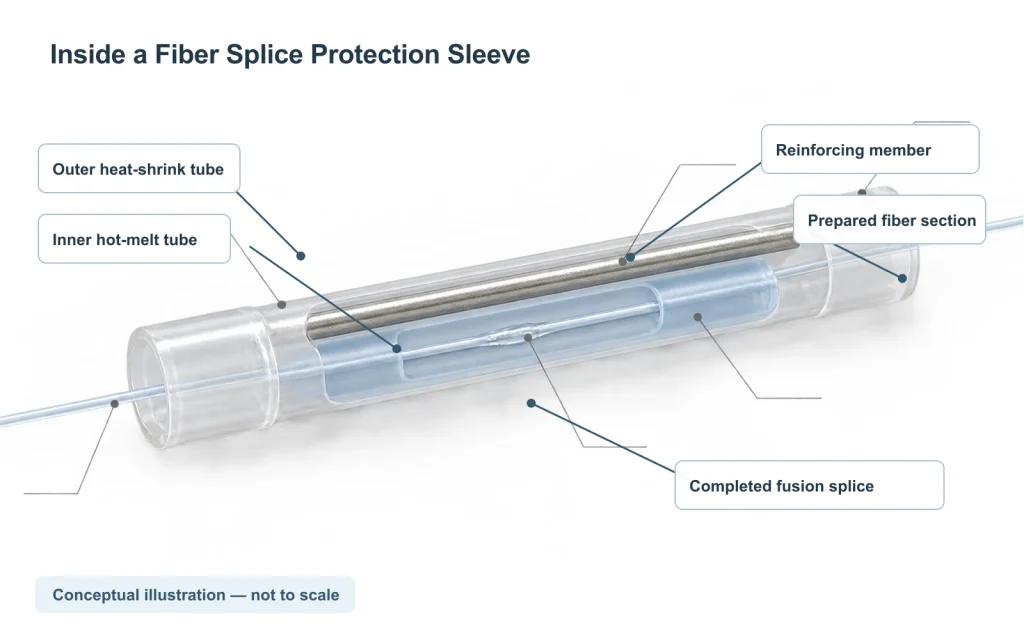
Every fusion splice in an FTTH network needs a splice protection sleeve, and every group of splices lives in a closure or tray. In the drop segment this means two situations:
- The distribution point closure. A dome or inline closure where the distribution cable meets 4–24 drop cables. Splice trays hold the sleeved splices, and splitter modules often live in the same closure — specify tray count and splitter slots together.
- The customer wall plate or ONT. Many modern drops terminate with pre-connectorized cable or a fast connector, but hard-spliced drops still need a sleeve inside the wall box. Match sleeve length to the tray: compact drop trays take 25–30 mm sleeves, standard trays take 40 mm. Our sleeve size guide covers the selection, and the sleeve buying guide covers materials and compliance.
The most common failure mode in drop networks is not the sleeve — it is the closure seal. Water tracks along the drop jacket into an unsealed gland and sits in the tray. For buried or exposed closures, specify an IP-rated fiber optic splice closure and verify the seal with a 100 kPa, 15-minute air-pressure immersion test after closing. Sleeve installation technique is covered in our installation guide, and failure diagnosis in the troubleshooting FAQ.
Common FTTH Drop Installation Mistakes
- Using indoor drop cable outdoors. It degrades in UV and moisture. Use PE-jacketed or UV-stabilized outdoor construction for any exposed run.
- Tight bends around corners. Even G.657.A2 fiber has a 7.5 mm minimum bend radius — staples, nails, and cable ties can all violate it.
- No strain relief. Secure drops so wind or pull does not stress the splice or the connector at the wall plate.
- Wrong closure size. A closure designed for 12 fibers will not fit a 96-fiber distribution point — count fibers and cable entry ports before ordering.
- Specifying A1 fiber to save money on a tough route. The savings disappear the first time a staple corner causes a macrobend.
- Ignoring drum length planning. Match 1 km or 2 km drums to your route survey plus 5–10% spare — a drop cut 3 meters short is a full re-pull.
How to Compare Drop Cable Suppliers
Price per meter is the last thing to compare, not the first. Six checks, in order:
- Same code, same table. Force every quote onto your model code plus the specification table. A quote for “2-core drop cable” alone cannot be compared with anything.
- Test data with the quote, not after delivery. A manufacturer pulls drum-level reports from production; a reseller promises them later.
- The failure answer. Ask what happens when a drum fails your incoming inspection — retest, replace, or argument. The answer tells you who actually made the cable.
- Samples before volume. A supplier confident in quality cuts samples without a lecture. Bend them, staple them, splice them.
- Customization flexibility. OEM printing, jacket colors, non-standard drum lengths — useful now, decisive on the next project.
- Engineering response quality. Send one technical question before ordering. Data within a day beats a sales deck within an hour.
Ask us for per-drum test data with your quote — we supply it as standard, and so should anyone on your shortlist.
Common Procurement Mistakes
- Comparing quotes with different attenuation wording. One bid at “typical 0.35 dB/km” and another at “max 0.4” are not two prices for one product. Normalize the specification table before comparing anything.
- Ordering on price per meter with no test-report terms in the PO. The cheapest meter is the one that fails at 1550 nm in month two.
- Accepting “G.657” without the letter. A1 and A2 differ by 2.5 mm of bend radius — that is the difference between a clean install and a macrobend callback.
- Skipping samples to save a week. A cut sample costs days; a wrong container costs a quarter.
- Saving a few percent by dropping from 2-core to 1-core. You are removing the cheapest repair path the network will ever have.
Frequently Asked Questions
What is FTTH drop cable?
The last-mile fiber cable between the distribution point and the customer’s building — the final segment of the optical distribution network. It typically carries 1–4 G.657.A2 single-mode fibers in a flat, round, or figure-8 self-supporting construction.
Which fiber type should FTTH drop cable use?
G.657.A2 single-mode fiber. It survives the tight bends of in-wall and facade routing that standard G.652.D cannot, and it splices into distribution fiber anywhere in the ODN. Multimode (OM3/OM4/OM5) has no place in a drop — PON optics are single-mode end to end.
What do model codes like GJYXCH and GJXH mean?
They describe construction: GJYXCH is a figure-8 self-supporting aerial drop with a steel messenger and steel strength wires; GJYXFCH keeps the steel messenger but swaps the fiber unit to FRP; GJXH is a flat indoor drop. The code sets the construction; the specification table sets the quality floor — you need both on the PO.
Flat, round, or figure-8 — which drop cable do I need?
Flat (GJXH) for indoor wall routing; round for conduit pulls and stronger mechanical loads; figure-8 (GJYXCH) for aerial spans where a messenger carries the tension; ASU for short dielectric aerial runs near power lines.
What is the difference between G.657.A1 and G.657.A2?
Bend radius and price. A1 handles 10 mm bends long-term; A2 handles 7.5 mm. A2 is the right choice for stapled wall runs, tight corners, and any outdoor drop. A1 is acceptable only on gentle, protected indoor pathways.
Aerial or underground: which is better for FTTH drops?
Aerial is cheaper and faster to build; underground lasts longer and fails less often. Use aerial where poles or facades exist and permits allow; use ducted or microduct underground in dense urban areas; use direct burial in rural routes where armored plant fits. A route survey comparing civil-work quotes for both methods is the only reliable answer for your project.
What aerial span can a figure-8 drop cable cover?
Typical pole-to-building spans of 30–80 m are routine for standard GJYXCH. Longer spans need a larger messenger diameter or a rated ADSS/ASU cable. Always check the manufacturer’s sag and span table before ordering.
Can I bury standard drop cable directly?
No. Standard drop cable is not direct-burial rated. Use HDPE conduit, specify an armored direct-burial construction, or use microduct with a suitable blown cable.
Duct, direct burial, or microduct — which underground method?
Duct pulls cable through buried conduit — flexible and replaceable. Direct burial puts armored cable straight in the soil — cheapest but hardest to change. Microduct blows cable into small tubes — fastest in cities and easiest to expand later.
What is the minimum bend radius for drop cable?
7.5 mm long-term for G.657.A2 — about the diameter of a pencil. G.657.A1 allows 10 mm. Standard G.652.D needs 30 mm and should never be routed like drop cable.
What closure should I use for drop splices?
One matched to fiber count, cable entry diameters, and environment. Dome closures are common for FTTH distribution; wall-mount boxes serve customer premises. For buried or exposed closures, specify an IP-rated unit and verify the seal with a 100 kPa, 15-minute immersion test.
What drum lengths does drop cable come in?
Standard drums are 1 km and 2 km. Plan pulls to use whole drums efficiently, and order 5–10% spare for rework and training.
Can one cable serve indoor and outdoor runs?
Often yes — an LSZH-jacketed drop cable rated for limited outdoor exposure can run the whole way. Check local code: some authorities require a defined transition point where the outdoor-rated jacket ends.
How much does FTTH drop cable cost per meter?
There is no meaningful list price for B2B orders — cost moves with fiber count, construction, jacket, and volume. As a budgeting reference only, commodity 1–2 core G.657.A2 drop cable from Chinese manufacturers typically trades in the sub-USD-1-per-meter range at project volumes, with figure-8 aerial constructions priced above flat indoor types. Treat any online per-meter price as indicative; send your route survey and quantity for a firm project quote.
Should I order 1-core or 2-core drop cable?
Two cores, unless the budget is extremely tight. The second fiber is a low-cost spare: if the working fiber fails at a staple bend or a bad splice, the crew swaps to the spare in minutes instead of re-pulling the drop. For MDU risers and business drops, consider 4–12 fibers.
Pre-connectorized or field-spliced drop cable?
Pre-connectorized drops install faster and need no fusion splicer on site — the right choice for fast-turnaround projects and Quick ODN builds. Field-spliced drops cost less per meter and avoid exposed connector heads in harsh entries. If your crews do not have splicers, order pre-connectorized; if they do, splice. Budget the difference: a field-installed fast connector typically adds ~0.3 dB of insertion loss, where a good fusion splice stays under 0.05 dB — and specify APC polish at the ONT either way; the angled endface is what keeps return loss above 60 dB on a PON.
How long does FTTH drop cable last?
A properly installed drop — correct bend radius, strain relief, UV-rated jacket outdoors, sealed closures — is a 20–25-year asset. The failure points are almost always installation details, not the fiber itself.
What drop cable should I use for multi-dwelling units (MDUs)?
Run a 4–12 fiber drop or small distribution cable to a building terminal, then 1–2 core flat drops from the terminal to each unit. The riser uses the same model-code logic: more fibers, still G.657.A2, LSZH jacket inside the building.
What is the difference between GJYXCH and GJYXFCH?
One letter changes the fiber unit, not the messenger. GJYXFCH swaps the steel strength wires around the fibers for FRP rods, which improves crush behavior and corrosion resistance — but the messenger stays steel. If your route must be fully dielectric (power-line induction rules, zero-metal poles), specify an FRP-messenger construction or ASU explicitly on the PO; the F in GJYXFCH alone does not get you there.
What MOQ and lead time should I plan for drop cable?
Plan on a 1 km MOQ floor for commodity 1–2 core constructions; custom colors, printing, or special constructions often raise it to 2–5 km. Lead time runs from about two weeks for stock constructions to 4–6 weeks for volume orders in peak season. Confirm both on your RFQ — they move with factory load.
What documents should I require with the shipment?
Three: per-drum attenuation test reports (1310/1550 nm), the datasheet with your exact model code referenced, and — for LSZH jackets — the compound’s flame-retardant certification. Cables that arrive without drum-level test data have not been proven, whatever the datasheet says. On arrival, check drum flanges for transport damage before signing the delivery note — the signature is where damage claims die.
What warranty should I expect on drop cable?
Ask for written warranty terms — typically one to three years against manufacturing defects — plus the failure-handling process behind them. Design life (20+ years) and warranty are different things: one is engineering, the other is a contract. Get both in writing before the volume order.
Can I order private-label drop cable for distribution?
Yes. OEM/ODM is standard practice in Chinese cable manufacturing: your brand on the jacket print, your packaging, your drum markings. Expect a higher MOQ than stock constructions and extra lead time for custom printing — plan one production cycle ahead.
Standards Behind This Guide
Drop cable construction and testing trace to YD/T 1997.1-2014 (the Chinese access-network drop cable standard most Asian manufacturers build to), IEC 60794-1 (optical fiber cable generic requirements and test methods), and ITU-T G.657 (bend-insensitive single-mode fiber). Jacket flame-retardant claims are tested to IEC 60332, and indoor fire-rating classes follow TIA-568 and ISO/IEC 11801, with IEC 60794-6 covering indoor-outdoor constructions specifically — the set your local authority or project specifier most often references. Citing the model code, the specification values, and these standards is enough to get apples-to-apples quotes from any serious manufacturer.
Authoritative references for the values in this guide:
- ITU-T G.657 recommendation — bend-insensitive fiber classes and bend-radius test conditions
- Broadband Forum — FTTH ODN engineering and deployment guidance
- Fiber Broadband Association — deployment methods and adoption data for aerial, burial, and microtrenching
- The Fiber Optic Association — independent field installation and testing references
Related Reading
- FTTH Fiber Cable Guide: From OLT to ONU — where the drop sits in the full ODN chain
- Armored, ADSS & OPGW Fiber Optic Cable Guide — long spans and power-line corridors
- Fiber Optic Cable Types: Complete Selection Guide (2026) — SM/MM, OS/OM grades, jacket ratings
- Fiber Optic Cable Testing, Installation & Loss Budget Guide — testing the installed drop
- Fiber Optic Splice Sleeve Size Guide — sleeve length vs tray capacity
- FTTH Drop Cable ITP Template and Closeout Records — acceptance records and inspection templates for drop cable deliveries

Need FTTH Drop Cable for Your Project?
BWNFiber manufactures FTTH drop cables — GJYXCH, GJYXFCH, GJXH, and custom constructions — plus splice closures, trays, and splice protection sleeves for last-mile networks. OEM/ODM runs are routine: custom jackets, printing, and drum lengths on request.
To quote accurately, send:
- Installation method per route (aerial / duct / direct burial / microduct / indoor)
- Span lengths or route survey
- Fiber count and fiber type (G.657.A2 default)
- Model code or construction from the table above
- Drum length preference (1 km / 2 km) and quantity
Still comparing suppliers? Ask for sample lengths first — bend them, staple them, splice them, then decide. BWNFiber supplies cut samples for exactly this, and specification datasheets are free.
Related BWNFiber products: FTTH drop cables · fiber optic splice closures · fiber optic splice sleeves · splicing tools and test equipment
📧 [email protected]
📞 +86-13615744790 (WhatsApp)
🌐 Visit our website
This guide is for internal reference and project planning. Data as of 2026-09-01.
BWNFiber · Business Intelligence Excellence