A patch cord that appears unused is not automatically available for removal. Fiber patch cord decommissioning starts with a decision from the service owner, tied to the exact assembly and its endpoints. Optical darkness, a disconnected end or an old label can prompt investigation; none establishes permission to recover the cable or release its ports.
The practical goal is to retire one identified connection while preserving every connection that remains. Separate the service retirement, physical removal, port release and recovered-item disposition. Each can finish at a different time. A cleanup ticket should make those differences visible before a technician enters a shared patching field.
Establish what has actually been retired
Start with the service or asset record and the responsible owner. Confirm whether the requested work retires a service, removes one patch segment, or clears an entire route. A canceled application may leave other equipment, standby paths or shared cabling in use. The removal boundary must name the physical items covered by the authorization.
The FOA fiber network design reference connects documentation with maintenance and restoration. It specifically warns that removing abandoned cables can damage premises cabling. That supports a deliberate removal plan. It does not supply a universal definition of an abandoned cable or establish the legal removal requirements for a particular building.
Distinguish an owner’s decision from an observation:
| Available information | What it establishes | What it does not establish |
|---|---|---|
| Service owner confirms retirement | The named service has a retirement decision | Every nearby cord is included |
| A power check finds no signal under the approved method | A measurement at the stated interface and time | Ownership, future reservation or removal authority |
| One connector is already unplugged | The observed end is disconnected | The other end and route are correctly identified |
| An old record marks the circuit unused | A historical recorded state | The current physical state or final disposition |
| Both endpoint identities and the removal scope are reconciled | A defined candidate for authorized work | That the route can be extracted without affecting neighbors |
A reserved spare path also needs an owner decision. If the records retain a future use, migration dependency or rollback reservation, include that status in the review. An expired project date is a reason to ask the owner, not permission to erase the reservation.
Do not unplug an uncertain circuit to find out who complains. Escalate an identity conflict to the network owner. The separate maintenance intervention guide explains why working connections should not be opened without a justified, controlled task.
Define a boundary around the assembly and its neighbors
Write the exact A-end and Z-end identifiers, assembly identifier where available, route segments and permitted actions into the work instruction. Identify intermediate managers or shared supports that the cord passes through. If the route cannot be followed confidently, record that gap before starting extraction.
The retained circuits matter as much as the target. A retired cord may share a hook-and-loop support, cross behind live connectors or disappear into a bundle. Moving that bundle can load an unrelated connector even when the target is correctly identified. Plan access and temporary support using the approved site method rather than treating extraction as a simple pull from one end.
A useful removal boundary states which connectors may be released, which supports may be opened and which components must remain untouched. It also states where the technician must stop: an unexpected branch, an unreadable label, resistance during extraction, a displaced neighboring cord or an unplanned service indication.
These are proposed operating controls, not a claim that every site uses the same form. The responsible owner decides the authorized work window, staffing, service monitoring and escalation method. This article does not authorize a live-network change or replace the enclosure and connector manufacturers’ instructions.
Prepare a removal record that survives a shift change
Keep the retirement authorization attached to the physical work record. A note saying “remove old yellow cords” is too broad: color does not uniquely identify a circuit, and a patching field can contain active and reserved cords with the same appearance.
Before work, assemble a small record containing:
- The service retirement or change reference and approving owner.
- The assembly, both endpoints and the route covered by removal.
- A marked photograph or drawing distinguishing target and retained connections.
- The approved extraction method, work window and stop conditions.
- The expected final state of each affected port and support.
- The destination and release status of recovered material.
Use photos to support identity, not to substitute for an unreadable identifier. A photograph taken from the front may not show a crossing behind the panel. Where the physical path remains uncertain, assign reconciliation rather than drawing a confident line through an unseen route.
For a multi-cord retirement, use an itemized list and record completion against each assembly. Do not approve an entire rack as “cleared” because the first few cords matched the schedule. The final count should expose a cord left in place, an unexpected item found or a removal deliberately stopped.
Remove under the approved method and reconcile the final state
During authorized work, preserve the ability to identify the cord as it leaves the patching field. Follow the actual connector release instructions and support the remaining cabling. Do not pull on the cable jacket to defeat a connector latch, cut an unidentified bundle or use force when the route resists extraction.
Optical safety remains relevant even when the service is believed retired. The FOA fiber safety guidance warns against viewing fiber ends and calls for power verification. Never look into a fiber end. Use the site’s isolation and optical-power verification procedure and suitable equipment before any activity requiring access to an optical interface. A label saying “unused” is not a safe-state verification.
After removal, compare the result with the planned boundary. Confirm the intended assembly was recovered, retained supports are restored, unrelated cords have not been displaced and the affected ports have the owner-specified identification and protection. Apply any required service and optical checks through the approved plan; visual tidiness is not proof of service preservation.
Keep “cord removed” separate from “port available.” A port may remain reserved, belong to another organization or await an asset-record change. The owner releases capacity after reconciling the actual final state. Updating the port map before the physical work is complete can create conflicting instructions for the next technician.
Decide whether recovered material belongs in stock
Recovery establishes possession, not readiness for reuse. Identify the removed assembly and retain its condition history until the responsible process assigns reuse, further evaluation, return, recycling or disposal. Do not mix uncertain recovered cords with ready spares simply because they look intact.
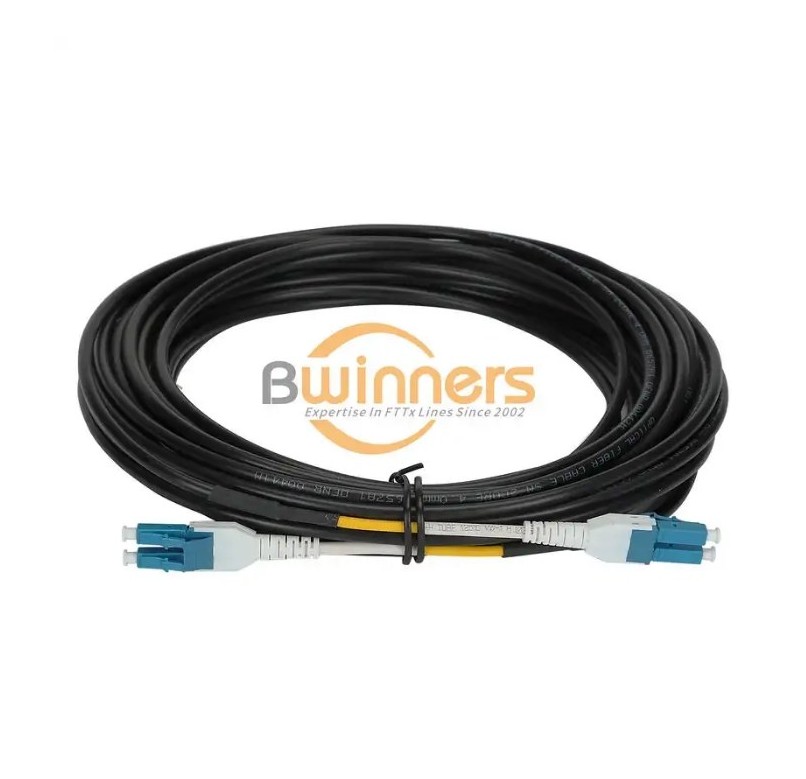
If a replacement or spare purchase is needed, the LC/UPC single-mode duplex uniboot patch cable is a concrete family to review for a matching documented connection. It is not evidence that a recovered cord is equivalent or suitable for a new assignment.

Confirm fiber specification, connector polish, duplex mapping, finished length, diameter, jacket and required documents for the actual order. A family page does not settle every option for a pictured or recovered item. The replacement part-number reconciliation guide addresses that purchasing comparison separately.
Close the retirement without erasing its history
Consider a hypothetical canceled circuit whose cord crosses a retained bundle. The service owner has approved retirement, but the technician cannot identify one route segment without moving neighboring cables. The useful outcome is a recorded partial completion and an assigned access plan, not a forced extraction or an unqualified “done.” No customer incident is claimed here.
Close the record when the actual work, remaining exceptions, port status and recovered-item destination agree. Preserve the former endpoint relationship as history while making the current state unambiguous. Another shift should be able to tell what was retired, what remains and which capacity is truly available.
For a new documented assembly requirement, send the approved endpoint configuration, routed length, quantity and required product records to [email protected] or +86-13615744790. We use those inputs to frame a defined product inquiry; retirement and removal approval remain with the network owner.
Sources and scope: FOA design guidance and the official product page were reviewed for this evergreen workflow on November 2, 2026. The boundary checklist and status distinctions are editorial recommendations. Building-code obligations, removal methods and item-specific reuse acceptance require the applicable project authority and documents.


