Technical notice: The interface and reach examples below are sourcing references, not guarantees for a selected product or installed channel. The exact module datasheets, peer compatibility record and approved project loss budget control the final specification.
Definition: "Fiber optic vs Ethernet cable" compares an optical transmission medium with a family of network standards. Ethernet links can use twisted-pair copper, optical fiber, twinax or other defined media. The useful question is not "fiber or Ethernet?" It is which medium and interface a specific Ethernet link should use.
For a short edge link that must power a camera or access point, copper may be the right answer. For a building backbone, an electrically isolated campus link or a high-speed switch interconnect, fiber is often the better fit. At 100G, 400G and 800G, the line rate still does not tell you which cable to order. You must identify the optical PHY and the exact module interface at both ends.
Quick answer: When should a network use fiber instead of copper Ethernet?

Use twisted-pair copper for short Ethernet edge links when the complete channel supports the application and the endpoint needs Power over Ethernet. Use fiber for longer routes, building backbones, electrical isolation or supported optical switch interfaces. At 100G and above, select the cable from the exact PHY and module connector at both ends, not from the line rate alone. If either endpoint module is unknown, the cable is not ready for release.
If you already know the two endpoints, start a link record now: write down both module part numbers, the route length, the environment and whether the endpoint needs power. The tables below turn those four inputs into an RFQ that a supplier can answer without guessing.
Procurement summary
For procurement, select the medium one link at a time. Confirm the endpoint equipment and module part number at both ends, the named Ethernet PHY, route length, environment, power requirement and existing pathway. If the design uses fiber, then specify fiber category, connector, polish, lane map, cable construction and acceptance evidence. Compare suppliers only against the same controlled revision, quantity, packing and delivery assumptions. Stop the RFQ when an endpoint, breakout map, route condition or acceptance limit is unresolved. The lowest cable price is not comparable when the quoted technical scope differs.
Five release rules
- Select the medium for a Link ID, not for an entire network by slogan.
- Record both endpoint modules before selecting a passive fiber assembly.
- Treat speed, module form factor and connector as different fields.
- Match fiber category and cable construction to the exact route and acceptance plan.
- Release a quotation or order only when drawing, BOM, Link Release Record and deviations agree.
Ethernet can run over copper or fiber
In everyday purchasing language, "Ethernet cable" usually means Cat5e, Cat6 or Cat6A twisted-pair cable terminated with an 8P8C modular connector commonly called RJ45. That shorthand is convenient but incomplete. IEEE 802.3 includes electrical and optical physical layers.
The protocol name does not select the cable:
| Term | What it tells you | What it does not tell you |
|---|---|---|
| Ethernet | The network standards family | Copper or fiber, connector, reach or lane count |
| 10G / 100G / 400G / 800G | Nominal line rate | The exact PHY or optical interface |
| SFP / QSFP / QSFP-DD / OSFP | Module form factor or host interface family | The front-panel optical connector used by every module in that form factor |
| SR / DR / FR / LR | A reach/medium class within a named PHY | A complete cable assembly specification without the full PHY and module datasheet |
| LC / MPO-12 / MPO-16 | A connector family | Fiber grade, polish, gender, keying, polarity, loss budget or compatibility |
Record the endpoint module and PHY first. Specify the passive cable after those fields are confirmed.
Choose the medium for each link, not the whole network

An enterprise or campus design can use both media. Copper can serve powered edge devices while fiber carries backbone and switch-to-switch traffic. Make the choice for each link rather than declaring one medium for the whole network.
Use copper for compatible short, powered edge links
Twisted-pair copper is often the practical choice when an access point, camera, phone or other endpoint needs both data and PoE, and the complete installed channel stays within the selected Ethernet application and cabling rules. Confirm the power class, bundle conditions, pathway and full channel length before release.
Use fiber for backbone, distance, isolation or optical interfaces
Use fiber when a link crosses buildings, exceeds the selected copper channel, needs electrical isolation, aggregates access traffic or terminates in optical modules. The route still controls the cable construction. An indoor patch cord, an aerial ADSS cable and an armored underground cable are not interchangeable merely because each contains optical fiber.
| Link condition | Copper twisted pair is usually favored when | Optical fiber is usually favored when | Confirm before release |
|---|---|---|---|
| Endpoint power | The device must receive PoE and the power/data channel is within the applicable cabling limit. | The endpoint has separate power or electrical isolation matters more than PoE. | PSE/PD class, cable category, bundle temperature and channel length |
| Distance | The full channel fits the selected copper application and installation rules. | The path exceeds the copper channel limit or crosses a campus/building boundary. | Actual route length, patching allowance and local code |
| Electrical environment | EMI and ground-potential differences are controlled. | Motors, high-voltage equipment, lightning exposure or building-to-building isolation makes a dielectric path desirable. | Surge/grounding design and whether the cable construction contains metallic armor or strength members |
| Bandwidth roadmap | The access edge will remain within the planned copper application. | The link is a switch backbone, data-center interconnect or high-density optical channel. | Named current and future PHYs, not a generic "future-proof" label |
| Operations | Field copper termination and PoE troubleshooting are available. | Pre-terminated optical assemblies, fiber cleaning, inspection and test processes are available. | Installer capability, spares and acceptance records |
A Wi-Fi access point may need copper for power, while its switch uplink may need fiber for distance or electrical isolation. Compare the installed system cost, not cable price per meter. Include optics, panels, termination, testing, spares, power equipment and future moves or changes.
Compare total installed cost with the same scope
A copper quote and a fiber quote are not comparable when one includes only cable and the other includes optics, termination and testing. Use the same cost boundary for both options.
| Cost field | Copper option | Fiber option | Question that prevents a false comparison |
|---|---|---|---|
| Active interfaces | Switch ports, PoE budget and any intermediate switches | Optical ports or pluggable modules at both ends | Are both endpoint interfaces included and supported? |
| Passive path | Cable, jacks, patch panels and patch cords | Cable, connectors, cassettes or panels, splices and patch cords | Does the quote cover the complete installed channel? |
| Installation | Pulling, termination, pathway and certification | Pulling, pre-termination or splicing, cleaning and inspection | Which field skills and tools are included? |
| Protection and power | Shielding, bonding, surge protection and PoE thermal controls as applicable | Local endpoint power and route-specific cable protection | Has the electrical and environmental design been priced? |
| Acceptance and operations | Copper certification records, labels and spares | Polarity, insertion-loss and any specified OTDR records, labels, cleaning tools and spares | Will both options produce equivalent handover evidence? |
| Change over the service life | Moves, added switches, power and category migration | Optics changes, connector/lane migration and fiber-capacity use | Which components must change for the named future PHY? |
Do not assign a generic payback period. Labor rates, pathway reuse, equipment already owned, outage cost and the migration plan are project inputs, not universal constants.
For a short switch interconnect, decide whether the BOM calls for separate pluggable optics and a passive fiber assembly, an active optical cable (AOC), or a direct attach copper cable (DAC). These options use different components and replacement practices. Do not ask a supplier to choose among them from the line rate alone.
Representative fiber interfaces from 1G to 800G
Use the table to shortlist an interface, not to place an order. Standards define several PHYs at the same speed, and vendors may offer other supported implementations. Verify the exact part number, PHY, connector, fiber type and reach at both ends.
| Rate | Representative optical PHY | Typical passive interface | Fiber / stated reach | Procurement note |
|---|---|---|---|---|
| 1G | 1000BASE-SX | Duplex LC on many pluggable modules | Multimode; reach depends on installed grade and channel | Check the existing MMF grade and modal bandwidth. |
| 1G | 1000BASE-LX | Duplex LC on many pluggable modules | Single-mode; kilometer-class | Confirm wavelength and any legacy MMF use conditions. |
| 10G | 10GBASE-SR | Duplex LC | OM3 up to 300 m; OM4 up to 400 m | Measure the full channel, not only the permanent link. Corning reference |
| 10G | 10GBASE-LR | Duplex LC | OS2; 10 km class | Confirm optical budget and patch/splice losses. Cisco reference |
| 25G | 25GBASE-SR / LR | Commonly duplex LC | MMF short reach / SMF 10 km class | The exact module datasheet controls reach. Cisco reference |
| 40G | 40GBASE-SR4 | MPO-12 with eight active fibers | OM3/OM4 short reach | Confirm MPO gender, keying and end-to-end polarity. |
| 40G | 40GBASE-LR4 | Duplex LC | OS2; 10 km class | WDM over a duplex fiber pair; not an MPO SR4 cable. Cisco reference |
| 100G | 100GBASE-SR4 | MPO-12 with eight active fibers | OM3/OM4 short reach | Do not apply the connector to every 100G optic. |
| 100G | 100GBASE-DR | Duplex LC in the cited Cisco implementation | OS2; 500 m | 100GBASE-DR is not the same interface as 400GBASE-DR4. Cisco reference |
| 100G | 100GBASE-LR4 | Duplex LC | OS2; 10 km class | Confirm peer module and channel loss. Cisco reference |
| 400G | 400GBASE-SR8 | MPO-16 APC in the cited Cisco implementation | OM4; up to 100 m | Eight transmit/receive lanes require a 16-fiber path. Cisco reference |
| 400G | 400GBASE-DR4 | MPO-12 APC in the cited Cisco implementation | OS2; up to 500 m | Four parallel SMF pairs; breakout intent affects the lane map. Cisco reference |
| 400G | 400GBASE-FR4 | Duplex LC UPC in the cited Cisco implementation | OS2; up to 2 km | WDM reduces the passive path to a duplex pair. Cisco reference |
| 800G | 800GBASE-SR8 | Commonly MPO-16 on cited implementations | MMF; up to 100 m class | Verify the module connector and the supported fiber grade. IEEE reference |
| 800G | 800GBASE-DR8 | MPO-16/APC on cited vendor implementations | OS2; up to 500 m class | Other 800G interface arrangements exist; do not order from "800G" alone. Juniper reference |
For detailed fiber-grade tradeoffs, use the single-mode vs multimode selection guide. For 400G, continue to the 400G optical interface guide. For DR8 topology, use the 800G DR8 connector guide.
After choosing fiber, match the cable construction to the route
Fiber grade and cable construction answer different questions. ITU-T G.652.D is a general single-mode transmission fiber, while ITU-T G.657.A1 and G.657.A2 add stronger bending-loss control for access and space-constrained routing. The current G.657 recommendation also states compatibility relationships among G.657 and G.652.D categories in access networks. None of those fiber names specifies the sheath, strength members, water blocking, armor or installation method of the finished cable. Use the current ITU-T G.652 and ITU-T G.657 recommendations for the fiber attributes, then approve the cable construction separately.
OM3, OM4 and OM5 are multimode fiber categories for premises and data-center cabling. OM5 is wideband multimode fiber specified to support multiple wavelengths, but "newer" does not make it the default choice. Select OM3, OM4 or OM5 from the supported PHY, reach, installed plant and migration plan. TIA identifies OM5 through the TIA-492AAAE specification; the module application still controls the usable channel.
| Route or application | Fiber and construction to consider | Evidence required before purchase |
|---|---|---|
| Data center or premises backbone | OS2 or a supported OM3, OM4 or OM5 channel; tight-buffered, distribution or other premises construction as the pathway requires | PHY and module datasheets, channel length, connector/lane plan, pathway, local fire classification and acceptance limits |
| FTTH feeder and drop | G.652.D may be used in feeder or distribution designs; bend-insensitive G.657.A1 or G.657.A2 is often considered where drop and indoor routing introduce tighter bends | OLT/ONT optical budget, splitter plan, bend route, cable datasheet, strength members, termination method and local indoor/outdoor requirements |
| ISP, metro or duct route | Loose-tube outdoor cable is a common starting point, with the fiber category set by the transmission design | Duct ID and occupancy, pulling route, cable diameter, tensile and crush limits, bend limits, water protection, drum length and closure plan |
| Aerial self-supporting route | ADSS only when the surveyed route and loading case support an all-dielectric self-supporting design | Every span, sag, wind, ice, temperature, attachment position, clearances, cable weight, MAT/RTS, fittings and route-owner approval. IEC 60794-4-20 and IEEE 1222-2019 with its active corrigendum provide standards context. |
| Direct burial or high mechanical risk | A cable may need armor, water blocking, rodent protection or another route-specific construction | Exact direct-burial declaration, trench or conduit design, soil and water conditions, tensile/crush/bend limits, armor termination and metallic-component grounding plan. "Armored" alone does not mean approved for direct burial. See the armored and direct-burial route guide. |
| FTTA or industrial link | Outdoor-rated or industrial construction matched to the equipment interface and route | Connector sealing, UV/chemical exposure, vibration, bend and tensile limits, grounding/isolation design, installation access and replacement method |
IEC 60794-3:2022 covers outdoor cable requirements across duct, direct-buried and aerial applications, but it does not approve a model for a specific route. Fire classification, utility attachment rules, burial design, grounding and acceptance documents also vary by jurisdiction and route owner. Name the required code and edition in the project specification. Do not treat "LSZH," "flame retardant," "UV resistant," "water blocked" and "rodent protected" as interchangeable claims:
- LSZH describes smoke and halogen behavior under specified test conditions; it does not by itself establish the required local fire classification.
- PE is widely used in outdoor cable jackets, but a PE label alone does not prove UV exposure, water penetration, flame or building-entry compliance.
- Metallic armor can improve mechanical protection, but it introduces bonding, grounding and termination questions. Nonmetallic rodent-resistant designs use different evidence.
- Loose-tube and tight-buffered constructions describe how fibers are protected and handled. They do not, by themselves, approve aerial, duct, burial or indoor use.
Parameters that must stay tied to the exact cable
| Parameter | What to specify | Common procurement error |
|---|---|---|
| Attenuation | Maximum cabled attenuation at named wavelengths and conditions | Copying a generic fiber value into a finished-cable specification |
| Insertion loss | End-to-end channel or assembly limit, reference method and test wavelength | Treating fiber attenuation per kilometer as the complete channel loss |
| Return loss / optical return loss | Interface- or project-specific reflection requirement and method | Requesting one universal value for every connector and PHY |
| Bend radius | Installation and long-term values for the exact cable state and loading | Applying a bare-fiber minimum bend radius to the finished cable |
| Tensile strength | Installation and long-term load limits with the referenced test method | Using ADSS span or pulling tension as a category-wide number |
| Crush resistance | Load, duration, test method and acceptance criterion | Comparing numbers that use different methods or units |
| Fiber count | Working fibers, protection, breakout needs and approved spare capacity | Ordering the largest count without checking tube plan, closures or ports |
| Jacket and protection | Material, fire/smoke classification, UV, water, chemicals, armor and rodent requirements as separate fields | Treating one label such as LSZH or armored as proof of all environmental properties |
Field risks that should change the cable schedule
The following are engineering review scenarios, not BWNFiber project case studies:
- One long aerial span can govern the ADSS cable and hardware even when every other span is shorter. Use the complete pole and loading schedule, not an average span.
- A duct route can fail at a bend, occupied section or cable-entry seal even when the straight-line distance is acceptable. Record duct dimensions, bends, pull access, cable diameter and pulling limits.
- An outdoor cable that enters a building may need a defined transition point or an approved indoor/outdoor construction. Resolve the local fire requirement before fixing the drum length.
- Reel access, drum length, minimum installation temperature, pulling direction, bend control, storage and lifting method affect transport and installation. Put them in the delivery plan instead of leaving them to site improvisation.
- Acceptance results need the same Link ID, wavelength, reference method and limit as the approved schedule. An OTDR trace cannot replace a required insertion-loss result, and a pass/fail label without the method is not a usable handover record.
Three worked decisions without a universal default
These examples show the decision record, not a product recommendation.
| Scenario | Weak shortcut | Better decision path | Release evidence |
|---|---|---|---|
| Ceiling access point within the supported horizontal channel | "Fiber is faster, so use fiber." | Keep copper when the access point needs PoE and the complete channel, bundle and pathway support the selected application. Evaluate fiber only with a defined local-power design. | PSE and PD data, channel length, cable category, bundle condition, pathway and certification plan |
| Link between two buildings | "Order OS2 patch cord." | Confirm the route, electrical isolation goal, endpoints and optics first; then select an outdoor construction and building-entry treatment that match the surveyed pathway and local rules. | Endpoint modules, route survey, loss budget, construction drawing, metallic-element decision, entry transition and acceptance plan |
| 400G switch-to-switch link | "Any 400G QSFP cable will work." | Identify the exact PHY and both module part numbers. A cited SR8, DR4 or FR4 implementation can require a different medium, connector and fiber count. | Two module datasheets, connector/polish, lane map, channel length, loss allowance and controlled assembly drawing |
Why the module name must come before the cable

Speed is not a connector specification
At 100G, an SR4 link may use an eight-active-fiber MPO path, while a DR or LR implementation may use duplex LC. At 400G, SR8, DR4 and FR4 differ in medium, fiber count, connector and reach. An RFQ that says only "100G QSFP28 cable" or "400G OSFP fiber" leaves the optical interface unresolved.
A complete endpoint record includes:
- equipment manufacturer and model;
- slot/port identifier;
- module manufacturer and exact part number;
- supported PHY name;
- optical connector at the module;
- fiber medium and grade;
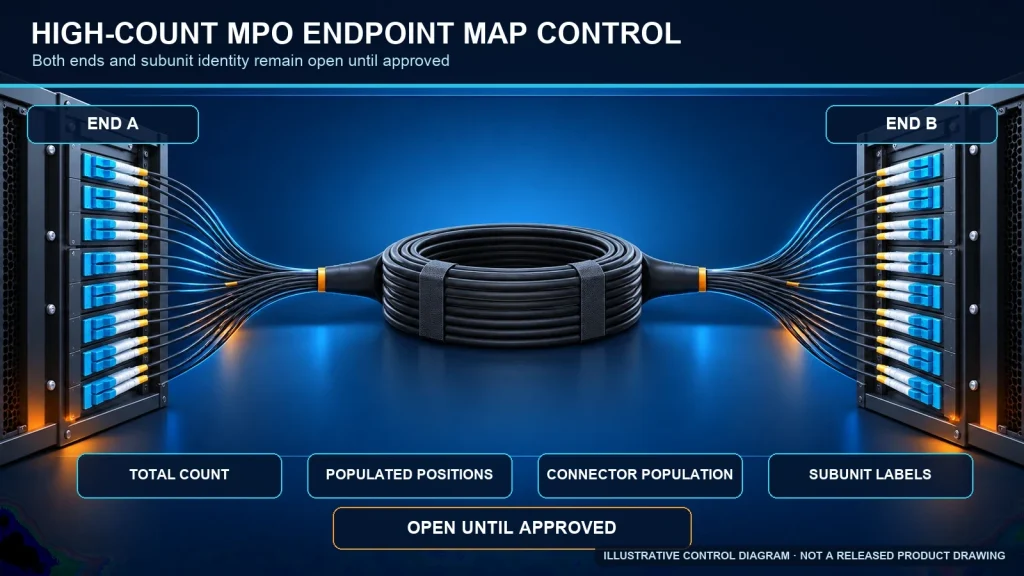
- whether breakout is required;
- peer endpoint with the same fields.
Duplex and parallel optics use different paths
A duplex optical link uses one transmit and one receive fiber. A parallel optic uses multiple transmit and receive lanes. The fact that both modules have the same aggregate rate does not make their passive paths interchangeable.
For an MPO channel, the cable schedule must also control:
- active fiber positions;
- connector gender and key orientation;
- APC or UPC polish where applicable;
- end-to-end polarity and any cassette or panel mapping;
- breakout destination for every lane;
- allowed connector count and channel loss.
Both endpoints must agree
The connector physically fitting one module proves only that it can be inserted. It does not prove that the far-end module uses the same wavelength, PHY, lane arrangement, FEC expectation or interoperability specification. Record both endpoints and the intended standard or supported interoperation before releasing the passive BOM.
Audit the installed plant before reuse
Reuse existing cabling only when the installed channel satisfies the new link. A familiar connector is not enough.
- Read the cable legend and records. Confirm OS2, OM3, OM4, OM5 or another grade instead of inferring it from jacket color.
- Measure the full path, including patch cords, cassettes, panels and routing slack. Room-to-room distance is not the optical channel length.
- Record every mating point, connector type, polish and intermediate component. An adapter cannot correct the wrong fiber medium or lane map.
- Verify polarity and active fiber positions for parallel optics and breakout channels.
- Calculate the loss budget from the selected application limits and the measured or specified fiber, splice and connector losses. A generic "low-loss" label is not evidence.
- Check the route and local code. Indoor, riser, plenum, outdoor, UV, moisture, mechanical and fire requirements apply to the cable construction, not the PHY name.
- Reconcile the drawings, labels, prior test records and field measurements. They should describe the same installed path.
If any of these fields is unknown, treat reuse as an engineering question. Do not turn an assumption into an RFQ requirement.
Build a supplier-ready Ethernet link schedule
Use one row per link or breakout destination. When the endpoints call for conventional LC, SC or other two-ended jumpers, use the fiber patch cord configuration guide to check fiber grade, connectors, polish, structure, jacket and length. A category name is not a final part number.
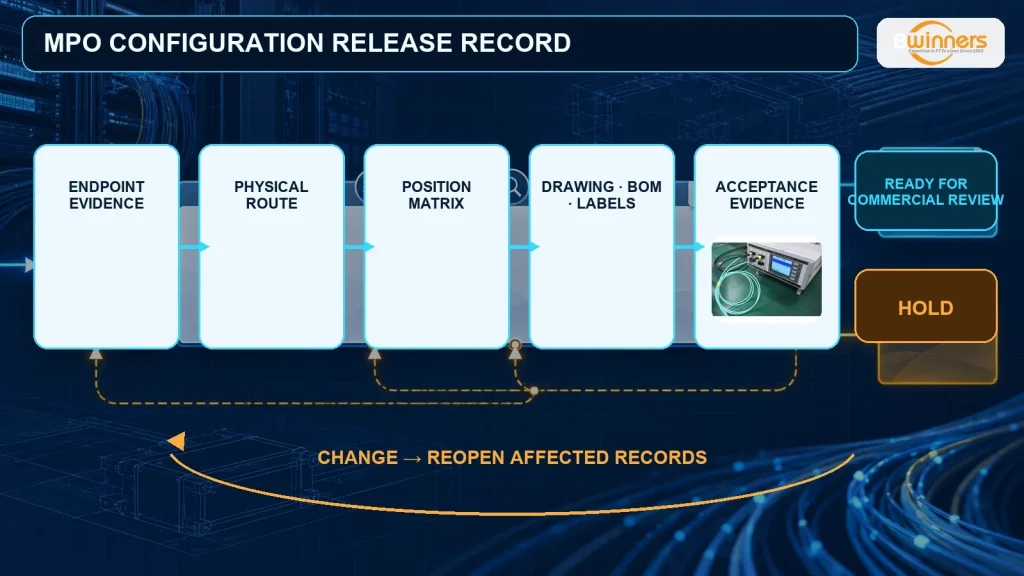
This guide calls the completed row a BWNFiber Link Release Record. It is a procurement worksheet, not a compatibility certificate. Its purpose is to keep the drawing, BOM, quotation, sample and acceptance result tied to the same Link ID.
| Field | Example format | Why it matters |
|---|---|---|
| Link ID | BLDG-A-MDF_to_BLDG-B-IDF-01 | Keeps drawings, BOM, labels and tests aligned |
| Endpoint A | Switch model, slot/port, module part number | Establishes the first optical interface |
| Endpoint B | Switch model, slot/port, module part number | Confirms peer compatibility |
| PHY / application | Exact name, e.g. 400GBASE-DR4 | Separates interfaces at the same rate |
| Breakout | None, 4 x 100G, or exact mapping | Controls lane destination and labeling |
| Route length | Installed estimate plus patching allowance | Determines reach and loss constraints |
| Fiber | ITU fiber category or OS2 / OM3 / OM4 / OM5, strand count | Controls medium and capacity |
| Connector A / B | Type, polish, gender/keying where relevant | Prevents mechanical mismatch |
| Intermediate path | Panels, cassettes, adapters, splices | Controls polarity and loss |
| Environment | Indoor/outdoor, pathway, code/rating | Controls cable construction |
| Acceptance | Inspection, continuity/polarity, IL; OTDR if specified | Defines evidence needed at handover |
| Quantity / spares | Installed quantity and separately approved spares | Separates design need from purchasing policy |
| Sample / first article | Required, not required, or pending approval; include acceptance fields | Prevents volume production before a high-risk configuration is checked |
| Commercial inputs | Quantity, requested delivery window, ship-to location and delivery term | Lets the supplier state price and lead-time assumptions on the same scope |
| Country and governing requirements | Installation country, authority, contract standard and edition | Prevents a generic regional assumption from replacing the project requirement |
| Branding and packing | Marking language, label/barcode data, reel or carton limits and export packing | Keeps private-label and site-handling requirements visible before quotation |
Stop the RFQ when any release field is missing
Do not release a final cable assembly when:
- either endpoint module is unknown;
- the record names only a speed or form factor;
- a parallel-optic lane map or breakout destination is missing;
- connector polish, gender or keying is unresolved;
- the route exceeds the application reach or has no loss allowance;
- an existing plant is assumed reusable without grade, polarity and loss evidence;
- the drawing, BOM and link schedule disagree.
A missing module, lane map or connector detail is not a clerical gap. It can change the physical assembly.
Release sequence before a volume order
- Obtain the controlled datasheet and drawing for the exact configuration. Reconcile them with both endpoint modules and the route schedule.
- Confirm the project environment, including pathway, indoor or outdoor boundary, temperature, moisture, UV, chemicals, mechanical load, fire requirement and local code.
- For a new, custom or high-risk assembly, define whether a sample or first-article review is required. State which dimensions, interfaces, labels and optical results must be approved before volume production.
- Agree on the acceptance record, test method, wavelengths, limits, quantity, spares, packing, reel or drum plan and document revision.
- Release the purchase order only after open deviations have an owner and written disposition. Keep the approved record for installation, maintenance and replacement.
Compare suppliers by controlled evidence, not brochure language
The lowest unit price is not the lowest project risk when the quotation leaves the interface, construction or acceptance record ambiguous. Require every supplier to answer the same technical schedule and record deviations in writing.
| Supplier-response item | Acceptable evidence | Hold condition |
|---|---|---|
| Exact configuration | Part number tied to a controlled datasheet, drawing and revision | Category name, marketing photo or an unrevisioned drawing only |
| Endpoint and interface match | Written mapping to both module part numbers, PHY, connector and breakout plan | Supplier selects a connector from speed or form factor alone |
| Route construction | Declared cable construction and applicable test standards matched to the route requirements | "Outdoor," "armored" or "LSZH" used as an all-purpose compliance claim |
| Optical acceptance | Test method, wavelengths, limits, sample format and unit identity | "100% tested" without method, limit or traceability |
| Mechanical and environmental limits | Values, units, conditions and referenced methods for the exact cable | Generic family values copied across variants |
| Sample or first article | Agreed approval fields and written disposition of deviations | Volume production begins while interfaces or dimensions remain open |
| Traceability and change control | Lot or serial policy as applicable, document revision and notification process | Undisclosed substitutions or no revision control |
| Packing and delivery | Length tolerance, reel or carton plan, labels, protection and site-handling constraints | Packaging left undefined for a route-sensitive cable |
This table is a comparison method, not a claim that BWNFiber currently supplies every listed record. Confirm the available document and test package for the exact product before publishing a supplier promise or issuing a purchase order.
Compare price and lead time after the technical scope is frozen
A low unit price is not comparable when the quote excludes connectors, testing, packaging, optics or delivery. Ask each supplier to return the same commercial fields against the same revision of the link schedule.
| Commercial field | What the buyer should provide | What the supplier should state |
|---|---|---|
| Configuration revision | Approved drawing or schedule revision | Exact quoted part/configuration and any deviation |
| Quantity and spares | Required units, lengths, reels and spare policy | Price basis, quantity break and over/under-length treatment |
| Sample or first article | Required checks and approval date | Availability, charge, production status and effect on the schedule |
| Delivery requirement | Requested date, ship-to location and delivery term | Estimated production and transit assumptions, quotation validity and dependencies |
| Documentation | Required datasheet, drawing, test evidence, packing list and labels | Included documents, excluded documents and when each becomes available |
| Change control | Approval owner and controlled fields | How substitutions, drawing changes or schedule risks will be reported |
Do not write a universal BWNFiber lead time, MOQ or price into this article. Those values depend on the confirmed configuration, quantity, documentation, material status, destination and quotation date. Request a project quotation only after the technical unknowns and commercial assumptions are visible.
Request documents by decision stage
| Decision stage | Document or record to request | What to verify |
|---|---|---|
| Technical comparison | Product datasheet and controlled configuration drawing | Fiber, construction, dimensions, interfaces, limits and revision match the link schedule |
| Sample / first article | Inspection and optical results defined in the approval plan | Unit identity, method, wavelength, limit, result and deviation status are recorded |
| Supplier qualification | Applicable quality, compliance or test documents for the exact product scope | Issuer, model or family scope, edition, validity and exclusions |
| Purchase release | Approved BOM, quotation, delivery assumptions and deviation log | The commercial offer uses the same revision engineering approved |
| Handover | Packing/serial or lot records as applicable, acceptance results and as-built labels | Delivered units can be reconciled with the PO, Link IDs and installation records |
A certificate title or logo does not prove that it applies to the quoted model, factory, material or destination. Ask for scope and revision, and record any gap before approval.
When should you request a customized cable design?
Open a controlled customization review when a standard item cannot satisfy a confirmed requirement such as connector/lane mapping, branch length, labeling, reel length, route construction, environmental exposure, mechanical load, packing or acceptance documentation. Do not customize merely to create a unique part number.
Before requesting a custom design, freeze the interfaces that should not change, identify the fields that may change, define sample or first-article approval, and assign an owner for deviations. If the application, endpoint or route is still unknown, complete the link schedule first.
How to use this guide when contacting BWNFiber
The strongest reason to contact a supplier is a well-defined decision, not a request for "the best fiber." For a BWNFiber inquiry, send the Link Release Record and ask the team to respond against the same fields:
- whether a standard configuration matches the record or a controlled custom review is needed;
- which datasheet, drawing, sample, test and traceability records are available for the exact configuration;
- which fields remain unknown or require engineering confirmation;
- what quantity, delivery and packing assumptions control the quotation;
- what must be approved before a sample, first article or volume order can proceed.
This is intentionally not a claim that every configuration, document, test, MOQ, lead time, OEM/ODM service or delivery option is available. BWNFiber should confirm those points for the exact product and project before the buyer relies on them.
International procurement: add country, route and delivery conditions

Region is a screening prompt, not a cable specification. Climate varies within every market, and the contract, authority having jurisdiction, route owner and installation method govern the final requirement. Name the country, site and applicable standard edition instead of asking a supplier for a generic "European cable" or "Middle East cable."
| Market or route context | Site and environmental questions | Standards and document questions | Commercial and delivery questions |
|---|---|---|---|
| North America | Is the route premises, campus, aerial, duct or direct burial? What fire, pathway, grounding and authority requirements apply? | Name the adopted code, project specification and any TIA or IEEE references with editions. Request evidence for the exact construction, not a family label. | Confirm ship-to site, reel access, delivery term, labeling, staged releases and required handover records. |
| Europe | Is the cable entering a building, remaining outdoors or crossing both conditions? What reaction-to-fire performance has the project specified? | Confirm whether the exact product falls within an applicable harmonised specification and which declaration, CE marking or national document the contract requires. Do not infer compliance from "LSZH." | State destination country, document language, packaging/recycling instructions, delivery term and any project-specific traceability. |
| Middle East | Record ambient and installation temperatures, solar and UV exposure, sand or dust, flooding, salinity and outdoor-storage duration. | Identify the client, utility or authority specification and the accepted IEC, ITU-T or other referenced editions. | Confirm drum protection, port and inland handling, storage limits, site access and phased-delivery dates. |
| Southeast Asia | Check heat, humidity, monsoon or flooding exposure, coastal salt, duct water, insects or rodents where the route assessment identifies them. | Record national requirements, operator specifications, fire requirements at building entry and the exact test-document scope. | Define moisture-resistant packing, drum lengths, island or remote-site logistics, customs documents and delivery batches. |
| Latin America | Check altitude, UV, temperature range, storms, coastal exposure, terrain and the actual aerial, duct or burial route. | Name the country, utility or EPC specification, required language and referenced standards. | Align reel size with transport and site equipment; state customs-document, labeling, spare and delivery-window requirements. |
| Africa | Check UV, temperature range, dust, flooding, remote-route access, storage duration and animal or mechanical risk identified by the survey. | Use the project, operator and national requirements; record standards and editions instead of assuming one rule for the region. | Confirm route access, drum handling, split shipments, site spares, packing protection and document language. |
For private-label, OEM/ODM or bulk inquiries, separate a requested service from an approved capability. The inquiry should state jacket print, brand artwork, label and barcode fields, language, unit or reel length, length tolerance, carton or drum requirements, pallet limits, quantity by configuration, requested sample approval and change-control rules. BWNFiber must confirm feasibility, minimum quantity, tooling or setup, document scope, production assumptions and delivery terms for that exact request before any promise is published or relied on.
A useful international RFQ therefore adds these fields to the Link Release Record: installation country and site, governing authority or customer specification, standard edition, route and climate exposure, fire or building-entry requirement, branding and language, reel or carton constraint, export document list, delivery term, ship-to point, requested delivery date and responsible deviation owner.
Acceptance checks and records
Match the acceptance plan to the product and project. Do not request every test by habit, and do not accept "100% tested" unless the record identifies the test method and limit.
For a typical passive fiber channel, define as applicable:
- visual inspection and connector cleanliness;
- end-to-end continuity and label reconciliation;
- polarity or lane-map verification for parallel optics;
- insertion-loss measurement at the project wavelengths and reference method;
- return-loss evidence when required by the interface or project specification;
- OTDR traces when the project needs event location or installed-path records;
- as-built route, port and component records;
- exception, retest and approval records.
The cable datasheet, module datasheet, drawing, BOM and acceptance form should describe the same link. If one document changes, review the others before release.
For installed single-mode cabling, IEC 61280-4-2:2024 addresses attenuation and optical return loss measurement and includes installed plant with connectors, adapters, splices and other passive devices. ANSI/TIA-568.3-E is the current TIA optical fiber cabling component standard, while ISO/IEC 11801-1:2017 with its current amendment provides common generic-cabling requirements for customer premises. Use the standard and edition named by the contract and jurisdiction. None of these references replaces the selected module limit, cable datasheet or project acceptance plan.
Common specification mistakes
"Use OS2 everywhere and it will support every future speed"
OS2 can preserve valuable optical options, but the future channel may need a different connector, lane count, polish, loss budget or parallel-fiber path. A migration design is more defensible than a blanket future-proof claim.
"The switch has QSFP, so order MPO"
QSFP describes a module family, not one front-panel connector. Depending on the PHY, a module may present LC, MPO or another interface. Use the exact part number.
"Between buildings always means one cable type"
A building-to-building link may use OS2 for reach and electrical isolation, but fiber grade does not approve the cable construction. The cable must still match the pathway, environment, fire boundary, metallic elements and local code.
Frequently asked questions
Is Ethernet copper or fiber?
Ethernet can use copper or fiber. "Ethernet cable" commonly means twisted-pair copper in everyday language, but IEEE 802.3 also defines many optical Ethernet PHYs.
Is fiber faster than an Ethernet cable?
That wording mixes categories. Compare a specific fiber PHY with a specific copper PHY at the required distance. Copper can serve high-speed short links; fiber supports many high-rate and longer-reach Ethernet applications.
Can fiber connect directly to an Ethernet switch?
Yes, when the switch has a compatible optical port or accepts the required pluggable module. A copper-only port needs an appropriate switch, media converter or other active interface. A passive connector adapter cannot convert the signal.
When should a campus network use fiber instead of copper?
Fiber is commonly chosen for links that exceed the applicable copper channel, cross buildings, require electrical isolation, or aggregate enough traffic to justify an optical backbone. Copper often remains at powered edge devices.
Which fiber do I need for 100G Ethernet?
It depends on the PHY. Examples include parallel multimode 100GBASE-SR4, duplex single-mode 100GBASE-DR, and duplex single-mode 100GBASE-LR4. Confirm both module part numbers before selecting the cable.
Does every 400G link use MPO-16?
No. A cited 400GBASE-SR8 implementation uses MPO-16, 400GBASE-DR4 uses MPO-12 APC, and 400GBASE-FR4 uses duplex LC UPC. The exact module interface controls.
Does every 800G link use MPO-16?
No. MPO-16 is used by cited SR8 and DR8 implementations, but 800G is a rate, not a universal connector specification. Verify the named PHY and module at both ends.
Can I reuse an existing OM3 or OM4 channel at a higher speed?
Possibly. Verify the fiber grade, total path length, connector count/loss, polarity and the new PHY's channel limits. Connector fit alone is not sufficient evidence.
Do I need OTDR testing for every patch cord?
Not necessarily. Define acceptance by product and project scope. For a short assembly, specify inspection, polarity or continuity, and insertion-loss testing as required. Add OTDR when the project needs event location or an installed-path record.
What should I send with a fiber cable RFQ?
Send a link schedule with both endpoint models and module part numbers, PHY, distance, fiber, connectors, intermediate path, environment, breakout/lane map, quantity and required acceptance records.
Do I need a media converter to connect fiber to copper Ethernet?
Only when the equipment does not already provide compatible copper and optical interfaces. A media converter is an active device, not a passive connector adapter. Confirm rate, duplex, optical PHY, management needs and the interfaces at both ends before specifying one.
Can a fiber cable be specified from the switch speed alone?
No. The same speed can use different PHYs, fibers and connectors. Record the exact module part number and interface at both endpoints, route length, breakout requirement and installed path before selecting the passive cable.
Send a Link Release Record, not "fiber for 400G"
Send one row for each Link ID with the endpoint equipment and modules, route length, installed-fiber details, breakout requirement, environment, quantity, requested delivery window and required documents. Mark unresolved fields as "unknown" rather than letting a supplier infer the connector.
Send BWNFiber your Link Release Record to ask which configuration, documents, sample path and quotation inputs can be confirmed for the project. For high-speed application context, continue to BWNFiber data center fiber connectivity.