I have probably installed more fiber optic splice sleeves than I can count. In a typical FTTH project, every home connection needs at least one fusion splice, and every fusion splice needs a splice sleeve. Get the sleeve wrong — wrong size, wrong material, wrong shrink temperature — and the splice fails months later when the truck is already gone. I have seen crews lose a full day because a 3.0 mm sleeve was ordered for a 0.9 mm coated fiber. The sleeve could not seal, moisture crept in, and the link dropped.
This guide covers everything I check before buying or specifying fiber optic splice sleeves. The naming varies by supplier and region — fusion splice sleeve, heat shrink sleeve, fiber splice protector — but the part and the selection logic are the same.
Short on time? Send us your coated fiber diameter, tray model, and quantity — we will recommend a sleeve and quote within one working day.
What You Will Learn

- What a fiber optic splice sleeve is and why it is not optional
- The main types: single-fiber, ribbon, micro, and pre-shrunk sleeves
- How to choose the right type, rod material, and tube material
- Materials: PE vs polyolefin tubes, steel vs ceramic rods, EVA hot melt adhesive
- Compliance: RoHS, REACH, Telcordia GR-1380, and when each is required
- Shrink temperature vs service temperature — the difference that trips people up
- Common buying mistakes and how to avoid them
- A 10-point checklist to send a supplier before you order
What Is a Fiber Optic Splice Sleeve?
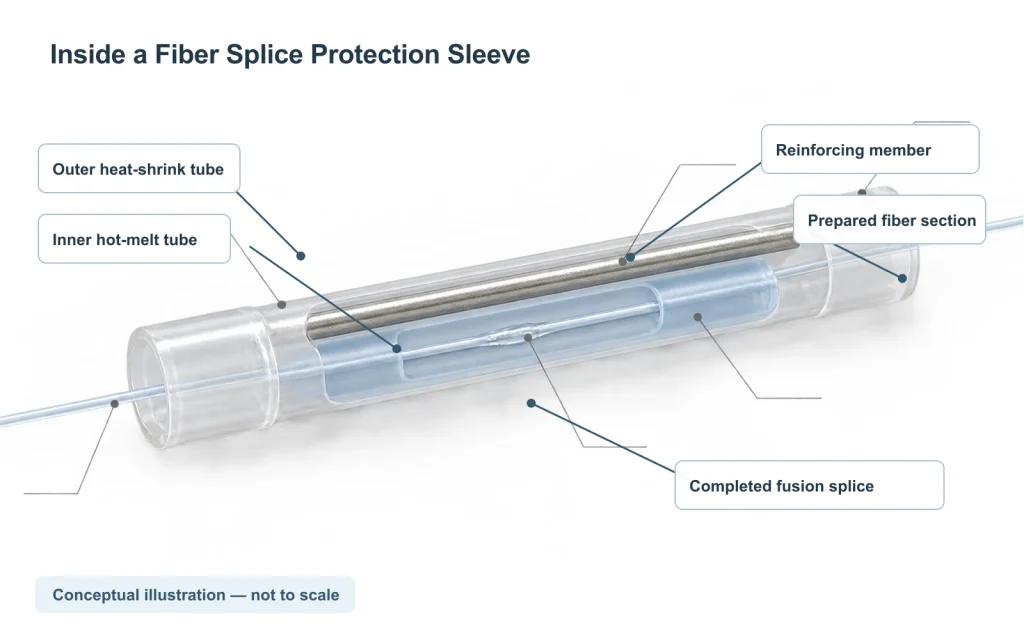
A fiber optic splice sleeve, also called a fusion splice protection sleeve, fusion splice protector sleeve, or fiber splice protector, is a small heat-shrink tube that protects a fusion-spliced fiber joint. It has three parts: an outer polyolefin or PE tube that shrinks around the splice, an inner EVA hot-melt adhesive that melts and flows to block moisture, and a central strength member — usually a steel or ceramic rod — that keeps the splice straight.
When heated, the sleeve shrinks tightly around the fiber and the splice. The result is a sealed, mechanically protected joint that can last 20 years or more inside a splice tray or splice closure. We use these sleeves after every fusion splice. They are not optional. A bare fusion splice is fragile. One bend, one drop of moisture, one touch during closure routing, and the splice breaks. In the UK and Commonwealth markets, the same part is sold as a fibre optic splice protection sleeve or a fiber optic joint sleeve.
Related BWNFiber product: fiber optic splice sleeves
How a Fiber Splice Sleeve Works
The whole shrinking process takes under a minute in a heat oven:
- Slide the sleeve over the splice. Position the splice in the middle of the strength member.
- Apply heat at the datasheet temperature. Place the sleeve in the heat oven or under a hot air gun.
- Let it cool without moving it. The outer tube shrinks around the fiber, the inner adhesive melts and flows around the splice, and the rod locks into place to support it.
A properly shrunk sleeve should be tight and smooth, free of bubbles, centered on the splice, and straight, not bent. Bad shrinking causes air bubbles, weak seals, and sleeves that peel open later. Always use the right temperature and time settings for the sleeve model.
For step-by-step installation, see our installation and heat-shrink guide.
Fiber Optic Splice Sleeve Types
The right type depends on the cable construction, splice method, and how much tray space you have. Single-fiber sleeves are the default for FTTH drops. Ribbon sleeves handle mass fusion. Micro sleeves fit compact trays. Pre-shrunk sleeves are rare outside factories.
Fusion Splice Protection Sleeve
This is the standard sleeve used after a fusion splice. It is typically 40 mm or 60 mm long and fits single fibers from 0.7 mm to 3.0 mm in diameter. The inner rod keeps the splice straight, and the hot-melt adhesive seals it. We specify fusion splice protection sleeves for FTTH, backbone, and data center work.
Heat Shrink Splice Sleeve
“Heat shrink splice sleeve” is another name for the same product. The sleeve activates at about 120–150 °C and shrinks to a tight fit. A good sleeve shrinks evenly without bubbles or gaps. A bad sleeve shrinks unevenly and leaves the splice exposed. For installers, “heat shrink” describes how it goes on; “fusion splice protection” describes what it does.
Ribbon Splice Sleeve
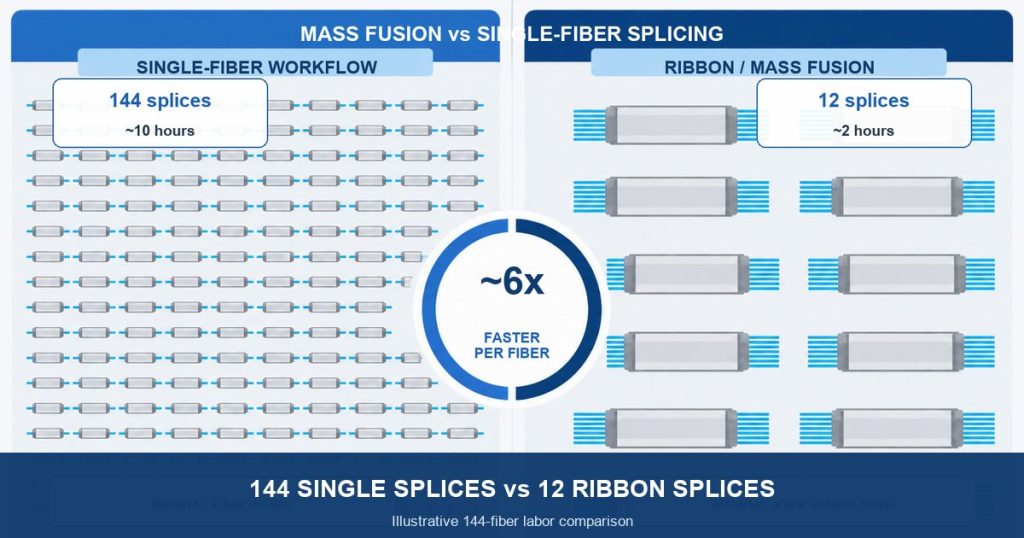
Ribbon sleeves protect multiple fibers spliced at once in a ribbon cable. They are wider than single-fiber sleeves and may use dual ceramic rods to support the ribbon. We use them in high-density splicing for data centers and central offices. A 12-fiber ribbon sleeve is a completely different part from a single-fiber sleeve.
Micro Splice Sleeve
Micro sleeves are shorter and thinner, designed for compact splice trays and high-density closures. They save space but still provide full mechanical and environmental protection. Do not use them for drop cables or harsh outdoor environments where longer protection is needed.
Double-Needle Splice Sleeve
A single-fiber variant with two parallel steel rods instead of one. The second rod adds rigidity and load capacity for high-strain joints: aerial drops, long unsupported spans, and drop-to-drop splicing where the sleeve itself sees tension. If the closure feeds an aerial cable with no strain relief at the splice point, specify double-needle. Otherwise single-needle is fine, cheaper, and easier to seat in standard trays.
Pre-Shrunk vs Open-Ended Sleeves
Most field sleeves are open-ended and require a heat oven or hot air gun to shrink. Pre-shrunk sleeves are factory-shrunk and used in specialized manufacturing or repair scenarios where no heat source is available.
One more naming trap: a mechanical splice uses a different device entirely. A mechanical splice — the kind used for quick field restoration — is held by an index-matching gel and a crimp or V-groove housing, and it uses a rigid clamshell optical fiber splice protector, not a heat-shrink tube. Heat-shrink sleeves are for fusion splices only. If your crew is doing mechanical restoration splices, order the crimp-type protectors separately. For direct-buried drop restoration, use ceramic double-clip protectors rated IP68 — no oven needed, and they survive being buried.
Sleeve Type Comparison
| Sleeve Type | Fibers Protected | Length | Rod | Best For |
|---|---|---|---|---|
| Single-fiber fusion splice sleeve | 1 | 25–60 mm | Steel / ceramic | FTTH, field splicing, enterprise |
| Heat shrink splice sleeve | 1 | 25–60 mm | Steel / ceramic | Same as single-fiber; describes install method |
| Ribbon splice sleeve | 4–12 | 40–60 mm | Dual ceramic / steel | Mass fusion, data centers, central offices |
| Micro splice sleeve | 1 | 20–30 mm | Steel / ceramic | Compact trays, high-density closures |
| Double-needle splice sleeve | 1 | 40–60 mm | Dual steel | Aerial drops, high-strain joints |
| Pre-shrunk splice sleeve | 1 | 25–60 mm | Steel / ceramic | Factory assembly, repair kits |
How to Choose a Splice Sleeve
Choosing a sleeve comes down to matching the part to the fiber, the tray, and the environment. I ask four questions: What is the coated fiber diameter? How long can the tray hold? Will the sleeve see moisture or temperature swings? Does the project require compliance paperwork?
The short version: Match the sleeve inner diameter to your coated fiber, the length to your tray holder, and the rod to the environment. For standard FTTH single-mode work, a 1.5 mm × 40 mm polyolefin sleeve with a stainless-steel rod is the safest default — go 60 mm outdoors. Put the rod grade on the purchase order, request RoHS and REACH paperwork, and shrink five samples in your own oven before committing to bulk.
Splice Sleeve Size Selection
Sleeve size has two dimensions: inner diameter and length. The diameter must slide over your coated fiber and shrink tight; the length must fit your splice tray holder slot and cover the stripped window with enough room to grip the coating, not bare glass. Suppliers also label the same sleeve three different ways — by inner diameter, recovered outer diameter, or steel needle — so a bare size number on a listing is never enough.
We keep the measurement method, the full diameter and length charts, the naming-convention decoder, and a five-number RFQ template in our dedicated fiber splice sleeve size guide. Work through that first. The sections below cover sleeve types, rod materials, and compliance — the rest of the buying decision.
Rod Material: Steel vs Ceramic
The strength member inside the sleeve keeps the splice straight. The two main materials are stainless steel and ceramic. Steel is the default for single-fiber sleeves because it is strong, flexible, and low cost. Ceramic is better for corrosive or high-voltage environments but is more brittle.
| Rod Material | Pros | Cons | Best For |
|---|---|---|---|
| Stainless steel | Strong, flexible, low cost | Can rust if the seal fails | General FTTH, indoor trays |
| Ceramic | Corrosion-proof, rigid, non-conductive | More brittle, higher cost | Coastal, chemical, high-voltage |
For outdoor and humid environments, we often prefer ceramic or 304 stainless steel rods. For standard indoor FTTH, regular steel rod sleeves work well if the closure is dry. The “steel rod falling out” issue I have seen usually comes from poor-quality sleeves where the rod is not bonded to the tube. A good sleeve keeps the rod centered even after shrinking.
I have also rejected an entire lot over rod material. The sleeves came with plain carbon-steel rods — cheaper than stainless — and on a humid coastal job the rods showed surface rust while still in the shipping drum, before a single splice was made. Humid coastal work, from Southeast Asia to the Gulf coast to West Africa, is where we see this most. The tubes looked fine; the rods were the failure waiting to happen. Now we write the rod grade into every humid-climate spec — 304 stainless as the minimum, ceramic for the worst sites — instead of accepting “steel rod” on the paperwork.

Materials and Compliance Standards
Outer Tube Materials
- Polyolefin: Most common. Good shrink ratio, good moisture resistance, wide temperature range.
- PE (polyethylene): Common for outdoor sleeves. Good UV and moisture resistance.
- Transparent / clear: Lets you inspect the splice after shrinking.
- Colored: Helps with fiber identification in high-count trays.
- LSZH (low smoke zero halogen): Low-smoke, halogen-free tube for rail, tunnel, and indoor public spaces where smoke toxicity matters.
Inner Adhesives
- EVA hot melt: Standard adhesive that flows when heated and seals the splice.
Compliance Standards Reference
| Standard | What It Means | When You Need It |
|---|---|---|
| RoHS | Restricts hazardous substances like lead and cadmium | Most global telecom projects |
| REACH | EU chemical safety compliance | European projects and exports to Europe |
| Telcordia GR-1380 / Bellcore | Telco-grade splice protection requirements for single-fiber and ribbon protectors | Carrier and RFP projects |
| MIL-PRF-24623 | Military-grade heat shrink specification | Defense, aerospace, rugged industrial |
| SAE AMS-DTL-23053 | Aerospace heat-shrink tubing standard | Aviation or satellite ground stations |
| UL 94 V-0 | Flammability rating of the heat-shrink tube | Projects with fire-safety requirements |
Telcordia GR-1380-CORE, Generic Requirements for Fusion Splice Protectors, covers dimensions, materials, strength, temperature cycling, and moisture resistance for both single-fiber and ribbon protectors. For telecom and carrier projects, we specify RoHS and REACH compliant sleeves. For military or utility work, MIL-spec sleeves may be required. For enclosed spaces like rail tunnels and building risers, we also check the tube’s UL 94 V-0 flammability rating.
Shrink Temperature and Time
A fiber optic heat shrink sleeve needs the right heat to shrink without cracking or under-sealing. Most polyolefin sleeves shrink at 120–140 °C. PE sleeves may need 130–150 °C. Time depends on the heat source.
| Sleeve Material | Temperature | Time in Heat Oven | Time with Hot Air Gun |
|---|---|---|---|
| Polyolefin | 120–140 °C | 30–45 seconds | 45–90 seconds |
| PE | 130–150 °C | 45–60 seconds | 60–120 seconds |
| Transparent | 120–140 °C | 30–45 seconds | 45–90 seconds |
Always follow the manufacturer’s datasheet. Overheating weakens the tube. Underheating leaves the adhesive dry and unsealed. And expect the datasheets to disagree — we have seen polyolefin shrink temperatures quoted anywhere from 100 °C to 140 °C depending on the compound — so run a sample batch through your own oven before standardizing on a supplier.
Do not confuse shrink temperature with service temperature. The sleeve only sees 120–140 °C for under a minute during installation. After that, it must survive the installed environment for decades. Manufacturer datasheets typically rate the finished sleeve for about −45 °C to +100 °C service, with tensile strength around 18–20 MPa on the shrunk tube — enough for outdoor cabinets, ducts, and aerial closures. If your project runs outside that range (extreme desert heat, high-altitude cold), confirm the rating in writing before ordering.
Common Buying Mistakes
| Mistake | Why It Hurts | How to Avoid |
|---|---|---|
| Wrong diameter | Too tight damages coating; too loose will not seal | Measure coated fiber diameter with a caliper |
| Wrong length | Short sleeve may not protect splice from bending; long sleeve may not fit tray | Check tray capacity before ordering |
| Low-quality adhesive | Weak hot-melt does not flow evenly, leaving gaps | Test samples and check shrink quality |
| Wrong rod material | Outdoor projects need corrosion-resistant rods | Specify stainless steel or ceramic for wet/corrosive environments |
| No compliance docs | Carrier and government projects need RoHS, REACH, or Telcordia paperwork | Request certificates before shipment |
| Ignoring tray fit | A 60 mm sleeve will not fit a tray designed for 25 mm sleeves | Match sleeve length to tray slot length |
Buyer Checklist Before Ordering
Use this checklist when contacting a supplier. It is the same list our team runs through before releasing a purchase order.
| Item to Confirm | What to Ask |
|---|---|
| Fiber coating diameter | “What inner diameter fits my fiber?” |
| Sleeve length | “Will 40 mm or 60 mm fit my splice tray?” |
| Rod material | “Do you offer stainless steel or ceramic rods?” |
| Outer tube material | “Is this polyolefin, PE, transparent, or colored?” |
| Compliance | “Can you provide RoHS, REACH, and Telcordia GR-1380 reports?” |
| Shrink temperature | “What temperature and time do you recommend?” |
| Splicer heater compatibility | “Will this sleeve work with my fusion splicer’s heater program?” |
| Batch quality | “Can you provide batch test reports for shrink ratio, tensile strength, and rod adhesion?” |
| Packaging | “What is the MOQ and packing unit? Can you do private label? Are the drums moisture-sealed for sea freight?” |
| Samples | “Can I test samples before placing a bulk order?” |
Spotting a Bad Sleeve in a Sample Batch
When the samples arrive, shrink five and inspect them before you talk price:
- Rod ends: Chamfered or polished ends slide over the fiber without snagging. Sharp, cut ends can nick the coating — or the glass — as the sleeve goes on.
- Rod position: The rod should stay centered after shrinking. If it migrates sideways, it was never bonded properly and will eventually work loose.
- Adhesive flow: Melted EVA should run clear and bubble-free. Voids and unglued zones are future water paths.
- Tube wall: Shrinks evenly, with no thin spots, cracks, or gaps at the rod edges.
A sleeve that fails any of these four checks will fail in the field — it is just a question of when.
Where to Buy Fiber Optic Splice Sleeves in Bulk
BWNFiber supplies fiber optic splice protection sleeves for FTTH, telecom, data center, and industrial applications:
- Single-fiber and ribbon sleeves
- Lengths: 25 mm, 30 mm, 40 mm, 45 mm, 50 mm, 60 mm, and custom lengths
- Diameters: 0.7 mm to 3.0 mm
- Steel rod, stainless steel rod, and ceramic rod options
- PE, polyolefin, transparent, and colored tubes
- RoHS and REACH compliant
- OEM/ODM and private-label packaging available
How to Compare Suppliers
- Extrusion in-house or resale: Ask whether the supplier extrudes its own tubes. In-house extrusion means real control over the compound and shrink ratio; a reseller is quoting someone else’s datasheet.
- Batch traceability: Test report lot numbers should match the labels on your shipping drums. If they cannot connect the two, the reports are decoration.
- Sample policy: A supplier who hesitates to send samples is telling you what they think of their own product.
- OEM track record: Ask what private-label programs they already run — it predicts how smoothly yours will go.
Price and Lead Time Reality
Sleeve pricing is driven by the rod grade, the tube compound, and the documentation — not the logo on the drum. A carbon-steel-rod sleeve with no test reports can cost half as much as a fully documented stainless one, and a single truck roll to fix one failed splice costs more than the difference across a whole project. Standard sizes from stock typically ship in days, not weeks; custom lengths and private label add tooling time. Ask for the price with test reports included, not as a paid extra.
Reputable suppliers publish full test data with their sleeves — shrink ratio, tensile strength, temperature cycling, moisture resistance. The standards and academic literature behind those tests, such as Telcordia GR-1380 and the Springer reference on splice strength, reliability, and packaging, explain why they predict field life. We apply the same documentation standard to BWNFiber sleeves.
For FTTH, ISP, and data center projects, we usually confirm five things before recommending a sleeve: coated fiber diameter, tray slot length, closure type, environment, and compliance requirements. Send us those five items and we will reply with a specification sheet, samples, and a quote.
Related BWNFiber products: fiber optic splice sleeves · fiber optic splice closures · fiber optic test equipment and splicing tools
Frequently Asked Questions
Q: What is a fiber optic splice sleeve?
A: A fiber optic splice sleeve is a small heat-shrink tube with an inner adhesive layer and a central strength rod. It slides over a fusion splice, then shrinks when heated to seal, support, and protect the joint.
Q: What is the difference between a splice sleeve and a splice tray?
A: A splice sleeve protects the individual fusion splice. A splice tray organizes and holds multiple sleeves inside a closure. You need both. For the full comparison — capacity tables, placement rules, and the mistakes that kill closures — see our fiber splice sleeve vs splice tray guide.
Q: Can a fiber splice sleeve be reused?
A: No. Once shrunk, the sleeve cannot be removed without cutting it off. Always keep spare sleeves on site.
Q: What temperature shrinks a fiber splice sleeve?
A: Most polyolefin sleeves shrink between 120 °C and 140 °C. PE sleeves may need 130 °C to 150 °C. Check the manufacturer’s datasheet for exact time and temperature.
Q: What temperature range can a splice sleeve handle after installation?
A: Manufacturer datasheets typically rate installed sleeves for about −45 °C to +100 °C service. Do not confuse this with the 120–140 °C shrink temperature, which only applies for under a minute during installation.
Q: Will any splice sleeve fit my fusion splicer’s heater?
A: No. Match the sleeve length to your splicer’s heater program — most splicers have settings for 40 mm and 60 mm sleeves, and ribbon splicers need wide-slot programs. Confirm before a bulk order, or your oven program and sleeve length will fight each other.
Q: How long does a splice sleeve last?
A: A properly installed sleeve can last the life of the cable, typically 20+ years.
Q: Which sleeve should I use for FTTH?
A: A 40 mm or 60 mm polyolefin sleeve with a steel or ceramic rod, sized for the fiber diameter. RoHS compliance is standard for most markets.
Q: Are heat shrink fiber splice sleeves the same as fusion splice protection sleeves?
A: Yes. “Heat shrink” describes the installation method; “fusion splice protection” describes the function.
Q: What is a fibre optic splice sleeve?
A: It is the British spelling of fiber optic splice sleeve — the same protective sleeve for fusion splices.
Q: What does Telcordia GR-1380 cover?
A: It defines requirements for splice protection sleeves used in telecom networks, including dimensions, materials, strength, temperature cycling, and moisture resistance.
Q: Steel rod or ceramic rod — which is better?
A: Stainless steel is the default for flexibility and cost. Ceramic is better for corrosive, coastal, or high-voltage environments.
Q: What size fiber optic splice sleeve do I need?
A: Match the sleeve inner diameter to your coated fiber diameter. For standard 0.9 mm coated fiber, use a 1.5 mm sleeve. For length, use 40 mm as the default, 25–30 mm for compact trays, and 50–60 mm for drop cables or harsh environments.
Q: How many splice sleeves do I need for a project?
A: Count splices, not subscribers — a drop spliced at both ends consumes two sleeves. Order one sleeve per splice plus 5–10% for the re-splices — even a good crew re-does a few fibers per hundred. A fully loaded 48-fiber closure needs 48 sleeves, so we would quote 50–55.
Q: Where can I buy bulk fiber optic splice sleeves?
A: Source from a manufacturer with extrusion control, rod QC, batch testing, and OEM/ODM support. BWNFiber supplies bulk, wholesale, and custom sleeves.
Related Reading
- How to Install, Heat Shrink & Use Fiber Splice Protection Sleeves
- Fiber Splice Sleeve Size Guide: Diameter, Length & Size Chart
- Fiber Splice Sleeve Materials & Compliance: PE, Polyolefin, Steel vs Ceramic
- Single Fiber vs Ribbon Fiber Splice Protection Sleeve Guide
- Fiber Optic Splice Protection Sleeve Manufacturer & Supplier Guide

Request a Splice Sleeve Quote
Every fiber optic splice sleeve we ship is batch-tested for shrink ratio, rod adhesion, and seal quality. We manufacture in bulk, sample packs, and custom configurations. Send us your fiber diameter, length, rod material, and quantity for a fast quotation, or contact BWNFiber directly.
📧 [email protected]
📞 +86-13615744790 (WhatsApp)
🌐 Visit our website
Specifications and standards references as of 2026-09-01. Always confirm critical requirements against the manufacturer’s datasheet.
BWNFiber · Business Intelligence Excellence