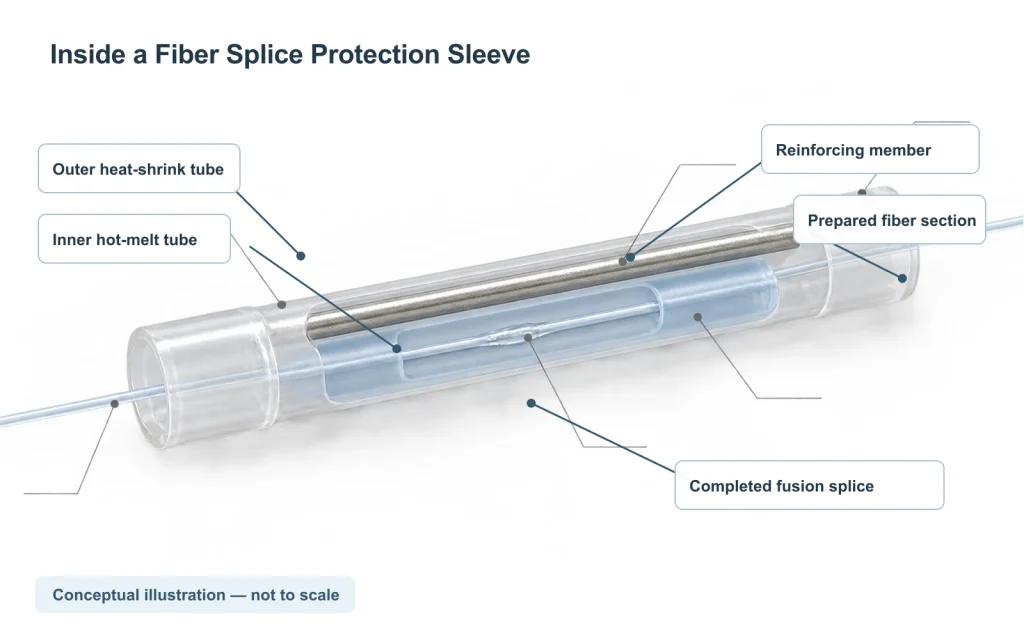
Short answer: A fiber optic splice protection sleeve manufacturer produces the heat-shrink sleeves that protect fusion splices after splicing. The right one controls tube extrusion, rod insertion, and batch testing in-house, so batch ten matches batch one. This guide shows how to find, audit, and qualify such a factory before you commit volume.
In 2022 I watched a contractor in Kenya lose three days on a 500-home FTTH rollout. The first batch of fiber splice sleeves passed every check. The second batch looked the same, but the steel rod fell out of one in five sleeves after shrinking. The crew had to reopen splice trays and redo fusion splices they thought were finished. The supplier was not a real manufacturer. They were a trader who bought tubes from one factory, rods from another, and assembled them in a garage. The price was 15% lower. The rework cost was ten times that saving.
This guide is for procurement managers at ISPs and FTTH operators, distributors, and OEM/ODM buyers who need to find a fiber optic splice protection sleeve manufacturer or supplier they can actually trust.

Already shortlisting suppliers? Send your spec through our contact page — or use the RFQ template in this guide with any supplier and compare our quote on equal terms.
What You Will Learn
- How to tell a manufacturer from a distributor or exporter
- What to check on a factory audit before you place a bulk order
- Which certifications and test reports matter for telecom projects
- How OEM, ODM, and private-label programs really work
- How price, MOQ, and lead time are connected
- What to put in an RFQ so suppliers cannot hide behind vague specs
- Why sample approval is the only safe path to bulk
- How international trade terms affect your real cost
Why Supplier Consistency Beats Price
A reliable fiber splice sleeve supplier delivers the same product in batch one and batch ten. Consistency matters more than a low unit price because one bad sleeve can force a crew to reopen a splice closure and rework splices that were already accepted. I have seen projects where the rod rusted, the adhesive did not melt, or the wall shrank so thin it tore. In each case the buyer chose price over verification. The factories behind those failures often had no extrusion line, no rod incoming inspection, and no batch test records. Our fiber splice sleeve troubleshooting guide covers how to diagnose and prevent each of these failure modes.
Related BWNFiber capability: fiber optic splice sleeves for FTTH, telecom, and data center projects
Manufacturer vs Distributor vs Exporter: Which One Do You Need?
Your choice depends on order size, customization needs, and how much risk you want to manage. A manufacturer controls production. A distributor holds stock and offers local support. An exporter or trading company handles documentation and consolidated shipping but may not own a factory.
| Role | Best For | Pros | Cons |
|---|---|---|---|
| Manufacturer | Bulk orders, custom specs, OEM/ODM | Lowest direct price, full customization, traceability | Higher MOQ, longer first-sample lead time |
| Distributor | Small quantities, fast local delivery | Low MOQ, quick shipping, local language support | Higher unit price, less customization |
| Exporter / Trading company | First-time imports, mixed container loads | Handles docs, consolidates freight, lowers logistics friction | Adds margin, less technical control |
For orders over 500,000 pieces per year or any custom fiber splice sleeve, work directly with a manufacturer. For urgent repairs or small pilot orders, a distributor is faster. If you are buying across multiple product lines from Asia, an exporter can simplify shipping.
Factory Audit Checklist: What to Verify Before You Trust a Supplier
A real manufacturer should let you see the production line. If they only send a PDF catalog and refuse a video call, treat that as a red flag. I always ask for a live factory tour before approving a new fiber optic splice protection sleeve supplier.
| Checkpoint | What to Look For | Why It Matters |
|---|---|---|
| ISO 9001 certification | Valid certificate, scope includes splice sleeves or telecom components | Shows a documented quality system, not just a workshop |
| Extrusion lines | In-house tube extrusion with inline diameter checks | Controls wall thickness, shrink ratio, and output consistency |
| Production capacity | Daily output per line, total lines, current order backlog | Lets you test lead-time claims; a “factory” that cannot state daily output is likely a trader |
| Clean assembly area | Dust control, rod insertion automation, contamination checks | Dust and fibers inside the sleeve ruin the seal |
| Rod incoming inspection | Straightness, rust, ceramic crack checks | Bad rods cause the “rod falling out” failure |
| Heat-shrink test ovens | Batch shrink testing per lot, typically at 90–110 °C for polyolefin/EVA sleeves | Verifies recovery ratio and seal quality per lot |
| Adhesive QC | EVA hot-melt flow test and batch records | Dry or uneven adhesive causes moisture ingress |
| Test lab or reports | Tensile, temperature cycling, moisture resistance data | Proves the sleeve survives field conditions |
| Packaging line | Custom bagging, boxing, and label printing | Supports OEM/ODM and private-label requirements |
| Export experience | Previous B/Ls, HS code knowledge, incoterms practice | Reduces customs and shipping surprises |
If a factory buys tubes from a third party and only does assembly, that is not a true manufacturer. Ask who extrudes their tubes and request that supplier’s qualification records.
Certifications & Test Reports Buyers Should Request
Not every project needs every certificate. The key is matching the document to the tender or market. I have seen RFQs fail because the buyer asked for the wrong standard, and suppliers have seen margins disappear because they were asked for certificates that did not apply.
| Certificate / Report | What It Covers | When You Need It |
|---|---|---|
| RoHS | EU hazardous-substance limits for electrical equipment (Directive 2011/65/EU) | Most global telecom and electronics projects |
| REACH | EU chemical registration and SVHC disclosure (Regulation (EC) 1907/2006) | European projects and exports to Europe |
| Telcordia GR-1380 / Bellcore | Telecom-grade splice protection requirements | Carrier, RFP, and North American projects |
| ISO 9001:2015 | Quality management system | Any serious B2B manufacturer qualification |
| COA (Certificate of Analysis) | Per-lot material and performance data | Batch traceability and acceptance testing |
| PPAP (Production Part Approval Process) | Sample approval, process capability, control plan | Automotive, utility, and high-reliability projects |
| Third-party lab reports (SGS, TÜV) | Independent verification of RoHS, REACH, or GR-1380 claims instead of factory self-declaration | When your tender requires independently tested evidence |
Ask for the actual report, not a one-page summary. Check the test date, the sample part number, and the testing lab. A certificate from 2019 for a different sleeve model is not evidence that your batch will pass. For the technical test requirements behind each standard — dimensions, temperature cycling, moisture resistance — see our materials & compliance guide. Note also which framework your tender uses: some government and utility tenders outside North America reference ITU-T L.400/L.12 (optical fibre splices) instead of Telcordia, and asking for the wrong one wastes time on both sides.
OEM, ODM & Private Label: Capability Matrix
Most established manufacturers offer some form of customization. The difference is who owns the design and who pays for the tooling. I have run all three models for BWNFiber customers, and the right path depends on how much control the buyer wants.
| Model | Design Owner | Tooling / Mold Cost | Typical MOQ | Best For |
|---|---|---|---|---|
| OEM | Buyer provides drawing/spec; factory builds to spec | Buyer pays for private molds if needed | 50,000–200,000 pcs | Unique dimensions, custom branding, exact project spec |
| ODM | Factory provides existing design; buyer adds branding | Usually no mold cost | 10,000–50,000 pcs | Fast private-label launch, distributor brands |
| Private Label | Standard product with your logo, color, packaging | Low — label and box art only | 5,000–20,000 pcs | Distributors building their own brand |
Common customizations include sleeve length, diameter, tube color, rod material, packing quantity, printed labels, and datasheet language. For private-label fiber splice sleeve programs, ask who owns the label artwork and whether the factory can register the HS code under your brand for export.
Price, MOQ & Lead Time: What to Expect
Splice sleeve pricing is the sum of material, labor, testing, packaging, certification, and order size. MOQ and lead time move together: custom sizes and private-label packaging need longer setup, while stock sizes ship faster. When a quote looks too low, look at what was left out.
Price Drivers
- Outer tube material: Polyolefin, PE, transparent, or colored
- Rod material: Carbon steel, 304/316 stainless steel (316 adds molybdenum for coastal corrosion resistance), ceramic, or quartz
- Adhesive grade: Standard EVA hot melt or higher-grade formulation
- Sleeve dimensions: Length and inner diameter (selection criteria are covered in our fiber splice sleeve size guide)
- Compliance requirements: RoHS, REACH, Telcordia, MIL-spec testing
- Packaging and labeling: Standard 100 pcs/bag, bulk packaging, or custom private-label box
- Order quantity: Larger volumes lower unit price
- Incoterms: FOB, CIF, or DDP change the landed cost significantly
Typical Ranges
| Order Type | MOQ | Lead Time | Notes |
|---|---|---|---|
| Stock standard sizes | 1,000–10,000 pcs | 2–4 weeks | Fastest path for small buyers |
| Custom dimensions | 10,000–50,000 pcs | 4–6 weeks | Requires sample approval first |
| OEM / private label | 5,000–50,000 pcs | 4–8 weeks | Depends on artwork and tooling |
| Bulk container load | 100,000–500,000 pcs | 6–10 weeks | Best unit price, but needs planning |
When comparing quotes, make sure each supplier is quoting the same specification. A lower price may mean carbon steel rods instead of stainless, thinner walls, or no compliance documents.
RFQ Template: What to Send a Fiber Splice Sleeve Supplier
Suppliers can only quote the specification you send them. A vague request produces vague numbers that cannot be compared across suppliers. The RFQ template below forces every supplier to quote the same spec, so price, MOQ, and lead time can be compared on equal terms.
| Item | What to Include |
|---|---|
| Fiber type | Single-mode, multimode, ribbon, or drop cable |
| Coated fiber diameter | 250 μm, 900 μm, or other buffer size |
| Sleeve length | 25 mm, 30 mm, 40 mm, 45 mm, 50 mm, 60 mm, or custom |
| Inner diameter | Match to coated fiber plus buffer |
| Rod material | Carbon steel, 304/316 stainless steel, ceramic, or quartz |
| Outer tube | Polyolefin, PE, transparent, or colored |
| Compliance required | RoHS, REACH, Telcordia GR-1380, Bellcore, MIL, etc. |
| Packing quantity | 100 pcs/bag, 500 pcs/box, or custom |
| Labeling / private label | Logo, barcode, language, datasheet |
| Target quantity | Annual volume and first order size |
| Destination / Incoterms | FOB, CIF, DDP, or your preferred term |
| Sample requirement | Yes/No, and how many pieces |
| Payment terms | T/T deposit-and-balance, L/C at sight, or escrow for first orders |
| Warranty & claims | Rework, replacement, or credit terms for field failures |
For a fast quotation from BWNFiber, send these details through our contact page and we will return a spec-matched quote.

Sample Approval Process: From Sample to Pilot to Bulk
Never skip samples. I have saved projects by rejecting a bad sample before it became a bad container. The right process has three gates: sample evaluation, pilot order, and bulk approval with a locked specification. Skipping any gate is how buyers end up with rod fall-out, poor seals, and field failures.
- Sample evaluation: Test visual fit, shrink, seal, bend, and rod adhesion. Run at least 50 sleeves, not five.
- Pilot order: Place a small production lot, usually 1,000–5,000 pcs, from the same line that will run bulk.
- Bulk approval: Compare the pilot lot COA to the sample report. Lock the specification in writing before the full order. For a first bulk order, book a third-party pre-shipment inspection (SGS, Bureau Veritas, or TÜV). It costs a few hundred dollars and happens before your balance payment, not after the goods arrive.
Simple Sample Test Protocol
These six checks mirror the mechanical and environmental loads that ITU-T L.400/L.12 and Telcordia GR-1380 apply to fusion joints. A sleeve that fails any of them will not protect a joint that must survive handling, coiling, and tray stacking.
- Inspect visually — tube clarity, rod centering, adhesive distribution
- Test the fit — slide over the target fiber diameter
- Shrink at spec — use the recommended temperature and time
- Check the seal — look for bubbles, gaps, or adhesive overflow
- Bend to radius — apply the minimum bend radius and check for cracking
- Pull the rod — try to slide or pull the strength rod out of the shrunk sleeve
If the sample fails any of these, do not accept “we will fix it on bulk.” Fix it on sample, or find another supplier.
International Procurement: FOB, CIF, HS Code & Export Cartons
Buying from overseas adds logistics risk. The wrong Incoterm can turn a cheap price into an expensive mistake. FOB, CIF, and DDP each shift responsibility between buyer and seller, and the right HS code determines how fast your fiber splice sleeves clear customs.
| Term | What You Pay | Best For |
|---|---|---|
| FOB (Free On Board) | Seller loads goods at port; buyer pays ocean freight and insurance | Experienced importers with their own forwarder |
| CIF (Cost, Insurance, Freight) | Seller pays to destination port; buyer handles import clearance and inland delivery | Buyers who want predictable landing cost |
| DDP (Delivered Duty Paid) | Seller handles everything to your door | Buyers who want minimum logistics management |
Payment Terms: T/T, L/C, and First-Order Protection
Payment terms are where new buyers take the most risk. For standard orders, T/T (telegraphic transfer) with a 30% deposit and 70% against the bill of lading is the industry norm. For orders above roughly USD 50,000, an L/C at sight through your bank protects both sides. For a first order with an unverified supplier, use Alibaba Trade Assurance or a similar escrow structure, and never accept 100% advance payment. Whatever you agree, write it into the purchase order together with the inspection point that releases the balance payment.
Buying from China: Business License & Region Checks
Most fiber optic splice sleeve manufacturing is concentrated in Sichuan (Chengdu) and Guangdong. That concentration is useful: it means real factories compete on equipment and QC, not just price. Two checks matter more than anything on a marketplace profile page. First, ask for the Chinese business license and verify the company name and legal representative on the National Enterprise Credit Information Publicity System (gsxt.gov.cn). Second, treat Alibaba or Made-in-China membership years as a lead, not proof — factories and traders sit side by side on both platforms, so run the factory video tour and capacity checks in this guide before you trust the listing.
For fiber optic splice protection sleeves, the common HS codes are 9001.10 (optical fibers and optical fiber bundles) or 8544.70 (optical fibre cables). Depending on customs practice, heat-shrink sleeves may instead be classified as plastic articles under 3926.90 — US Customs rulings place electrical heat-shrink tubing there, outside heading 3917 — and trade data also shows 3917.32 and 3917.39 for certain forms. Confirm with your broker before shipping, because the wrong code delays customs and changes duties.
Export cartons should be double-wall for sea freight, with inner bags protected from moisture. For coastal and tropical destinations, specify 304 or 316 stainless steel rods instead of carbon steel and add desiccant to the cartons. For desert and high-temperature regions, confirm the tube and adhesive rating covers your ambient range — standard polyolefin/EVA sleeves are rated around −45 °C to +100–105 °C, but your project specification should state its own limits. I have seen cartons collapse in humid ports and sleeves rust before they reached the site. Ask for packing photos before shipment.
Red Flags: How to Spot a Risky Supplier
A supplier who refuses a factory video, cannot show test reports, or quotes far below market without explanation is not saving you money. They are shifting risk to your project. Ask for the evidence before you send a deposit.
| Red Flag | Why It Is a Problem | Evidence to Request |
|---|---|---|
| No factory video or audit allowed | May be a trader or substandard facility | Live video call, ISO 9001 certificate, utility bill |
| Cannot provide RoHS or REACH certificates | Compliance risk for EU and telecom projects | Third-party test report with part number |
| Refuses free samples | Hiding quality issues | Written sample policy and evaluation report |
| Price 30% below market without explanation | Likely lower-grade rod, thinner wall, or no testing | Detailed cost breakdown |
| No batch testing or QC records | No traceability | COA and inspection records |
| Inconsistent product between sample and bulk | Production line not controlled | Pilot lot report and bulk COA |
| Refuses third-party pre-shipment inspection | The line you were shown may not be the line that ships | SGS, Bureau Veritas, or TÜV inspection booking |
| No written warranty or claims process | You absorb the full cost of any field failure | Written warranty terms and a claims procedure; multi-year terms are common among established factories |
| Cannot explain HS code or Incoterms | Inexperienced exporter | Previous B/L or shipping doc sample |
Supplier Scorecard: A Weighted Comparison Method
Red flags tell you who to avoid. A scorecard tells you who wins when three suppliers all look qualified. Score each finalist from 0 to 5 in every area below, multiply by the weight, and compare total scores on evidence, not impressions.
| Evaluation Area | Weight | What to Score | Evidence Source |
|---|---|---|---|
| Quality system & batch records | 25% | ISO 9001 validity, per-lot COA, shrink-test records | Certificates, lot COA |
| Compliance & test reports | 20% | RoHS/REACH/Telcordia coverage, report part-number match | Third-party reports |
| Commercial terms | 20% | MOQ flexibility, payment terms, warranty & claims process | Written quote |
| Production capability | 15% | In-house extrusion, daily capacity vs your volume, rod QC | Live video tour |
| Logistics & export | 10% | HS code knowledge, export packing, on-time B/L history | Packing photos, B/L samples |
| Engineering & communication | 10% | Response time, drawing review, OEM/ODM engineering input | RFQ exchange record |
A total above 4.0 is a green light. Between 3.0 and 3.9, run a pilot order and re-score. Below 3.0, walk away — no unit price compensates for a supplier you cannot verify.
The short version: Send the same 14-line RFQ to three suppliers. Score their replies with the weighted scorecard, and reject anyone who blocks a factory video, a business-license check, or third-party inspection. Approve the winner’s samples — at least 50 sleeves through all six tests — then place a 1,000–5,000 piece pilot from the line that will run bulk. Negotiate 30/70 T/T terms with a pre-shipment inspection point, confirm the HS code with your broker, and lock the specification in writing before the full order. That sequence, not the unit price, is what protects your project.
What BWNFiber Offers as a Manufacturer & Supplier
BWNFiber is a fiber optic splice protection sleeve manufacturer and supplier for global telecom, FTTH, and data center projects. We run extrusion, assembly, and testing in-house, and the factory audit checklist above describes our own daily process — that is what “batch ten matches batch one” means in practice.
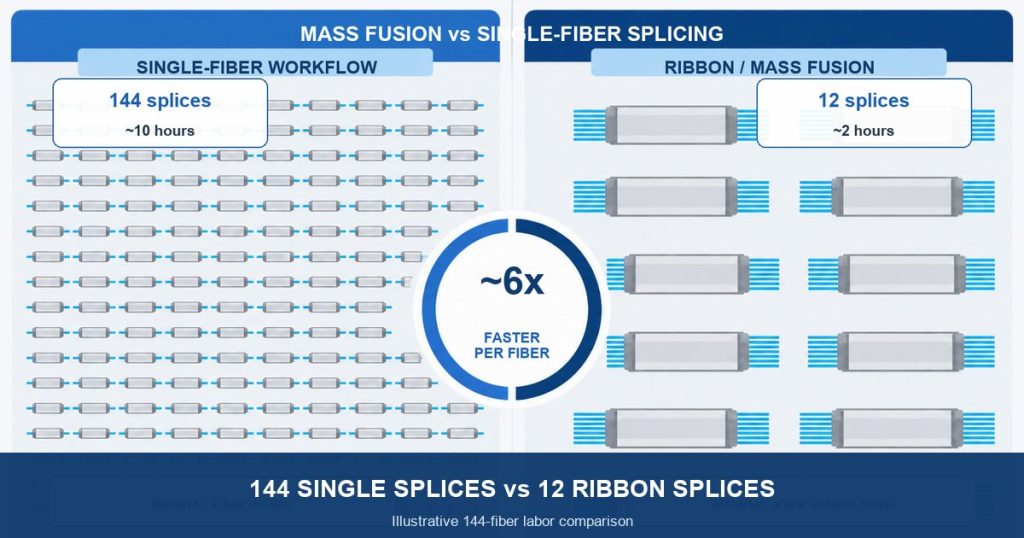
- Single-fiber and ribbon fiber splice sleeves
- Standard and custom diameters from 0.7 mm to 3.0 mm
- Lengths from 25 mm to 60 mm and custom sizes
- Polyolefin, PE, transparent, and colored outer tubes
- Carbon steel, 304 stainless steel, ceramic, and quartz rod options
- RoHS and REACH compliant materials
- Telcordia GR-1380 / Bellcore test reports available
- Bulk, wholesale, sample, and OEM/ODM packaging
- Private-label and custom branding programs
- Export carton packing and HS code support
Learn more about BWNFiber: about BWNFiber and our manufacturing capabilities
If you need a fiber splice sleeve manufacturer as a long-term partner, send us your RFQ details — we answer with numbers and back them with samples you can test.
Frequently Asked Questions
Q: What is the difference between a fiber splice sleeve manufacturer, distributor, and exporter?
A: A manufacturer owns production. A distributor holds stock and sells locally. An exporter handles shipping and documentation, often without owning a factory. Choose a manufacturer for bulk and customization, a distributor for speed, and an exporter for mixed imports.
Q: What MOQ should I expect for custom fiber splice sleeves?
A: Custom dimensions usually start at 10,000–50,000 pieces. Private-label packaging can start lower, around 5,000–10,000 pieces. Stock standard sizes may have MOQs as low as 1,000 pieces.
Q: How do I verify a fiber optic splice protection sleeve factory?
A: Request a live video tour, ISO 9001 certificate, extrusion and assembly photos, rod incoming inspection records, and a sample lot for testing. If the supplier refuses any of these, move on.
Q: Do I need to visit the sleeve factory in person before ordering?
A: Not necessarily. A live video tour, a verified business license, and a third-party pre-shipment inspection cover most of what a visit would confirm. Visit in person only for very large annual contracts, or when the supplier cannot provide the records this guide lists.
Q: Where are most fiber optic splice sleeve manufacturers located?
A: The majority are in China, concentrated in Sichuan (Chengdu) and Guangdong, with additional suppliers in India and the United States. Location matters less than evidence: extrusion lines, capacity numbers, and batch records.
Q: What certifications should a reliable splice sleeve supplier have?
A: At minimum, RoHS for global telecom and REACH for Europe. Carrier projects often require Telcordia GR-1380 or Bellcore. Automotive or utility projects may ask for PPAP or COA per lot.
Q: Can I get OEM, ODM, or private-label fiber splice sleeves?
A: Yes. OEM means you provide the spec. ODM means the factory provides the design and you brand it. Private label means standard product with your logo and packaging. MOQ and tooling cost vary by model.
Q: What is the typical lead time for bulk fiber splice sleeve orders?
A: Stock sizes ship in 2–4 weeks. Custom sizes take 4–6 weeks after sample approval. Bulk container loads of 100,000+ pieces may take 6–10 weeks depending on raw material availability.
Q: How are fiber splice sleeve prices calculated?
A: Price depends on tube material, rod material, length, diameter, compliance testing, packaging, and order quantity. The biggest price jumps come from stainless steel or ceramic rods and from custom private-label packaging.
Q: What should I include in an RFQ for custom fiber splice sleeves?
A: Include fiber type, coated diameter, sleeve length and inner diameter, rod material, outer tube material, compliance requirements, packing quantity, labeling needs, target quantity, destination, and incoterms.
Q: Why are samples non-negotiable before a bulk order?
A: Samples prove the supplier can produce the spec once. A pilot lot proves the line can repeat it. Neither gate is optional: every failure this guide describes was visible at sample stage.
Q: What Incoterms are common when buying fiber splice sleeves from China?
A: FOB, CIF, and DDP are the most common. FOB gives you freight control. CIF gives you a predictable port cost. DDP gives you door-to-door simplicity but usually costs more.
Q: What payment terms should I expect from a fiber splice sleeve manufacturer?
A: T/T with 30% deposit and 70% against the bill of lading is the standard for most orders. L/C at sight is common above USD 50,000. For a first order with an unverified supplier, use escrow or Alibaba Trade Assurance, and never agree to 100% advance payment.
Q: How do I avoid low-quality fiber splice sleeve suppliers?
A: Check for ISO 9001, ask for a factory video, request RoHS/REACH/Telcordia reports, run sample tests, and compare quotes against a detailed spec. If the price is far below market, ask why.
Q: Is a very low MOQ a sign of a fiber splice sleeve trader?
A: Not by itself. Real factories keep MOQs as low as 1,000 pieces for stock sizes they already run. The warning sign is a supplier who accepts tiny custom orders, has no stated daily capacity, and cannot show the production line. That combination usually means a trader, not a manufacturer.
Q: Does BWNFiber offer wholesale, sample, and OEM/ODM fiber splice sleeves?
A: Yes. BWNFiber supplies wholesale and bulk fiber splice sleeves, sample packs for evaluation, and OEM/ODM/private-label programs. Contact us with your RFQ details for a fast quote.
Related Reading
- Fiber Optic Splice Sleeve: The Complete Buying & Specification Guide
- Fiber Splice Sleeve Materials & Compliance: PE, Polyolefin, Steel vs Ceramic
- Fiber Splice Sleeve Size Guide: Diameter & Length Selection
- Single Fiber vs Ribbon Fiber Splice Protection Sleeve Guide

Request a Quote or Samples
BWNFiber is a fiber optic splice protection sleeve manufacturer and supplier. Whether you need standard stock, custom sizes, OEM/ODM, or private-label packaging, we return a spec-matched quotation and ship with full export documentation.
Related BWNFiber products: standard and custom fiber optic splice sleeves · contact us for a project quote
📧 [email protected]
📞 +86-13615744790 (WhatsApp)
🌐 Visit our website
This guide is for internal reference and project planning. Data as of 2026-09-26.
BWNFiber · Business Intelligence Excellence