Specification notice: This selection framework is for reference only. It is not a product specification or performance guarantee. Confirm the exact part number, interface drawing, materials, test conditions and acceptance limits for the ordered model before release.
Already have a panel drawing, port list or replacement sample? Keep it beside the schedule below. Those records expose unresolved positions before price comparison or quotation.
Quick answer
A fiber optic adapter is a passive mechanical interface that mates two connectorized fiber ends and maintains their alignment. A bulkhead adapter performs that function through a panel or enclosure wall. Cylindrical-ferrule connectors commonly rely on an internal alignment sleeve, while MPO interfaces align through guide pins and guide holes at the ferrule.
For purchasing, the connector family is only the starting point. Each position should identify both mating interfaces, polish and fiber system, port format, alignment or MPO keying, mounting and cutout, panel thickness, installed clearance, service environment and approval evidence. Compare suppliers only after those fields refer to the same configuration. If drawings cannot close fit, replacement identity or mating compatibility, request a traceable sample. If a critical field remains unknown or contradictory, keep that position on hold rather than approving a family-level match.
Key conclusions:
- An adapter joins connectorized interfaces; an optical splitter or coupler changes the optical power path.
- Housing color is a useful cue, not approval evidence for polish, fiber system or model identity.
- Panel fit must be checked with the mating connectors, cable route, door and service tools installed.
- Mechanical fit, end-face inspection, attenuation, return loss, MPO polarity and environmental suitability require different evidence.
Quick decision rule: do not release an adapter by connector name or housing color alone. Confirm the function, both mating interfaces, panel geometry, installed environment and required acceptance evidence. If a critical field is unknown, use a traceable sample or keep the position on hold.
Name the function before naming the part
The word “coupler” causes avoidable errors in adapter requests. It can mean a mating adapter that joins two connectorized interfaces. It can also mean a passive device that splits or taps optical power. The buyer should state the required action before selecting a catalog item.
| Term in the request | Function to confirm | Port logic | Information required for review |
|---|---|---|---|
| Mating adapter | Retains and aligns two compatible connectorized interfaces | One opposed mating path per port | Connector family on side A and side B, polish and fiber system, alignment method, port format and mounting |
| Bulkhead adapter | Provides a mating interface through a panel or enclosure wall | Usually one inline path per port | All mating-adapter fields, plus cutout, panel thickness, retention method, sealing requirement and installed clearance |
| Equipment receptacle or port | Exposes the optical interface of a transceiver, instrument or active device | Defined by the equipment | Equipment make and model, interface standard, approved mating connector and access constraints |
| Optical coupler or splitter | Intentionally splits, taps or combines optical power | Branching ports such as 1×2 or 2×2 | Topology, coupling ratio, wavelength range, optical limits, package and terminations |
An “LC coupler” often refers to an LC-to-LC mating adapter. An FBT coupler is a different component because it changes the optical power map. If the design calls for a split or monitoring tap, move the request to the FBT splitter and optical coupler category. Do not try to resolve the ambiguity with the product name alone.
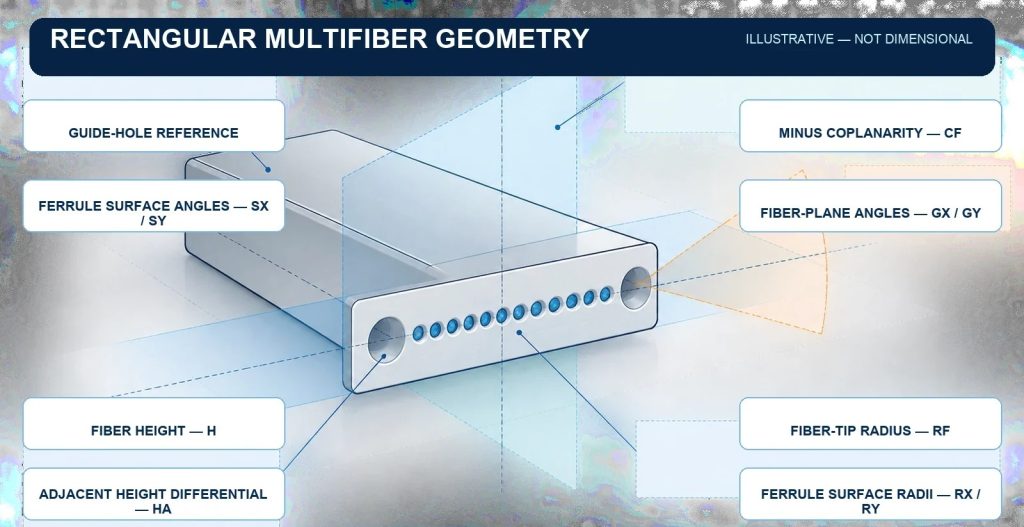
The alignment method also depends on the interface. LC, SC and other cylindrical-ferrule families commonly use an alignment sleeve inside the adapter. MPO connectors align through guide pins and guide holes at the ferrule interface; the adapter body controls engagement and key orientation. A request such as “ceramic sleeve MPO adapter” mixes two alignment architectures and needs clarification before quotation.
IEC 61754-4 defines the SC connector-family interface, while IEC 61754-20 defines the LC family. Those standards define interfaces; they do not certify a supplier’s adapter model.
Specify the panel position, not just the adapter
An adapter can match the connector family and still be wrong for the panel. The cutout may fit while the clip cannot engage the plate thickness. A rear boot may hit the door or force the cable route into an unacceptable bend. A cleaning tool may be blocked after the neighboring ports are populated.
Build one schedule row for every panel position, including spare ports. Review that schedule against the panel drawing and the exact adapter model record.
| Schedule field | What to record | Release check |
|---|---|---|
| Panel and position ID | Rack, chassis, plate and port number | Matches the controlled port map and label plan |
| Side A and side B interface | Same-interface pair or both sides of a hybrid adapter | Both plugs are named; a hybrid position is not reduced to “LC adapter” or “SC adapter” |
| Polish and fiber system | Project-approved connector end face and single-mode or multimode system | Matches the connected cords and equipment interface; housing color is not approval evidence |
| Alignment and keying | Sleeve declaration for cylindrical interfaces; MPO keyway, connector gender and key orientation where applicable | Matches the exact connector drawings and the complete polarity method |
| Port format | Simplex, duplex, quad or the exact multi-fiber interface | Matches panel density, labeling and service access |
| Mounting and cutout | Flange, reduced flange, screw, clip, snap-in or threaded bulkhead; cutout and hole pattern | Adapter and panel drawings use the same dimensions and revisions |
| Panel thickness and retention | Allowed plate thickness, clip or nut engagement, fastener and torque when specified | Retention is approved for the installed panel material and thickness |
| Installed clearance | Rear connector body, strain relief, cable route, door and tool access | The assembled connection fits; the check is not limited to the empty adapter body |
| Environment and protection | Indoor, controlled cabinet, shuttered or dust-protected, or a named hardened connector system | Any sealing or environmental claim belongs to the exact mated system and its test record |
| Approval evidence | Part number and revision, dimensioned drawing, material declaration, applicable test conditions, sample record and label requirement | Each claim maps to the quoted model rather than a generic family table |
If a row still contains an unknown interface, cutout, keyway or environmental requirement, keep it open. Send the panel drawing and incomplete schedule for model review before comparing offers.
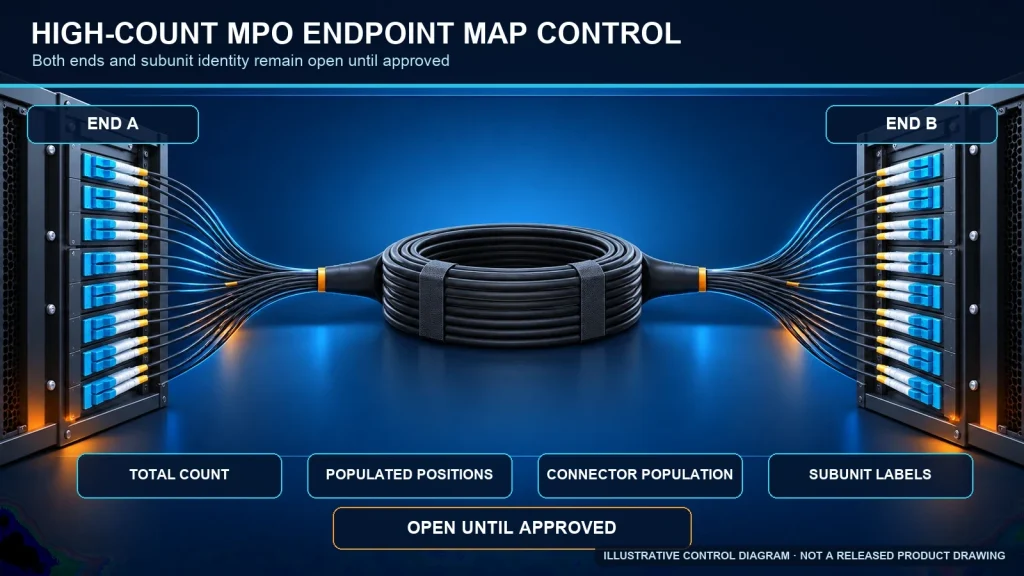
For an MPO position, recording “Type A” or “Type B” in the adapter row does not solve the channel. Record the adapter keyway and connector gender, then link that row to the approved fiber map, connector orientation and complete polarity method in the MPO connectivity design. Center-key and offset-key interfaces must also be kept distinct in the approval record.
A hybrid adapter needs the same discipline on both sides. “SC to LC” is incomplete until the polish and fiber system, mounting body, cutout, installed clearance and exact approved model are recorded. Use the fiber optic patch-panel owner for chassis capacity, cable management and panel-level selection.
What should the supplier return?
The review should return a quoted part number and revision, a dimensioned drawing, the panel cutout, the declared alignment or keying details, applicable test conditions and a list of exceptions. If a requested field cannot be confirmed, it should remain open rather than being filled from a similar family table.
This response gives the buyer a record that can move into drawing approval, sample review and incoming inspection. It also exposes disagreements before the panel is drilled or the purchase order is released.
When should the position be held?
Hold the position when:
- the model name and drawing revision do not agree;
- only one side of a hybrid interface is defined;
- housing color is the only evidence for polish or fiber compatibility;
- an MPO keyway or mating gender is missing;
- the empty body fits but the assembled connector, cable route or cleaning tool does not;
- a family-level loss, durability or environmental value has been copied to an unverified model; or
- the supplier cannot state the test condition behind a quoted value.
For troubleshooting after installation, separate adapter fit from connector cleanliness, end-face condition and measurement method. The guide to common causes of connector loss covers those checks in more detail.
Match the acceptance method to the risk
A panel-fit review and an optical acceptance test answer different questions. Passing one does not prove the other. Define the test object, reference method, wavelength, launch condition, limit and sample plan before a value is used for release.
| Risk to control | Appropriate evidence | What it does not prove |
|---|---|---|
| Wrong cutout, plate thickness or retention | Revision-controlled adapter and panel drawings, followed by an assembled sample-fit check | Optical performance |
| Contaminated or damaged connector end face | Inspection under the project procedure; IEC 61300-3-35 provides visual-inspection methods and criteria | Attenuation or return loss; the standard states that inspection does not replace optical measurement |
| Excess attenuation through the mated connection | A defined attenuation measurement, with the method and conditions recorded; IEC 61300-3-4 describes methods for optical-component attenuation | Which physical item caused the result unless the test plan isolates it |
| Unacceptable reflection | A defined return-loss measurement under the project method; IEC 61300-3-6 covers return-loss measurement of the device under test | Panel fit, cleanliness or end-to-end polarity |
| Wrong MPO path | Connector-gender and keyway checks plus end-to-end continuity and polarity verification against the approved fiber map | That every link in the channel meets its loss limit |
| Outdoor or hardened-port exposure | Evidence for the exact complete mated connector system and its declared service environment | Sealing or environmental performance of a different plug, receptacle or adapter combination |
An OTDR can help locate events in an installed link, but it is not a substitute for the specified component or channel acceptance method. Likewise, a generic family claim should not be transferred to an exact adapter model without the applicable test record. ANSI/TIA-568.3-E provides premises optical-fiber cabling and component context; citing it does not by itself demonstrate that a supplier model complies.
The measured result belongs to the defined mated connection, not automatically to the adapter body. Corning’s Fiber Optic System Testing Tutorial explains that connectors and adapters are evaluated as a mated connection rather than as independently measurable loss elements. A failed result therefore needs an isolation plan covering the reference cords, both connector end faces, seating, the adapter and the measurement setup.
Match the adapter to the operating position
The same connector family can require a different approval path when the position changes. Use the application to identify the dominant failure consequence, then complete the same position schedule rather than relying on a generic application label.
| Operating position | Dominant risk | Fields that deserve extra review | Release evidence |
|---|---|---|---|
| FTTH distribution box or ODF | Wrong project interface, contaminated open port or inaccessible service position | Project-approved connector and polish, port numbering, dust protection, technician access and replacement route | Controlled port map, panel drawing and approved mated sample |
| High-density LC patch field | Adjacent ports block latches, cleaning tools or rear cable routing | Duplex or quad footprint, port spacing, label visibility, rear boot clearance and door clearance | Populated-panel fit review, not an empty-panel check |
| MPO cassette or trunk interface | Keyway, mating gender or fiber map does not match the channel design | Exact MPO interface, center-key or offset-key format, connector gender, key orientation and polarity-method reference | Drawing review plus end-to-end continuity and polarity verification |
| Equipment, instrument or legacy replacement | The catalog name matches while the receptacle, key or mounting body differs | Equipment make/model, approved mating connector, both hybrid sides, key width or orientation, cutout and access | Equipment-interface record and physical sample when the installed part is uncertain |
| Outdoor or hardened connection point | A generic adapter or dust cap is mistaken for a sealed mated system | Named plug and receptacle combination, mounting wall, sealing interfaces, service environment and protective cap state | Exact complete-system drawing and applicable environmental record |
These are review scenarios, not claims about a specific BWNFiber deployment. A real case should be added only when the configuration, observed problem, verification record, corrective action and publication permission are available.
Compare supplier offers on the same approved configuration
A lower unit price is not a valid comparison if the offers refer to different mounting bodies, evidence packages, test conditions or exception lists. Normalize the technical and commercial basis before comparing suppliers.
| Procurement stage | Buyer sends or controls | Supplier should return | Hold condition |
|---|---|---|---|
| RFQ normalization | Position schedule, drawings, quantity, packaging, destination and requested delivery basis | One quoted part number and revision for each position, plus stated assumptions | A family name or generic photo is used in place of an exact model |
| Technical submittal | Required interface, mounting, environment and acceptance fields | Dimensioned drawing, material declaration, declared interface/keying, test method and conditions, and a line-by-line exception list | A value has no test object, method or model traceability |
| Sample approval | Approved comparison plan and sample identity | Labeled sample tied to the quoted revision and supplied records | The sample cannot be traced to the production offer |
| Incoming inspection | Purchase-order revision, approved sample and sampling plan | Lot/label traceability and any agreed conformance records | The delivered label, drawing revision or material declaration differs from approval |
During sample review, check the adapter in the assembled panel with the intended mating connectors. Record retention, installed clearance, latch and tool access, labels, dust protection, MPO orientation where applicable, and the project-defined optical checks. A pass on one sample does not establish an undisclosed production claim; the purchase order should state which records, sampling and change-notification rules continue into supply.
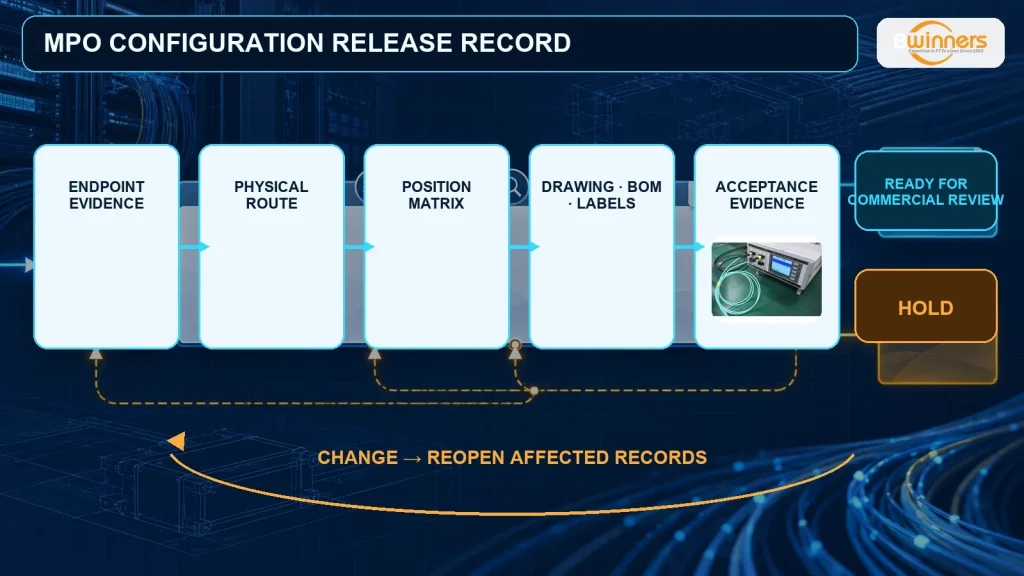
Release each position with one visible status
Do not hide unresolved technical questions inside an email chain. Give each position one of three statuses and keep the reason beside the controlled part and drawing revision.
| Status | Minimum basis | Buyer action | Supplier response |
|---|---|---|---|
| Ready for quotation | Both interfaces, panel geometry, environment and required evidence are closed | Compare the price, quantity, packaging, destination and delivery basis against the same approved revision | Quote the exact model and revision, and state assumptions and exceptions |
| Sample required | Identity, assembled fit or mating compatibility cannot be closed from controlled records | Define the sample identity, fit checks, optical checks and approver before testing | Supply a labeled sample tied to the proposed production revision and records |
| Hold | A critical field is missing, contradictory or supported only by a family claim | Keep the position out of technical approval and purchase release | Return the open field, required evidence and affected offer line without guessing |
The approval record should show the panel and position ID, candidate part and revision, status, open fields, required evidence, buyer approver and decision date. That record gives purchasing, engineering, panel assembly and incoming inspection the same release basis.
Localize the approval pack, not the optical interface
The connector and adapter interface does not change because the shipment crosses a border. The project approval pack may change because the site conditions, contract, adopted standards, documentation, labeling, packaging and import process are different. Treat every regional note as an RFQ question, not as a shortcut based on geography.
| Market or project region | Conditions and documents to confirm in the RFQ | Do not assume |
|---|---|---|
| North America | Project-specified ANSI/TIA or FOCIS references where applicable, panel and equipment requirements, requested safety or material records, label format, named delivery place and import responsibility | A TIA reference proves that an exact adapter model complies, or every project uses the same acceptance limit |
| Europe | Controlling IEC or adopted EN references, buyer-requested RoHS/REACH or material declarations, label language, packaging obligations, named delivery place and importer requirements | A generic CE statement applies to every passive adapter or replaces model-specific evidence |
| Middle East | Actual indoor or outdoor location, temperature range, dust, UV, salt exposure, cabinet sealing, local authority or operator specification, document legalization if contractually required, and destination logistics | One climate profile or one national requirement represents the entire region |
| Southeast Asia | Actual humidity, condensation, heat, flood or coastal exposure where relevant, indoor/outdoor enclosure design, operator specification, label language and import documents | All sites need a hardened interface or the same moisture-protection evidence |
| Latin America | Operator or EPC specification, altitude, humidity, coastal or industrial exposure where relevant, Spanish or Portuguese document needs, delivery terms and customs records | One language, climate or approval route applies to every country and project |
| Africa | Project and operator standards, dust, heat, humidity, coastal or high-altitude exposure where relevant, spare-position protection, transport packaging, destination access and customs documents | Price is the primary selection rule or one logistics plan covers the continent |
For any destination, state the named delivery place and agreed trade-term version, required invoice and packing-list fields, country-of-origin or customs records where applicable, carton labels, quantity per pack, dust-cap or shutter state, and drawing/sample approval milestones. Separate sample lead time, technical-approval time, production time and transit/customs time.
If the buyer requests OEM labeling, nonstandard packaging or a modified mounting body, treat it as a controlled requirement. Confirm feasibility, drawing ownership, marking content, minimum order, validation, change control and commercial terms before describing it as an available BWNFiber capability.
Request an adapter schedule review
What should you send?
Send the panel drawing or cutout, position list, connector interface on both sides, polish and fiber system, MPO keyway and gender when applicable, mounting method, environment, quantity, packaging and destination, requested delivery basis, and required approval records. If this is a replacement, include the installed equipment reference and clear views of both sides of the existing part.
What can BWNFiber return?
BWNFiber can compare the request with currently available model records. The review should return either an exact candidate part number and drawing revision for buyer confirmation, or a visible list of open fields, assumptions and exceptions. It should not convert an incomplete family match into a production recommendation.
What happens next?
- Close any open interface, panel, environment or acceptance field.
- Confirm that every supplier offer refers to the same approved configuration and commercial basis.
- Review the exact drawing and any agreed model-specific records.
- Request a labeled sample when fit, replacement identity or mating compatibility cannot be closed from controlled records.
- Release the quotation or purchase order only against the approved revision, sample status and required supply records.
Final release still depends on the exact drawing, stated test conditions and the buyer-approved sample where required. Request an adapter schedule and model review.