
ECOC 2026 gave AI infrastructure teams fresh reasons to revisit their optical roadmaps. It also sharpened a practical question: which developments belong in a technology watchlist, which justify a qualification project, and which are ready to change a purchase order?
Our assessment is that procurement teams should maintain separate records for technology capability, product availability, and deployment approval. A promising demonstration can justify engineering work without establishing that a complete, supported system is ready for production. That distinction matters when switches, transceivers, fiber assemblies, and facility schedules are being selected by different teams.
This September 26 review connects two official announcements from the week of September 20–26 with a decision framework for network planners. It is an analysis of published information, not a report of hands-on testing or attendance at the exhibition.
What changed in the optical roadmap this week?
On September 20, Marvell announced ECOC demonstrations covering 2 nm optical technologies, including 400G-per-lane optical PAM4, 800G ZR/ZR+ with MACsec, and 1.6T ZR and O-band coherent-lite technologies. The announcement also included its 102.4T co-packaged optics platform. These are vendor-described demonstrations; the announcement should not be read as a blanket statement of production availability for every implementation. Marvell announcement
On September 21, Lumentum announced plans to demonstrate an eight-wavelength dense wavelength division multiplexing (DWDM) external laser module in the External Laser Small Form Factor Pluggable (ELSFP) format for Optical Compute Interconnect Multi-Source Agreement (OCI MSA) applications. It identified co-packaged optics (CPO) and near-packaged optics (NPO) as intended applications and projected initial availability in the first half of 2027. That timing is a company expectation, not a delivery commitment for a particular customer. Lumentum announcement
Read together, these announcements put both faster signaling and the physical organization of optical systems on the planning agenda. Our inference is that evaluating the next speed generation will require more than comparing headline bandwidth. Buyers should ask how the system is assembled, maintained, qualified, and supplied.
Start with the deployment question
Before comparing architectures, write one sentence describing the problem the project must solve. Examples include connecting additional accelerator racks inside a building, increasing capacity between facilities, or reducing congestion in an existing patching field. These are different projects, even when their presentations use similar AI terminology.
Then describe the installed environment. Record the equipment families, optical interfaces, routes, available space, maintenance ownership, and deadline. A team that starts with a technology label can spend weeks evaluating an attractive option that does not address its immediate constraint. A team that starts with the deployment question can identify which announcement deserves a closer look.
Keep the current build and the future platform evaluation in separate workstreams. The current build needs an approved configuration and a delivery plan. The future platform evaluation needs test access, engineering time, and explicit decision criteria. Neither workstream should silently borrow the other’s assumptions.
Use three evidence levels in purchasing discussions
A simple evidence register prevents a public announcement from turning into an unsupported specification. Assign each important statement to one of three levels, and keep a link to the document that supports it.
| Evidence level | What the team actually has | Appropriate next action |
|---|---|---|
| Announced capability | A dated release or demonstration description | Add a watchlist item and define open questions |
| Qualifiable product | An identified revision, documentation, samples, and a test plan | Run a bounded evaluation with recorded conditions |
| Approved configuration | Accepted test results and a documented purchasing configuration | Release the defined scope through project controls |
This is an editorial planning framework rather than an industry certification scheme. Its value comes from making the missing evidence visible. A supplier may have excellent technology while a specific customer configuration remains unqualified. Conversely, a mature component can still fail a project review if the required documentation or service process is absent.
Attach an owner and a next review date to every open question. “Awaiting information” is not a useful long-term status unless someone is responsible for requesting the information and deciding what happens when it arrives.
Separate optical architecture from the cable order
Terms such as co-packaged optics, near-packaged optics, coherent pluggables, and external laser sources describe different aspects of an optical system. They are not cable part numbers. For a procurement team, the useful question is where its responsibility begins and ends within the proposed design.
Ask the equipment supplier to mark the interfaces that are factory integrated, field replaceable, or customer supplied. Then identify the physical connection at each customer-supplied boundary. Do not assume that a familiar aggregate data rate identifies the connector, fiber count, polish, or channel mapping.
The same discipline applies to an existing pluggable deployment. BWNFiber’s 1.6T transceiver connector guide addresses the separate task of reading the actual port configuration. Use a connector guide to organize questions, then resolve those questions against the exact equipment documentation and approved revision.
A cable request should therefore reference a controlled interface record. If the equipment choice changes, that record must be reviewed before the associated assembly order is released. This reduces the chance that an early planning assumption survives into a final bill of materials.
Product choices for the passive connection scope
Once a project has defined its customer-supplied optical interfaces, two practical decisions remain: how to carry fibers along the route and how to terminate them at the patching boundary. The following products illustrate those separate decisions within our current catalog. They are not evidence of qualification with the newly announced ECOC systems.
Route planning: a pre-terminated MMC trunk
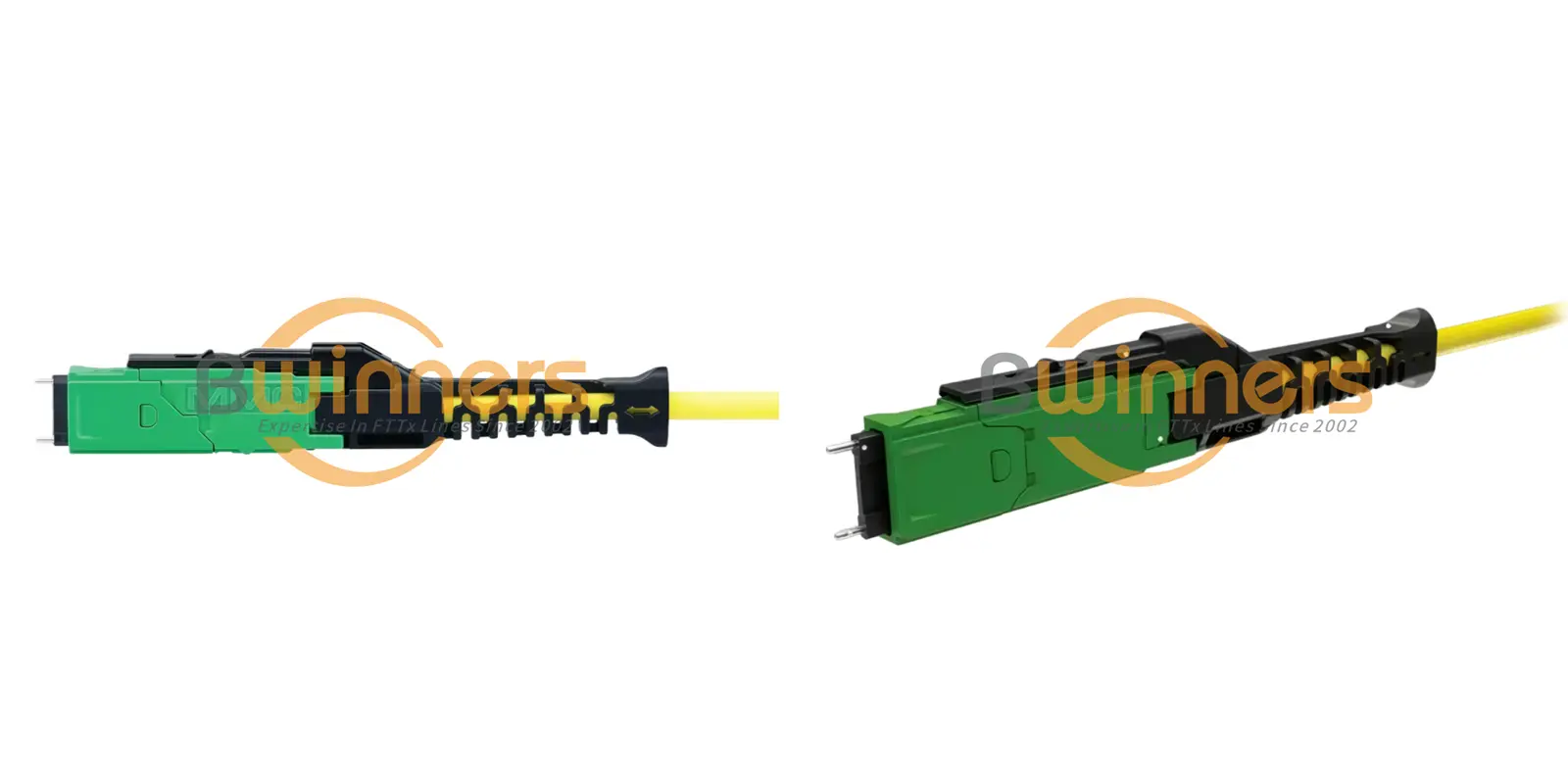
The pre-terminated 4× MMC-MMC trunk cable is a product to review when both ends of a planned trunk are specified for MMC. Use the route drawing to request the required length, connector map, jacket, labels and installation protection. If the retained infrastructure ends in MPO, this MMC-MMC trunk alone does not provide the transition; define that boundary separately.

Interface planning: MMC connectors and adapters
For the patching boundary, review the MMC connectors and adapters for VSFF fiber panels against the actual panel drawing and mating-component details. Confirm the required fiber count, gender, polish and mounting arrangement. A small connector footprint does not establish compatibility with an unspecified panel or optical engine.
For a useful quotation, send the product team the approved interface record together with the route and panel drawings. Request the specific assembly and acceptance documentation required by your project, rather than a general claim of readiness for an advertised network speed.
Evaluate serviceability as a project requirement
Lumentum’s external-source announcement gives planners a reason to ask a broader question: what must a technician replace when one part of the optical system needs attention? The answer needs to come from the proposed system’s service documentation, not from the name of an architecture.
For each candidate design, request a service sequence. Identify the replaceable unit, the tools required, the access path, the work area, and the acceptance checks after replacement. Ask whether adjacent connections must be disturbed and which team owns the work. Record any required training before scheduling a trial.
Then test the service sequence in the intended physical arrangement. A laboratory setup with unrestricted access does not automatically represent a populated rack. The review should include labeling, identification, cable support, replacement handling, and the ability to match a physical link to its documentation.
Avoid assigning a numerical reliability or downtime benefit without supporting measurements. A maintainable design is a project objective; the achieved result depends on the selected implementation and operating process. This distinction keeps a useful design discussion from becoming an unsupported performance claim.
Build a qualification plan before requesting samples
A sample evaluation should begin with a written decision, not a shipment. State what must be learned and what evidence would change the purchasing decision. Otherwise, a successful demonstration can leave the project with no answer to its original question.
A practical qualification record should identify the equipment and firmware revisions, interface drawings, assembly configuration, installation arrangement, and test owner. It should also name the acceptance criteria and the source of each limit. If a requirement has not been established, mark it as unresolved rather than borrowing a number from a different application.
Separate component acceptance from end-to-end system acceptance. A report for an individual assembly does not, by itself, approve the entire network path. Likewise, a system demonstration does not necessarily document the production configuration of every passive component that will be ordered later.
At the review meeting, capture both the result and its boundaries. “Passed” should mean a specific configuration met specified criteria under recorded conditions. It should not become shorthand for every product in the same family or every future revision.
Keep supply planning separate from technology confidence
A technical roadmap can be convincing while its purchasing schedule remains uncertain. Ask suppliers for the milestones relevant to your project: documentation release, sample access, qualification support, orderable configuration, and delivery planning. Keep forecasts visibly separate from agreed commitments.
For a near-term deployment, define what happens if a milestone slips. The alternative might be keeping the currently approved architecture, reducing the initial scope, or separating an experimental segment from the production build. The correct choice depends on the project’s operational requirements and contractual obligations.
Avoid describing a new component as a direct substitute until its interfaces and operating requirements have been checked. A procurement comparison should include the cost and schedule of qualification, installation changes, spares, and support. Unit price alone cannot explain the effort required to introduce a different architecture.
This is also a useful point to reconcile the engineering and purchasing calendars. A late interface change can affect assembly drawings, labels, sample approvals, and delivery dates even when the headline network capacity remains unchanged.
What fiber infrastructure teams can do now
The most useful immediate action is to improve the interface information attached to the next project. Inventory the links that are already approved, the links whose equipment selection remains open, and the links reserved for evaluation. Do not mix those states in one undifferentiated cable schedule.
For high-density connection planning, our MMC solutions catalog provides a starting point for assembly discussions. Product selection still needs a confirmed equipment interface and project-specific review; this article does not claim that those assemblies have been qualified with the newly announced systems.
Before your next supplier meeting, bring an interface drawing, route schedule, acceptance requirements, and a list of unresolved decisions. Ask for a configuration review rather than a generic claim of readiness for a particular speed generation. Send that material to [email protected] when the discussion reaches the passive connection scope.
Questions to close before changing the BOM
Can the team identify the exact product revision under evaluation? Is the availability statement dated and attributed? Are the customer-supplied interfaces documented? Who accepts the installed link, and what evidence is required? Which changes would trigger requalification?
If those questions remain open, keep the item in evaluation. If the answers are documented and approved, carry them into the purchase order and handover package. The useful outcome of ECOC 2026 is a clearer engineering decision, with a traceable path from announcement to qualification to deployment.
Contact phone: +86-13615744790.


