I was on a project in Brazil where the cable route crossed a soybean field. The client wanted to use standard direct-burial cable to save cost. I recommended armored cable instead. Six months later, a harvester clipped the cable in a neighboring field. Our armored section survived. The non-armored section did not.
Harsh environments need harsh-environment cables. This guide covers three specialized outdoor types — armored fiber optic cable (GYTA, GYTS, GYTA53), ADSS aerial cable, and OPGW — including the model codes and specification values you need to order the right construction.
Quick answer: Armored cable (GYTA53) is for buried routes with dig or rodent risk. ADSS is for aerial routes on poles, selected by span rating — 50 m urban to 1,000 m long-span — with an anti-tracking jacket near power lines. OPGW is for high-voltage transmission towers and is bought with utility short-circuit data. All three are single-mode G.652.D constructions: armored cable follows YD/T 901 / IEC 60794-1, ADSS follows IEEE 1222, OPGW follows IEEE 1138. Send your route length, installation method, longest span, and corridor voltage to get comparable quotes from any serious manufacturer.
What You Will Learn

- When to use armored fiber optic cable, and which of GYTA, GYTS, or GYTA53 you actually need
- The other armored codes that appear in quotations — GYXTW, GYFTY53, GYTA33/333 — and where each belongs
- Armored cable specifications: tensile strength, crush resistance, bend radius
- How ADSS cable works and how to select a span rating
- What OPGW cable is, how it is built, and who buys it
- How to choose between these cable types
If your route is already surveyed, jump to What to Send the Manufacturer below — or send it to us and we will return a matched cable spec.
Armored Fiber Optic Cable
Armored cable adds a metal protective layer between the cable core and the outer jacket. The armor protects against:
- Rodents
- Crushing loads from soil, rock, and traffic
- Digging accidents
- Abrasion in rocky soil
The mistake I see most often is treating “armored” as one product. It is not. The armor type decides where the cable can survive, and the model code tells you the armor type.
Armored Cable Model Codes: GYTA, GYTS, GYTA53
Export datasheets use the YD/T 908 designation system. Three codes cover most armored requirements, and confusing them is the most common armored-cable procurement error:
| Model Code | Armor / Barrier Type | Direct Burial? | Best For |
|---|---|---|---|
| GYTA | Aluminum-polyethylene laminate (APL) — moisture barrier only | No | Duct and lashed aerial; moisture protection without mechanical armor |
| GYTS | Corrugated steel tape (PSP) | Not recommended | Duct routes needing crush and rodent resistance |
| GYTA53 | APL + corrugated steel tape between two PE sheaths | Yes — the default | Direct burial, rocky soil, high dig-risk routes |
Read the middle letters carefully: in GYTA, the A means aluminum tape — a moisture barrier, not armor. I have watched contractors bury GYTA because the datasheet said “outdoor cable” and then wonder why a backhoe took it out. For direct burial you want GYTA53 or GYTS53: double sheath with corrugated steel tape between the PE layers.
For submarine and river crossings there are heavier constructions — GYTA33 (single) and GYTA333 (double) with round steel wire armor rated to tens of kilonewtons. Those are specialized projects with their own engineering; the sleeve note in the OSP section below still applies to their joints.
Two more codes appear often in quotations and deserve a warning label. GYXTW is light armored cable: a central loose tube wrapped in corrugated steel tape under a single PE sheath, common in 2–24 fiber counts for duct and lashed aerial runs. It has steel in it, but it is not a burial-class construction — for direct burial, the 53-series still applies. GYFTY53 looks similar on a datasheet but solves a different problem: it swaps the steel central strength member for glass-reinforced plastic (FRP) while keeping the corrugated steel tape armor and double-sheath burial build. With no continuous metal core, it is the standard recommendation for lightning-prone regions and power-corridor burial routes. The steel tape armor is still metallic and still gets bonded.
One more label appears in North American quotes and should not join this comparison: AIA (aluminum interlock armor) is an indoor distribution cable format for the plenum and riser market. It is not an export OSP construction, so keep it out of any GYTA53 price comparison.
For direct burial, the model follows the route:
| Route Scenario | Default Model | Why |
|---|---|---|
| Normal soil, low traffic | GYTA53 | Best balance of cost and protection |
| Rocky fill, shared trench, road crossing | GYTA53 | Double sheath and steel tape handle point loads and dig risk |
| Rodent-prone rural area | GYTA53 | Corrugated steel tape stops gnawing |
| Lightning-prone or power-corridor burial | GYFTY53 | FRP core removes the longitudinal metal path that carries induced current |
| River crossing or underwater section | GYTS33 / GYTA333 | Steel wire armor carries the tensile load |
Regional Conditions That Move the Spec
Route risk is local; climate is not. Four conditions change the specification before any pole is planted:
- High-UV deserts. Standard PE weathers faster under sustained heat and sunlight. For Middle East, Central Asia, and African routes, specify the UV-stabilized PE grade and confirm the jacket compound on the datasheet.
- Frost regions. Burial depth follows the frost line, not the average. Northern China, Eastern Europe, and Canada commonly need 100–120 cm, not 60.
- Typhoon and monsoon coasts. Raise the ADSS span rating one step and default to double-jacket AT. Wind-driven swing, not static load, is what breaks under-rated spans.
- Polluted industrial corridors. Chemical pollution etches jackets faster than rural dust. Specify AT even at medium voltage.
Armored Cable Specifications
Typical values for quality cable meeting YD/T 901 and IEC 60794-1. Confirm against the manufacturer datasheet before contract:
| Parameter | GYTA / GYTS | GYTA53 (Double-Sheath) |
|---|---|---|
| Tensile strength | 600 N long-term / 1,500 N short-term | 1,000 N long-term / 3,000 N short-term |
| Crush resistance | 300 N/100mm long-term / 1,000 N/100mm short-term | 1,000 N/100mm long-term / 3,000 N/100mm short-term |
| Bend radius (static / dynamic) | 10–12.5× cable OD / 20–25× | 12.5× cable OD / 25× |
| Attenuation (G.652.D fiber) | ≤0.35 dB/km @1310 nm; ≤0.20 dB/km @1550 nm | Same fiber, same limits |
| Operating temperature | −40 °C to +70 °C | −40 °C to +60 °C |
| Fiber count | 2–144 (up to 288) | 2–144 standard; up to 288 common, 432 in ribbon construction |
PE is the default outdoor jacket in these constructions. Where the route transits tunnels or indoor handoffs, specify LSZH variants to satisfy low-smoke, zero-halogen fire codes.
Three field notes from burial jobs:
- Pull on the strength member, never the jacket. The 3,000 N short-term figure assumes correct pulling grip attachment. A jacket grip on a double-sheath cable can slip and transfer the full pull to the core.
- Bend radius is measured on the cable, not the trench. A 12.5× OD static bend on a 15 mm cable is ~190 mm — most backhoe buckets do not bend that gently.
- Bury below disturbance depth, and mark what you bury. 60–120 cm deep per local code, warning tape 30 cm above the cable, and 5–10 m slack loops at each splice point. The repair you planned for is the one that does not need a new cable pull.
These are build values, not marketing numbers. We hold armored fiber optic cable to YD/T 901 across the GYTA, GYTS, and GYTA53 range — request the datasheet for your model code and fiber count. To verify a supplier’s mechanical numbers against the IEC 60794 test methods — including the N/100 mm unit traps that make weak cables look strong — see our armored cable mechanical ratings guide.
Two procurement notes that belong in every armored cable purchase order:
- Metallic armor is conductive. Bond and ground steel tape or steel wire armor at splice and termination points per your local code. The methods are covered in our armored cable grounding and bonding guide.
- Armor costs money, and that is fine. Armored constructions typically run 15–30% above the equivalent non-armored cable. Burial-grade GYTA53 sits at the top of that band. Run the repair math before deciding against it: on a 10 km rural route the armor premium is a few thousand dollars, and a single dig-in repair — crew, excavator, splice, re-acceptance — runs to several times that before anyone counts the outage.
ADSS Fiber Optic Cable
ADSS stands for All-Dielectric Self-Supporting. It has no metal: the strength comes from aramid yarns or glass-reinforced plastic (GRP) rods, and the cable supports its own weight on poles and towers without a separate messenger. It is the default cable for aerial fiber routes; our aerial fiber optic cable guide covers the category in more depth.
ADSS Is Selected by Span Rating
The first question on any ADSS order is the span — the distance between supports. Standard designs are rated by span:
| Span Rating | Typical Use |
|---|---|
| 50 m | Urban pole lines, short facade crossings |
| 100 m | Standard distribution spans |
| 200 m | Long rural spans, river crossings |
| 400 m+ | Specialized long-span designs with heavy aramid content |
Higher span ratings mean more aramid or larger GRP rods, which means cost. Do not over-spec — a 100 m cable on a 60 m urban span is wasted money — but never under-spec, because an under-rated cable creeps and sags into its final failure over a few windy seasons. Manufacturers also stock intermediate ratings (80 m, 120 m, 150 m, 300 m) matched to actual pole spacing; whatever the rating, it must cover the longest single span on the route, not the average.
How to Measure Your Span Before Ordering
- Survey the route and record the distance between every pair of supports — do not trust the as-built drawing without checking.
- Set the span rating from the longest single span on the route. Average span is not a rating input.
- Add margin for future pole moves: if the longest span is 90 m, order the 100 m rating, not the 80 m.
Sag follows the catenary approximation S ≈ wL²/(8T) — unit weight times span squared, divided by eight times the installation tension. Use it to sanity-check a proposal, never to design one. For spans above 400 m, or any route in a high wind or ice district, expect the supplier to run a full sag-tension calculation on IEC 60826 loading principles — and be suspicious of a catalog rating offered without one.
Advantages
- No metal, so no grounding or induced-current problems near power lines
- Lighter than steel-messenger constructions
- Long aerial spans without separate support wire
- Fast installation with preformed suspension and dead-end fittings
The Anti-Tracking Jacket
On corridors near medium- and high-voltage lines, specify an anti-tracking ADSS jacket. Dry-band arcing on a polluted jacket surface can etch a conductive track straight through the sheath. Standard PE jackets are fine on ordinary telecom routes; near power lines, the anti-tracking grade is not optional. IEEE 1222 governs ADSS design and testing for these environments. Our working rule: on corridors above 66 kV, or spans longer than 600 m, specify double-jacket AT as standard. Below 200 m on a low-voltage distribution line, single-jacket PE is usually enough. Between those points, decide from the corridor voltage and the local pollution level.
We supply ADSS fiber optic cable in span ratings from 50 m urban spans to 1,000 m long-span designs, with aramid or GRP strength members and anti-tracking jackets for power-line corridors. Match the rating to your longest span, not your average one. We also supply the matched hardware — preformed tension clamps, suspension clamps, vibration dampers, and down-lead clamps — as a kit, because a cable is only as reliable as the hardware holding it.
OPGW Fiber Optic Cable
OPGW stands for Optical Ground Wire. It replaces the conventional overhead ground wire on high-voltage transmission towers, combining two functions in one strand:
- Lightning shield — aluminum-clad steel (ACS) wires carry fault and lightning current to ground, exactly like a normal ground wire
- Communications path — optical fibers sealed inside a stainless steel tube at the center (or between the ACS layers) give the utility a fully dielectric data highway along the tower line
OPGW is specified differently from ordinary fiber cable. Two constructions dominate the market: a central stainless steel tube — the default for most new builds — and stranded designs that embed the tube(s) between helical ACS layers for higher fiber counts and better flexibility. Utility buyers ask for:
- Short-circuit capacity in kA²·s — how much fault energy the ACS layers can carry without cooking the fibers
- Rated tensile strength — typically 50–200 kN depending on tower spacing and ice/wind loading
- Fiber count and type — usually 12–96 G.652.D fibers in the stainless tube
- IEEE 1138 compliance — the governing OPGW standard
Installation is done by power utility crews during line construction or maintenance, with splices made in specialized closures on the towers. If you are an ISP building an FTTH network or a contractor on a data center interconnect, OPGW is not your cable — it is utility transmission infrastructure. If you are a utility or a contractor serving one, it is the backbone you plan the network around.
Armored vs ADSS vs OPGW
These three cable types solve three different problems, and choosing wrong is expensive to undo. Armored cable survives underground. ADSS hangs on poles. OPGW lives on transmission towers. The table maps the differences; the four questions below turn them into a selection. If the decision is strictly between ADSS and OPGW — a power-corridor question with its own installation, cost, and maintenance trade-offs — our dedicated ADSS vs OPGW project manager’s guide goes deeper on that two-way choice.
| Factor | Armored Cable (GYTA53) | ADSS | OPGW |
|---|---|---|---|
| Environment | Underground, industrial | Aerial, near power lines | High-voltage transmission |
| Metal content | Yes (steel armor) | No | Yes (aluminum-clad steel) |
| Self-supporting | No | Yes | Yes (on towers) |
| Key selection spec | Burial risk + crush rating | Span rating + jacket type | Short-circuit capacity |
| Typical use | Direct burial routes | Pole-to-pole aerial | Power utility backbone |
| Cost | Medium | Medium-high | High |
| Standards | YD/T 901, IEC 60794-1 | IEEE 1222 | IEEE 1138 |
Splice Sleeves in Outside-Plant Environments
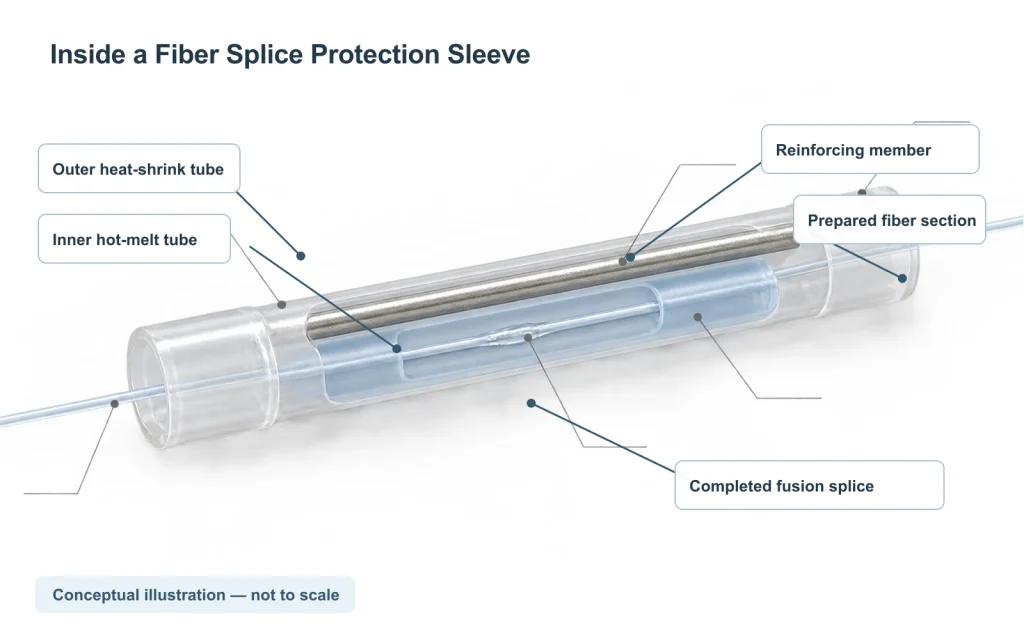
Every fusion splice in an OSP network — armored, ADSS, or OPGW — needs a splice protection sleeve, and the sleeve is only as good as the closure around it. For OSP work we specify:
- 40 mm or 60 mm sleeves for mechanical protection in trays
- PE or polyolefin outer tube with stainless steel or ceramic rod
- A sealed fiber optic splice closure rated for the burial or aerial environment — verify the seal with a 100 kPa air-pressure immersion test
The failure pattern in OSP is consistent: the cable and sleeves are fine, and the closure seal failed years ago. A sealed closure with mediocre sleeves usually holds. Good sleeves in a leaky closure never do. Sleeve installation technique is in our installation guide; failure diagnosis is in the troubleshooting FAQ.
Submarine note: submarine and river-crossing repairs use heavy GYTA33/GYTA333 constructions, and standard splice sleeves still sit inside the repair joint. The joint itself — a large, ruggedized enclosure far beyond a normal closure — is built on dedicated cable ships. If you are spec’ing that work, the sleeve is the least of your engineering concerns; the joint design and cable storage dominate. For everyone else, this is background knowledge, not a shopping list.

How to Choose
Work through these four questions in order:
- Is the route underground with dig or rodent risk? → GYTA53 armored cable, or standard cable in HDPE conduit where the risk is low. Burial depth and bedding practice are covered in our direct burial fiber optic cable guide.
- Is the route aerial on telecom or shared poles? → ADSS, selected by span rating and corridor voltage
- Is this a high-voltage transmission line? → OPGW, specified with the utility’s short-circuit data
- Is this a short last-mile drop? → That is a different product entirely — see the FTTH drop cable guide
Common Mistakes
- Using standard cable where armor is needed. Rodents and diggers do not care about your budget — the damage patterns, and the constructions that stop them, are in our outdoor cable protection guide.
- Burying GYTA as “armor.” The aluminum tape is a moisture barrier. Direct burial needs GYTA53-class construction.
- Installing ADSS without span calculations. Too tight and it breaks. Too loose and it swings into the span below.
- Skipping the anti-tracking jacket near power lines. IEEE 1222 exists because failures here are spectacular.
- Confusing ADSS with OPGW. They are for completely different applications — pole lines vs transmission towers.
- Ignoring closure sealing. A good cable with a bad closure still fails, usually in the first wet season.
- Leaving metallic armor unbonded. Conductive armor left floating picks up induced voltage and can carry it straight into your equipment. Bond and ground it at every splice and termination point.
Frequently Asked Questions
What is armored fiber optic cable?
Armored fiber optic cable is outdoor cable with a metal protective layer — corrugated steel tape or steel wire — between the core and the jacket. The armor resists rodents, crushing, digging damage, and abrasion, and is the standard choice for direct burial and industrial routes.
What is the difference between GYTA, GYTS, and GYTA53?
GYTA uses an aluminum-polyethylene tape that blocks moisture but provides no mechanical armor. GYTS wraps the core in corrugated steel tape for crush and rodent resistance. GYTA53 combines both — aluminum moisture barrier plus steel tape between two PE sheaths — and is the direct-burial default with up to double the tensile rating and three times the crush rating of the single-sheath codes.
Is GYTA cable suitable for direct burial?
No. GYTA’s aluminum tape is a water barrier, not armor. For direct burial, specify GYTA53 (or GYTS53), or pull GYTA through buried HDPE conduit where mechanical risk is low.
What does ADSS stand for and how does it work?
ADSS stands for All-Dielectric Self-Supporting. Aramid yarns or GRP rods inside the cable carry the tensile load, so the cable hangs between poles with no steel messenger. Being fully non-metallic, it induces no currents and needs no grounding, which is why it is standard near power lines.
How do I choose an ADSS span rating?
Measure the actual distance between supports and order the matching standard rating — typically 50 m, 100 m, or 200 m. Span rating drives the strength-member content and the price. Over-spec wastes money; under-spec sags and creeps toward failure under wind and ice load.
Can ADSS be installed near power lines?
Yes — that is its main purpose. Because it contains no metal, it is safe alongside medium-voltage distribution lines. On high-voltage corridors, specify an anti-tracking jacket rated for the corridor class per IEEE 1222. Live-line installation methods and clearance rules are covered in our ADSS vs OPGW project manager’s guide.
What is the maximum span of ADSS cable?
Standard catalog ADSS reaches 1,000 m between supports. Beyond that is custom engineering with heavy aramid content and double-jacket construction. Long-span designs require a proper sag and tension calculation for local wind and ice loading — never extrapolate a catalog rating.
What is the difference between single jacket and double jacket ADSS?
Single-jacket ADSS has one PE sheath and suits short spans and low electric fields. Double-jacket adds an inner PE layer under the outer jacket, improving mechanical protection and making an anti-tracking outer layer practical. On corridors above 66 kV, or spans longer than 600 m, specify double-jacket AT.
Can GYTS be used as an aerial cable instead of ADSS?
Only for short, low-risk runs. GYTS is a steel-armored duct and lashed-aerial cable: it needs a messenger or duct, its steel strength member invites induced-current problems near power lines, and its weight over long spans becomes its own enemy. ADSS exists precisely because GYTS fails on long aerial spans and power corridors.
What fiber type is used in armored, ADSS, and OPGW cable?
Almost all three cable families use G.652.D single-mode fiber for telecom. G.657.A bend-insensitive fiber appears in FTTH drops and tight-routing sections near closures — A2 for the 7.5 mm-radius bends that drop and indoor routing demand, A1 for gentler premises runs. Multimode has no place in outside-plant backbones.
What is OPGW cable and how does it work?
OPGW (Optical Ground Wire) replaces the ground wire on high-voltage transmission towers. Aluminum-clad steel wires carry lightning and fault current while optical fibers in a central stainless steel tube provide communications. One strand does the shielding and the networking.
What is the difference between ADSS and OPGW?
ADSS hangs on distribution poles as a standalone telecom cable; OPGW is installed on transmission towers as part of the power line itself. ADSS is specified by span rating; OPGW by short-circuit capacity in kA²·s. Different buyers, different standards (IEEE 1222 vs IEEE 1138), different price class. For installation method, cost structure, and maintenance trade-offs between the two, see the dedicated ADSS vs OPGW project manager’s guide.
Is armored cable necessary for direct burial?
It depends on route risk. Low-risk soil with few rodent or digging hazards can use standard cable in HDPE conduit. Rocky fill, farmland, road crossings, and rodent territory call for GYTA53 armored cable. When in doubt, armor is cheaper than one repair truck roll.
Does armored fiber optic cable need to be grounded?
Yes — metallic armor (steel tape or steel wire) is conductive and must be bonded and grounded at splice and termination points per local code. This applies to GYTS, GYTA53, GYFTY53, and the steel-wire river-crossing constructions. If the route must be completely metal-free, armored cable is the wrong product: use ADSS on aerial sections and dielectric cable in conduit for burial. The bonding methods are covered in our armored cable grounding and bonding guide.
How much does armored fiber optic cable cost?
As a rule of thumb, armored cable costs 15–30% more than the equivalent non-armored construction, with burial-grade GYTA53 at the top of the band. The final price depends on fiber count, armor type, and order quantity. Per-meter list prices for export cable are meaningless without those three variables — send your route spec for a project quote.
What MOQ and lead time should I expect?
Standard loose-tube OSP constructions are commonly supplied on 1–4 km reels, and MOQ scales with fiber count and customization. Lead time runs in weeks, not days, for anything beyond stock items — custom jackets, long-span ADSS, and high fiber counts add production time. Ask for MOQ, reel length, and lead time in the first exchange: these three answers disqualify suppliers faster than price.
What should I check about packaging and delivery?
Three things protect a cable drum in transit: heat-sealed end caps against moisture ingress, lagged or battened drums for sea freight, and reel lengths matched to your route segments so joints land where closures are planned — not wherever the drum ran out. Test reports and the certificate of origin travel with the shipping documents; ask for them in the same email as the quote.
Is armored fiber optic cable rodent-proof?
Steel tape and steel wire armor are effectively rodent-proof: no rodent gnaws through corrugated steel. FRP-armor variants deter rodents better than a plain PE jacket but are not rodent-proof. If rodent activity is confirmed on the route, specify steel.
How long does armored fiber optic cable last?
Quality armored OSP cable is designed for a 25–30 year service life, and GYTA53 installations routinely reach it when burial depth, bedding, and closure sealing are done right. The cable rarely dies of age — it dies of dig-ins and water.
How deep should direct burial fiber optic cable be buried?
Typically 60–120 cm depending on jurisdiction, soil, and road crossings. Armored cable tolerates shallow burial and poor bedding better than non-armored, but local code sets the depth. Practice details are in our direct burial fiber optic cable guide.
Which splice sleeve should I use for outside-plant closures?
Use 40 mm or 60 mm heat-shrink sleeves with stainless steel or ceramic rods, in PE or polyolefin tubes. Match sleeve length to the tray, and spend your real attention on the closure seal — a 100 kPa, 15-minute immersion test after closing catches leaks before they reach the splices.
How are submarine fiber cables repaired?
By specialized cable ships that recover the damaged section, splice new cable aboard using heavy steel-wire-armored joints, and lower the joint back to the seabed. Standard splice sleeves sit inside the joint, but the joint enclosure and procedure are a dedicated engineering discipline — not field work.
Which cable is used on industrial sites like mines, railways, and wind farms?
These sites share one trait: heavy machinery, rocky soil, and long distances. Buried routes get GYTA53, or GYFTY53 where lightning induction is a concern. Aerial sections along electrified rail or transmission access roads get ADSS with an anti-tracking jacket. Match the cable to each route segment — not to the site name.
Which cable do I need: armored, ADSS, or OPGW?
Underground with dig or rodent risk → armored (GYTA53). Aerial on poles, especially near power lines → ADSS by span rating. High-voltage transmission towers → OPGW with utility short-circuit data. Short last-mile drops → FTTH drop cable, a different product.
Which fiber optic cable is best for outdoor use?
There is no single best outdoor cable — there is a right construction per route. Underground routes with dig or rodent risk need armored GYTA53. Aerial pole lines need ADSS selected by span rating. High-voltage transmission corridors need OPGW. Last-mile drops need FTTH drop cable. The deciding variables are installation method, mechanical risk, and proximity to power lines — match the cable construction to those three and the choice makes itself.
Standards Behind This Guide
Armored constructions trace to YD/T 901 (stranded outdoor cable) and IEC 60794-1 (generic cable requirements and tests), with long-term reliability guidance from Telcordia GR-20. ADSS performance and testing follow IEEE 1222, including the anti-tracking jacket requirements for power-line corridors. OPGW is governed by IEEE 1138. Fiber types in all three cable families trace to ITU-T G.652. On North American projects, buyers usually cite Telcordia GR-20 in place of YD/T 901 — name the acceptance regime in the purchase order so quotes stay comparable. Citing these in a purchase order is enough to get comparable quotes from any serious manufacturer.
Related Reading
- ADSS vs OPGW Cable: A Project Manager’s Guide to Choosing the Right Solution
- Armored Fiber Cable Mechanical Ratings: How to Compare Test Evidence
- Direct Burial Fiber Optic Cable: Requirements, Features & Applications
- Fiber Optic Cable Types: Complete Selection Guide
- FTTH Drop Cable & Aerial/Underground Fiber Cable Guide
- Fiber Splice Sleeve Troubleshooting & Moisture Protection FAQ
- Fiber Optic Splice Sleeve: The Complete Buying & Specification Guide
How to Compare Fiber Optic Cable Suppliers
Price per meter is the last filter, not the first. Four checks separate a manufacturer from a reseller with a datasheet:
- Test evidence. Ask for mechanical test reports — tensile, crush, bend — with the exact IEC 60794 method and edition printed on the report. “Per IEC 60794” alone is not a citation. A factory with its own lab produces these in days; a trader takes weeks.
- Engineering response. Send a route description and watch what comes back. A manufacturer asks about span, soil, and corridor voltage; a seller sends a price list. Our mechanical ratings guide shows what comparable evidence looks like.
- Sample policy. A production sample with its OTDR trace before the bulk order is standard practice among serious factories. Reluctance here tells you who is being asked to carry the quality risk.
- Standards fluency. Quote YD/T 901 or IEEE 1222 in your RFQ. The quality of the reply — correct construction, current standard version — predicts what lands on your site.
What to Send the Manufacturer
A cable quote is only as good as the route data behind it. Send these six items and any serious manufacturer can return a matched specification:
- Route length and segment breakdown — total meters, plus splice-point locations if known
- Installation method — direct burial, duct, or aerial on poles or towers
- Longest single span (aerial) or soil and traffic conditions (burial)
- Corridor voltage, if the route runs near power lines
- Fiber count and fiber type — G.652.D for standard OSP, G.657.A2 where bend radius is tight
- Applicable standards and test requirements — YD/T 901, IEC 60794-1, IEEE 1222 or 1138, plus any project-specific test reports
With those six, we can spec the cable, closures, sleeves, and fittings as one package. Two verification steps protect the order: ask for a production sample with its OTDR trace before releasing the bulk quantity, and verify delivery against bidirectional OTDR results at 1310 and 1550 nm — the datasheet attenuation values are the acceptance baseline, not marketing.
Specifying an Armored, ADSS, or OPGW Route?
BWNFiber manufactures armored fiber optic cables — GYTA, GYTS, GYTA53, and river-crossing constructions — plus ADSS cables in standard span ratings. Send us your route length, burial or aerial method, span distances, and any power-line corridor details, and we will spec the right construction with the closures and sleeves to match. OEM jacket printing, custom colors, and project-specific reel lengths are available — OEM orders add two confirmation steps before production: jacket printing artwork approval, and a choice of neutral packaging or buyer-branded drums and documents. Production samples with OTDR traces ship for qualified projects before bulk orders.
Related BWNFiber products: armored fiber optic cables · ADSS fiber cables · fiber optic splice closures · fiber optic splice sleeves
📧 [email protected]
📞 WhatsApp +86-13615744790
🌐 Visit our website

Structured Data (Publish Package)
Embed the four JSON-LD blocks below into the page
(or body end). Upload images to the media library first; OG/featured image and Article schema image must use full URLs, in-article img src uses bare filenames.FAQ Schema (25 questions)
{
  "@context": "https://schema.org",
  "@type": "FAQPage",
  "mainEntity": [
    {
      "@type": "Question",
      "name": "What is armored fiber optic cable?",
      "acceptedAnswer": {
        "@type": "Answer",
        "text": "Armored fiber optic cable is outdoor cable with a metal protective layer — corrugated steel tape or steel wire — between the core and the jacket. The armor resists rodents, crushing, digging damage, and abrasion, and is the standard choice for direct burial and industrial routes."
      }
    },
    {
      "@type": "Question",
      "name": "What is the difference between GYTA, GYTS, and GYTA53?",
      "acceptedAnswer": {
        "@type": "Answer",
        "text": "GYTA uses an aluminum-polyethylene tape that blocks moisture but provides no mechanical armor. GYTS wraps the core in corrugated steel tape for crush and rodent resistance. GYTA53 combines both — aluminum moisture barrier plus steel tape between two PE sheaths — and is the direct-burial default with up to double the tensile rating and three times the crush rating of the single-sheath codes."
      }
    },
    {
      "@type": "Question",
      "name": "Is GYTA cable suitable for direct burial?",
      "acceptedAnswer": {
        "@type": "Answer",
        "text": "No. GYTA's aluminum tape is a water barrier, not armor. For direct burial, specify GYTA53 (or GYTS53), or pull GYTA through buried HDPE conduit where mechanical risk is low."
      }
    },
    {
      "@type": "Question",
      "name": "What does ADSS stand for and how does it work?",
      "acceptedAnswer": {
        "@type": "Answer",
        "text": "ADSS stands for All-Dielectric Self-Supporting. Aramid yarns or GRP rods inside the cable carry the tensile load, so the cable hangs between poles with no steel messenger. Being fully non-metallic, it induces no currents and needs no grounding, which is why it is standard near power lines."
      }
    },
    {
      "@type": "Question",
      "name": "How do I choose an ADSS span rating?",
      "acceptedAnswer": {
        "@type": "Answer",
        "text": "Measure the actual distance between supports and order the matching standard rating — typically 50 m, 100 m, or 200 m. Span rating drives the strength-member content and the price. Over-spec wastes money; under-spec sags and creeps toward failure under wind and ice load."
      }
    },
    {
      "@type": "Question",
      "name": "Can ADSS be installed near power lines?",
      "acceptedAnswer": {
        "@type": "Answer",
        "text": "Yes — that is its main purpose. Because it contains no metal, it is safe alongside medium-voltage distribution lines. On high-voltage corridors, specify an anti-tracking jacket rated for the corridor class per IEEE 1222. Live-line installation methods and clearance rules are covered in our ADSS vs OPGW project manager's guide (https://www.bwnfiber.com/adss-vs-opgw-cable-a-project-managers-guide-to-choosing-the-right-solution/)."
      }
    },
    {
      "@type": "Question",
      "name": "What is the maximum span of ADSS cable?",
      "acceptedAnswer": {
        "@type": "Answer",
        "text": "Standard catalog ADSS reaches 1,000 m between supports. Beyond that is custom engineering with heavy aramid content and double-jacket construction. Long-span designs require a proper sag and tension calculation for local wind and ice loading — never extrapolate a catalog rating."
      }
    },
    {
      "@type": "Question",
      "name": "What is the difference between single jacket and double jacket ADSS?",
      "acceptedAnswer": {
        "@type": "Answer",
        "text": "Single-jacket ADSS has one PE sheath and suits short spans and low electric fields. Double-jacket adds an inner PE layer under the outer jacket, improving mechanical protection and making an anti-tracking outer layer practical. On corridors above 66 kV, or spans longer than 600 m, specify double-jacket AT."
      }
    },
    {
      "@type": "Question",
      "name": "Can GYTS be used as an aerial cable instead of ADSS?",
      "acceptedAnswer": {
        "@type": "Answer",
        "text": "Only for short, low-risk runs. GYTS is a steel-armored duct and lashed-aerial cable: it needs a messenger or duct, its steel strength member invites induced-current problems near power lines, and its weight over long spans becomes its own enemy. ADSS exists precisely because GYTS fails on long aerial spans and power corridors."
      }
    },
    {
      "@type": "Question",
      "name": "What fiber type is used in armored, ADSS, and OPGW cable?",
      "acceptedAnswer": {
        "@type": "Answer",
        "text": "Almost all three cable families use G.652.D single-mode fiber for telecom. G.657.A bend-insensitive fiber appears in FTTH drops and tight-routing sections near closures — A2 for the 7.5 mm-radius bends that drop and indoor routing demand, A1 for gentler premises runs. Multimode has no place in outside-plant backbones."
      }
    },
    {
      "@type": "Question",
      "name": "What is OPGW cable and how does it work?",
      "acceptedAnswer": {
        "@type": "Answer",
        "text": "OPGW (Optical Ground Wire) replaces the ground wire on high-voltage transmission towers. Aluminum-clad steel wires carry lightning and fault current while optical fibers in a central stainless steel tube provide communications. One strand does the shielding and the networking."
      }
    },
    {
      "@type": "Question",
      "name": "What is the difference between ADSS and OPGW?",
      "acceptedAnswer": {
        "@type": "Answer",
        "text": "ADSS hangs on distribution poles as a standalone telecom cable; OPGW is installed on transmission towers as part of the power line itself. ADSS is specified by span rating; OPGW by short-circuit capacity in kA²·s. Different buyers, different standards (IEEE 1222 vs IEEE 1138), different price class. For installation method, cost structure, and maintenance trade-offs between the two, see the dedicated ADSS vs OPGW project manager's guide (https://www.bwnfiber.com/adss-vs-opgw-cable-a-project-managers-guide-to-choosing-the-right-solution/)."
      }
    },
    {
      "@type": "Question",
      "name": "Is armored cable necessary for direct burial?",
      "acceptedAnswer": {
        "@type": "Answer",
        "text": "It depends on route risk. Low-risk soil with few rodent or digging hazards can use standard cable in HDPE conduit. Rocky fill, farmland, road crossings, and rodent territory call for GYTA53 armored cable. When in doubt, armor is cheaper than one repair truck roll."
      }
    },
    {
      "@type": "Question",
      "name": "Does armored fiber optic cable need to be grounded?",
      "acceptedAnswer": {
        "@type": "Answer",
        "text": "Yes — metallic armor (steel tape or steel wire) is conductive and must be bonded and grounded at splice and termination points per local code. This applies to GYTS, GYTA53, GYFTY53, and the steel-wire river-crossing constructions. If the route must be completely metal-free, armored cable is the wrong product: use ADSS on aerial sections and dielectric cable in conduit for burial. The bonding methods are covered in our armored cable grounding and bonding guide (https://www.bwnfiber.com/armored-fiber-cable-grounding-bonding/)."
      }
    },
    {
      "@type": "Question",
      "name": "How much does armored fiber optic cable cost?",
      "acceptedAnswer": {
        "@type": "Answer",
        "text": "As a rule of thumb, armored cable costs 15–30% more than the equivalent non-armored construction, with burial-grade GYTA53 at the top of the band. The final price depends on fiber count, armor type, and order quantity. Per-meter list prices for export cable are meaningless without those three variables — send your route spec for a project quote."
      }
    },
    {
      "@type": "Question",
      "name": "What MOQ and lead time should I expect?",
      "acceptedAnswer": {
        "@type": "Answer",
        "text": "Standard loose-tube OSP constructions are commonly supplied on 1–4 km reels, and MOQ scales with fiber count and customization. Lead time runs in weeks, not days, for anything beyond stock items — custom jackets, long-span ADSS, and high fiber counts add production time. Ask for MOQ, reel length, and lead time in the first exchange: these three answers disqualify suppliers faster than price."
      }
    },
    {
      "@type": "Question",
      "name": "What should I check about packaging and delivery?",
      "acceptedAnswer": {
        "@type": "Answer",
        "text": "Three things protect a cable drum in transit: heat-sealed end caps against moisture ingress, lagged or battened drums for sea freight, and reel lengths matched to your route segments so joints land where closures are planned — not wherever the drum ran out. Test reports and the certificate of origin travel with the shipping documents; ask for them in the same email as the quote."
      }
    },
    {
      "@type": "Question",
      "name": "Is armored fiber optic cable rodent-proof?",
      "acceptedAnswer": {
        "@type": "Answer",
        "text": "Steel tape and steel wire armor are effectively rodent-proof: no rodent gnaws through corrugated steel. FRP-armor variants deter rodents better than a plain PE jacket but are not rodent-proof. If rodent activity is confirmed on the route, specify steel."
      }
    },
    {
      "@type": "Question",
      "name": "How long does armored fiber optic cable last?",
      "acceptedAnswer": {
        "@type": "Answer",
        "text": "Quality armored OSP cable is designed for a 25–30 year service life, and GYTA53 installations routinely reach it when burial depth, bedding, and closure sealing are done right. The cable rarely dies of age — it dies of dig-ins and water."
      }
    },
    {
      "@type": "Question",
      "name": "How deep should direct burial fiber optic cable be buried?",
      "acceptedAnswer": {
        "@type": "Answer",
        "text": "Typically 60–120 cm depending on jurisdiction, soil, and road crossings. Armored cable tolerates shallow burial and poor bedding better than non-armored, but local code sets the depth. Practice details are in our direct burial fiber optic cable guide (https://www.bwnfiber.com/direct-burial-fiber-optic-cable/)."
      }
    },
    {
      "@type": "Question",
      "name": "Which splice sleeve should I use for outside-plant closures?",
      "acceptedAnswer": {
        "@type": "Answer",
        "text": "Use 40 mm or 60 mm heat-shrink sleeves with stainless steel or ceramic rods, in PE or polyolefin tubes. Match sleeve length to the tray, and spend your real attention on the closure seal — a 100 kPa, 15-minute immersion test after closing catches leaks before they reach the splices."
      }
    },
    {
      "@type": "Question",
      "name": "How are submarine fiber cables repaired?",
      "acceptedAnswer": {
        "@type": "Answer",
        "text": "By specialized cable ships that recover the damaged section, splice new cable aboard using heavy steel-wire-armored joints, and lower the joint back to the seabed. Standard splice sleeves sit inside the joint, but the joint enclosure and procedure are a dedicated engineering discipline — not field work."
      }
    },
    {
      "@type": "Question",
      "name": "Which cable is used on industrial sites like mines, railways, and wind farms?",
      "acceptedAnswer": {
        "@type": "Answer",
        "text": "These sites share one trait: heavy machinery, rocky soil, and long distances. Buried routes get GYTA53, or GYFTY53 where lightning induction is a concern. Aerial sections along electrified rail or transmission access roads get ADSS with an anti-tracking jacket. Match the cable to each route segment — not to the site name."
      }
    },
    {
      "@type": "Question",
      "name": "Which cable do I need: armored, ADSS, or OPGW?",
      "acceptedAnswer": {
        "@type": "Answer",
        "text": "Underground with dig or rodent risk → armored (GYTA53). Aerial on poles, especially near power lines → ADSS by span rating. High-voltage transmission towers → OPGW with utility short-circuit data. Short last-mile drops → FTTH drop cable, a different product."
      }
    },
    {
      "@type": "Question",
      "name": "Which fiber optic cable is best for outdoor use?",
      "acceptedAnswer": {
        "@type": "Answer",
        "text": "There is no single best outdoor cable — there is a right construction per route. Underground routes with dig or rodent risk need armored GYTA53. Aerial pole lines need ADSS selected by span rating. High-voltage transmission corridors need OPGW. Last-mile drops need FTTH drop cable. The deciding variables are installation method, mechanical risk, and proximity to power lines — match the cable construction to those three and the choice makes itself."
      }
    }
  ]
}
Article Schema
{
  "@context": "https://schema.org",
  "@type": "Article",
  "headline": "Armored, ADSS & OPGW Fiber Optic Cable Guide",
  "description": "Armored fiber optic cable (GYTA/GYTS/GYTA53), ADSS span ratings, and OPGW specs compared — model codes, selection tables, and ordering guidance for outdoor routes.",
  "datePublished": "2026-09-01",
  "dateModified": "2026-09-27",
  "author": {
    "@type": "Organization",
    "name": "BWNFiber Network Engineering Team",
    "url": "https://www.bwnfiber.com/"
  },
  "publisher": {
    "@type": "Organization",
    "name": "BWNFiber",
    "logo": {
      "@type": "ImageObject",
      "url": "https://www.bwnfiber.com/wp-content/uploads/og/bwnfiber-logo.png"
    }
  },
  "mainEntityOfPage": "https://www.bwnfiber.com/armored-adss-opgw-cable-guide/",
  "image": "https://www.bwnfiber.com/wp-content/uploads/og/armored-adss-opgw-comparison-infographic.jpg"
}
Breadcrumb Schema
{
  "@context": "https://schema.org",
  "@type": "BreadcrumbList",
  "itemListElement": [
    {
      "@type": "ListItem",
      "position": 1,
      "name": "Home",
      "item": "https://www.bwnfiber.com/"
    },
    {
      "@type": "ListItem",
      "position": 2,
      "name": "Blog",
      "item": "https://www.bwnfiber.com/blog/"
    },
    {
      "@type": "ListItem",
      "position": 3,
      "name": "Armored, ADSS & OPGW Fiber Optic Cable Guide"
    }
  ]
}
HowTo Schema
{
  "@context": "https://schema.org",
  "@type": "HowTo",
  "name": "How to Measure Your Span Before Ordering ADSS Cable",
  "description": "Three steps to set the ADSS span rating from the actual route: survey supports, size by the longest single span, and add margin for future pole moves.",
  "step": [
    {
      "@type": "HowToStep",
      "position": 1,
      "name": "Survey every span",
      "text": "Survey the route and record the distance between every pair of supports — do not trust the as-built drawing without checking."
    },
    {
      "@type": "HowToStep",
      "position": 2,
      "name": "Size by the longest span",
      "text": "Set the span rating from the longest single span on the route. Average span is not a rating input."
    },
    {
      "@type": "HowToStep",
      "position": 3,
      "name": "Add margin",
      "text": "Add margin for future pole moves: if the longest span is 90 m, order the 100 m rating, not the 80 m."
    }
  ]
}
Data as of 2026-09-10. Maintained by the BWNFiber network engineering team.
BWNFiber · Business Intelligence Excellence*