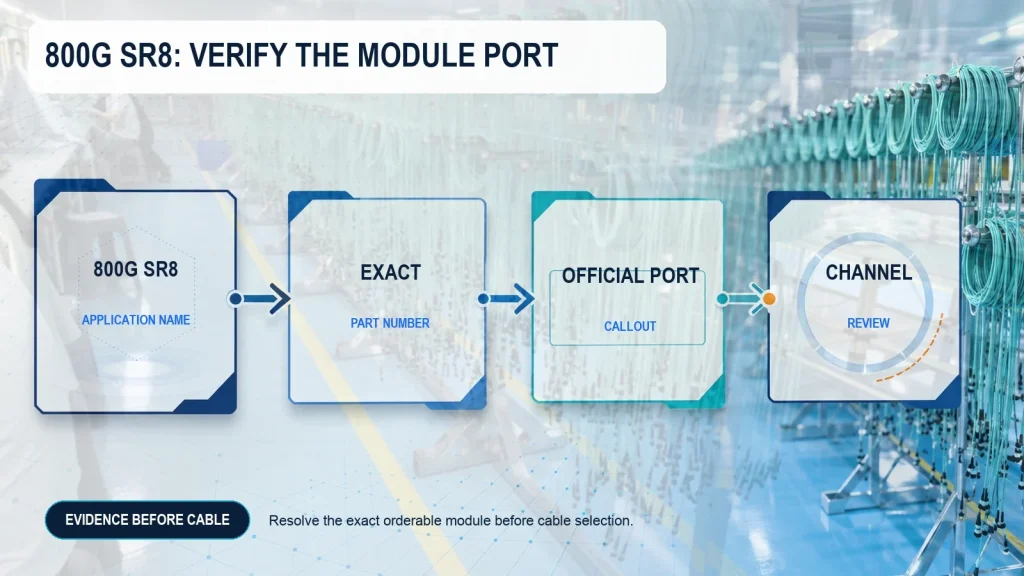
Before opening a cable BOM, establish what the transceiver manufacturer documents for the optical port. The application name is not an end-to-end polarity drawing, loss budget or acceptance plan.
Already have the complete part numbers for both endpoints? Open the MPO Polarity Checklist to capture the two interface records. If either optical port is still uncertain, use the evidence steps below before selecting a cable.
Key takeaways
800GBASE-SR8has two documented MDI options in the public IEEE ballot record, not one mandatory connector arrangement.- Option A is a flat dual-row 24-position interface; Option B is an angled single-row 16-fiber interface.
- Cisco documents multimode APC ports and DR8 products with either one MPO-16 APC port or two MPO-12 APC ports.
- MPO-16 describes a connector format. Media, polish, pinning and polarity remain separate fields.
- If the module drawing is missing or conflicts with another document, put the cable decision on hold.
Does 800GBASE-SR8 define an MPO-16 APC port?
It defines more than the application name, but it does not make MPO-16 APC the only SR8 interface. The IEEE P802.3df project page records approval of IEEE Std 802.3df-2024 on February 16, 2024. Public ballot records for Clause 167 show that the task force retained two MDI connector options for 800GBASE-SR8 and 800GBASE-VR8. A proposal to delete the dual-row option was rejected. (IEEE P802.3df project page; IEEE P802.3df D2.0 final comment record)
| Public IEEE ballot-record option | Interface description | What it means for purchasing |
|---|---|---|
| Option A | Flat dual-row interface with 24 fiber positions | Do not assume the module has an angled single-row MPO-16 port |
| Option B | Angled single-row interface with 16 fibers | An MPO-16 angled interface is permitted, but the module must implement this option |
Separate public task-force material describes 800GBASE-SR8 as eight multimode fibers in each direction with a target reach of at least 100 m. The published standard controls normative requirements. The public ballot and slide records explain the decision history; they do not replace the published text. (IEEE P802.3df D2.0 comment-resolution material)
For cable selection, the application name does not identify which permitted MDI option a module implements, and neither option is a complete cable-assembly or channel specification. These shortcuts can produce the wrong interface:
SR8means every vendor exposes the same physical port arrangement;multimodemeans the optical port must be UPC;16 fibersmeans every product has one MPO-16 connector;- a color seen in a product image is the approved interface definition.
Use the current documentation for the complete orderable transceiver part number. A related model, family overview or shortened product name may omit the suffix that changes the port.
Why can an 800G multimode port use APC?

The IEEE ballot record itself includes an angled single-row 16-fiber option for the 800GBASE-SR8/VR8 MDI. That is enough to reject multimode = UPC as a purchasing rule, while the retained flat option prevents the opposite shortcut that every SR8 port must be angled MPO-16.
Cisco also documents OSFP-800G-VR8P as a multimode product with one MPO-16 APC optical connector. Its related OSFP-800G-VR8 uses two MPO-12 APC connectors. (Cisco 800G OSFP data sheet)
The Cisco comparison is a product-level example, not a specification for another SR8, VR8 or eight-lane product.
Keep the naming layers separate. 800GBASE-SR8, 800GBASE-VR8 and 800GBASE-DR8 are IEEE PMD names. The complete Cisco and NVIDIA strings in the table below are manufacturer product identifiers; a product suffix must not be interpreted across brands.
What do named 800G VR8 and DR8 optical ports prove?
The cited manufacturer documents show both a single MPO-16 arrangement and dual MPO-12 arrangements across named VR8 and DR8 products. They are implementation examples, not substitute specifications for 800GBASE-SR8. Each row applies only to the named product.
| Named product | Media in the cited document | Optical-port arrangement | What the row establishes | What it cannot establish |
|---|---|---|---|---|
Cisco OSFP-800G-VR8 | Multimode fiber | Two MPO-12 APC ports | A multimode 800G-class product may expose two APC array ports | The port on an unnamed SR8 or VR8 product |
Cisco OSFP-800G-VR8P | Multimode fiber | One MPO-16 APC port | A multimode implementation may use MPO-16 APC | A universal multimode polish rule |
Cisco OSFP-800G-DR8 | Single-mode fiber | Two MPO-12 APC ports | DR8 alone does not guarantee one MPO-16 port | The connector on another vendor's DR8 |
Cisco OSFP-800G-DR8P | Single-mode fiber | One MPO-16 APC port | The named DR8P uses a single MPO-16 APC interface | That P has the same meaning outside this Cisco family |
NVIDIA MMS4X00-NM16 | Single-mode fiber | One MPO-16/APC port with eight transmit and eight receive lanes | The named NVIDIA module uses the documented MPO-16/APC interface | Cross-vendor host or cable interoperability |
Sources checked on September 2, 2026: Cisco 800G OSFP data sheet, updated January 5, 2026; and NVIDIA MMS4X00-NM16 specifications, last updated May 30, 2025.
Cisco also states that the optical connectors on these named modules are pinned and should mate with unpinned cable connectors. That condition applies to the products covered by the cited Cisco document. (Cisco 800G OSFP data sheet)
What if the data-sheet tables disagree?
The cited Cisco page contains inconsistent wording in some description cells. Its Optical connector column and named-product sections agree on the port arrangements summarized above: VR8 and DR8 use dual MPO-12 APC, while VR8P and DR8P use one MPO-16 APC. Treat the discrepancy as a document-control warning, not permission to choose whichever entry fits the BOM. Preserve the source date and ask the equipment vendor to reconcile any conflict with the quotation or current data sheet in writing.
How do you verify the optical port before choosing a cable?
Check the port before opening a cable BOM:
- Record the manufacturer and complete orderable transceiver part number, including every suffix.
- Open the current manufacturer data sheet or interface drawing for that part number.
- Record the number of optical ports and the connector callout for each port.
- Record the stated media, polish and device-side pinning or mating requirement separately.
- Record the document title, revision and date. If the faceplate, quotation and data sheet disagree, hold the order and ask the equipment vendor to reconcile the interface in writing.
- Leave unstated fields unresolved, then move the confirmed endpoint record into the end-to-end polarity and channel review.
What does BWNFiber need before a scoped interface review?
The six-step check should produce three review inputs:
- two endpoint records, each with the manufacturer and complete orderable module number;
- the current source record for each endpoint, including document title, revision or update date, and link;
- a short field-status list separating confirmed values, document conflicts and open questions.
BWNFiber can review whether this evidence pack is complete enough to enter a project-specific BOM and specification review. Missing or conflicting inputs remain open. This review does not confirm interoperability, a cable SKU, price, sample availability, production lead time or delivery.
This check identifies the transceiver interface only. After both endpoint records are documented, use the MPO Polarity Checklist for the route, lane map, passive components, polarity and acceptance plan.
Which document controls each 800G interface decision?

Connector decisions fail when a source that answers one question is used to answer another. Build the interface record in this order:
| Decision | Evidence that controls | Insufficient substitute |
|---|---|---|
| Which SR8 MDI options are permitted | The controlled published text of IEEE Std 802.3df-2024; public ballot records may explain the decision history | A product title, search result or uncited cabling rule |
| Which option a module implements | The current data sheet or interface drawing for the complete orderable module number | The PMD name, product-family page or a neighboring SKU |
| Whether two connector components can mate | The exact component and adapter drawings, checked against the applicable connector-interface standard | Fiber count, housing color or the word MPO alone |
| Which polarity and lane map the installed channel requires | Both approved endpoint records plus the controlled channel design | A transceiver faceplate or connector callout by itself |
Public IEEE ballot records establish the two-option decision history; a release decision should be checked against the controlled published Clause 167 text. If the exact module document is absent or inconsistent, the interface remains unresolved; the cable request does not advance to polarity or BOM approval.
What changes for an international 800G cabling project?
The destination does not change the transceiver's documented optical port. A module procured for North America, Europe, the Middle East, Southeast Asia, Latin America or Africa still requires the complete orderable part number and its current interface document. Location begins to matter in separate project, installation and commercial records after the port is confirmed.
| Procurement layer | Record before RFQ release | Boundary |
|---|---|---|
| Data-center design basis | The project-specified standard and edition, plus the owner's basis of design | ANSI/TIA-942-C covers data-center infrastructure, while ISO/IEC 11801-5:2017 covers generic cabling within and to data-center computer-room spaces. Neither identifies the port on a transceiver. |
| Installation route and environment | Whether the assembly remains in a controlled equipment room or crosses a building, campus or outdoor segment; applicable fire, temperature, water, UV and mechanical requirements | Do not infer jacket material, flame performance or environmental suitability from the country, connector or application name. Use the local code, authority having jurisdiction and approved project specification. |
| Quality and acceptance documents | Exact assembly configuration, test method, acceptance limits, report revision and any tender-required document | A generic statement such as tested or IEC/TIA compliant is not a configuration-specific acceptance record. |
| Commercial and logistics record | Destination, agreed Incoterms® rule and named place, quantity, packaging and label instructions, required document language, and requested delivery window | The current quotation and contract control. This page does not establish price, MOQ, production lead time, shipment date or export eligibility. (ICC Incoterms® 2020) |
Do not convert a regional label into a standards assumption. Record the tender's jurisdiction, named standard and edition, local approval authority and required documentation. Then keep those requirements separate from the exact module-port record and the end-to-end channel design.
Does MPO-16 automatically mean APC?
No. For the single-row 16-fiber interfaces discussed here, MPO-16 describes connector format and fiber count. It does not specify polish.
US Conec's MTP-16 handout describes a 16-fiber MT ferrule with an offset key, different from the centered key used by conventional MPO formats. The handout lists multimode, multimode APC and single-mode APC variants. MTP® is a US Conec trademark within the MPO connector family. (US Conec MTP-16 connector handout)
At the connector-family level, IEC 61754-7-1:2014 defines standard interface dimensions for one-row MPO connector variants. TIA's notice for ANSI/TIA-604-18-A identifies it as the connector intermateability standard for Type MPO-16. Neither source identifies a transceiver port or complete cable assembly.
Together, the connector sources set a clear boundary:
- Check the cited offset-key MTP-16 hardware against the exact adapter or mating-interface drawing. It is not mechanically interchangeable with conventional centered-key MPO hardware.
- The words
MPO-16do not, by themselves, specify media or polish.
Determine pinning and end-to-end polarity from the port and channel documents after the connector format is known.
For trunk, breakout, harness, patch-cord and loopback roles, use the MPO cable-type guide. The transceiver data sheet still controls the port definition.
Which BWNFiber page owns the next decision?

Once the port is known, the next question determines where to continue.
| Your remaining question | Correct next resource | Why it belongs there |
|---|---|---|
| Does the application name prove one specific optical port? | Stay on this page | The SR8 MDI-option table and named-product matrix answer that narrow evidence question |
| How do I trace both equipment ports, every passive component and the final lane map? | MPO Polarity Checklist | The existing worksheet owns endpoint, route, lane-map, BOM and revision control |
| How do I design and approve a complete MPO channel? | MPO Polarity Channel Design | The existing technical guide owns the end-to-end method, RFQ and approval workflow |
| Which assembly category, trunk, breakout, harness or patch cord, fits the architecture? | MPO cable-type guide | It owns product-category education and comparison |
| Which MPO products can I browse? | MPO cabling hub | It owns solution and product discovery |
| Is an MPO patch cord family relevant after the interface is confirmed? | MPO patch-cord family | Product-family fit comes after interface validation |
800G SR8 MPO-16 APC FAQ
Does 800GBASE-SR8 require APC?
Not as the only permitted interface. Public IEEE P802.3df ballot records retain a flat dual-row option and an angled single-row 16-fiber option for the SR8/VR8 MDI. Verify the published standard and the exact module's implemented option before choosing the cable interface.
Is MPO-16 required for every 800G SR8 transceiver?
No. The public IEEE ballot record retains both a flat dual-row 24-position option and an angled single-row 16-fiber option. Match the full orderable part number to the current port callout before releasing the cable interface.
Is VR8 the same as 800GBASE-SR8?
No. 800GBASE-VR8 and 800GBASE-SR8 are different IEEE PMDs. The complete strings OSFP-800G-VR8 and OSFP-800G-VR8P are Cisco product IDs. Their port comparison illustrates why the exact product matters; it does not redefine the SR8 interface options.
Why do some pages say multimode MPO uses UPC?
UPC is common in many multimode cabling systems, but it is not a purchasing rule. Cisco specifies APC for the named multimode VR8 products cited here.
Does every 800G DR8 module use one MPO-16 connector?
No. Cisco documents OSFP-800G-DR8 with two MPO-12 APC ports and OSFP-800G-DR8P with one MPO-16 APC port. Preserve the suffix and full orderable part number. (Cisco 800G OSFP data sheet)
What does the Cisco P suffix prove?
Within the cited Cisco family, the suffix distinguishes the documented port arrangements. It says nothing about another manufacturer's naming convention.
Is MTP-16 the same as MPO-16?
MTP® is a US Conec trademark within the MPO connector family. The trademark does not make every MPO-16 assembly identical; check the manufacturer's variant and interface documentation.
Can the MPO-16 format alone identify the polish?
No. Format and polish are separate attributes. US Conec lists more than one media and polish variant in its MTP-16 family. (US Conec MTP-16 connector handout)
Can MPO-16 mate with conventional MPO-12 hardware?
Do not plan direct mating from the fiber count alone. The cited MTP-16 family uses offset-key hardware intended to prevent inadvertent mating with conventional centered-key MPO hardware. Check the adapter and component drawings before purchase.
Are 800G transceiver optical ports pinned or unpinned?
Check the module documentation. Cisco states that the optical connectors on the products in its cited data sheet are pinned and should mate with unpinned cable connectors. That condition applies only to those documented products.
What if the exact interface drawing is unavailable?
Put the cable decision on hold. Request the current drawing for the orderable module; a neighboring product, connector color or supplier default cannot replace it.
What interface information should I send to a cable supplier?
Send both endpoint manufacturers, complete orderable part numbers, and the title, revision and date of each interface document. Record port count, connector format, polish and device-side pinning only when documented. Complete the path, lane map and BOM in the MPO Polarity Checklist.
Next step: move from interface evidence to channel evidence
Once both part numbers and interface documents are available, continue with the MPO Polarity Checklist. If a source is missing or conflicts with the faceplate or quotation, log the gap and ask the equipment vendor to resolve it.
BWNFiber review principle: evidence before cable. If the three-part evidence pack is complete, submit the two endpoint part numbers and current interface-document links for a scoped interface review. If it is incomplete, use the checklist first and keep the cable decision open. This page does not confirm a cable SKU, availability, test result or interoperability. Equipment-vendor and project approval still control the final assembly.
Engineering notice: The cited products and public standards provide reference points, not a guarantee of interoperability, availability or cable performance. Final assembly selection depends on current product documentation and the approved channel design.


